Friday, February 27, 2009

silver in seattle

yesterday morning sarah took me to the airport, virgin america took me to sea-tac, and a taxi took me to seattle where i was part of an event called Join USF in the Pacific Northwest at the edgewater hotel. the event included puget sound-area USF alumni, parents of USF students, a recently graduated USF student, and two admitted-to-USF students.

i began with this photograph.


this generation is the media maker generation, i said while sharing stories about my students in eating san francisco and digital media production. this is the generation of students i've been waiting for for fifteen years - they make media, they share media, they collaborate with media. at the same time, i shared my profound nervousness about the always-logged-on-ness of this generation. they are crazy creative but they are always on and always connected and some seem to have lost the ability to simply be with themselves and their thoughts. healthy attention spans seem to be at stake.

then i shared my teaching philosophy - log off before you blog off. i explained that i require my students to have offline, physical experiences and then use digital media to create and share stories about these experiences. to explain what i meant by this, i shared two student projects - eating san francisco student ali winston's North Beach Storybook 1 and recent USF media studies graduate lulu mcallister's How to Make a Delicious Omelet Using Wild Foods.


then i excitedly described USF's organic garden.

media studies professor melinda stone, art + architecture professor seth wachtel, and two year's worth of USF's garden project living learning community students have created a food-making, sustainable, beautiful, inspiring, and totally delicious organic garden on campus. USF architecture students designed and built a tool shed for the garden and various media studies classes have blogged, reported, and documented the garden and the gardeners. USF's organic garden offers different opportunities for different students in different courses taught by different professors from different disciplines. in two short years, the garden has become a working garden, a place for contemplation, a classroom, a community garden, a green lab.


time was getting tight so i raced through a past assignment for my intro to media studies students: edit USF's wikipedia page. returning to log off before you blog off, i explained that my students were required to work in groups to find books and other bound materials in gleeson library and to find relevant online resources to back up their wikipedia edits and additions. i mentioned that this semester my digital media production students will return to this assignment.

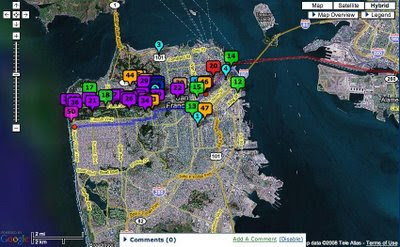
i ended with a map of san francisco filled with pins that link to blog posts and flickr sets created by last year's digital journalism students. i explained how my students began with campus, stretched to nearby golden gate park, and eventually took on the city as their beat. i then asked what would the map look like if it were generated by multiple students in multiple classes from multiple disciplines from multiple universities?


and then i said virgin america planes look like ipods, said something about me media and we media, and thanked them for inviting me to seattle.


(sorry for photographing only one side of the room!)

Wednesday, February 25, 2009

the difference between thin and thick tweets

this semester, i introduced my students to twitter and offered them my definitions for thin and thick tweets:

thin tweets are posts that convey one layer of information. thick tweets convey two or more, often with help from a hyperlink.

twitterers post thin tweets all the time. for example:

i'm grumpy today

oh snap, it's raining again

need more coffee

am about to leave for the post office

i luv cottage cheese

i encourage my students to use and experiment with twitter in any and all ways they see fit and this can of course include thin tweets. but when using twitter to fulfill one of my assignments, i require my students to post thick tweets.

thick tweets convey two or more layers of information. they often, but not always, include a hyperlink that takes readers from twitter to another source of information - a newspaper article, a blog post, a flickr set, a video. i encourage my students to use 140 characters or less to compose a thick tweet that is so compelling that no reader in his or her right mind can avoid clicking the link.

here's a few examples of thick tweets written by students in my digital media production and eating san francisco classes:


in this post, stephanienow gives a shout out to ESF, announces that her north beach project is ready for viewing, tempts us with recipes, informs us that she has a new blog, and supplies a link for us to visit. awesome: a thick tweet comprised of at least five layers of information.


here, smhz tells us about a trip to costa rica he took last month and encourages us to visit the pictures he recently posted. but i'd suggest a third layer. too often, twitterers tweet the present - sam suggests that past material (a past trip to costa rica) makes for a perfectly suitable present project (a flickr set). three layers of information.


in this thick tweet, teresacgarcia sends a shout out to ESF, tells us that she just viewed the film like water for chocolate, informs us that gleeson library has the film (borrow it for free!), and notifies us when it will be available for others. terrific: four layers of information.


in my final example, melstrikesback tells us that she'll be attending an academy awards gala, links to the event so that interested readers can learn more, and thanks the foghorn (USF's student newspaper, where melstrikesback works as scene editor) for the complimentary tix. three layers of information.

as i wrote above, i encourage my students to use twitter in any way they see fit. but my bias is evident. by requiring them to post thick tweets and by encouraging them to pack multiple layers of information within 140 characters or less, i'm trying to teach my students how to craft creative, meaty, and to-the-point messages that attract other people's attention.

plus, i'm politely suggesting that they may wish to think twice about tweeting their luv of cottage cheese.

Tuesday, February 24, 2009

blog assignment

blog assignment for digital media production

1. attend at least two films at USF's 7th annual human rights film festival. while there, watch, listen, learn, grab any relevant materials, and take interesting photographs.

2. organize and edit your photos into a flickr set. title the set and the photos. add descriptions when necessary.

3. if you do not already have a blog, or if you have a blog and do not want to integrate it into DMP, create a blog. you are strongly encouraged to create a free blog with wordpress.

4. for each film you watch, write and publish a blog post.

5. each blog post must contain: a) at least two or three paragraphs about the film, the filmmakers, the audience's reaction, and your reflections about the film; b) at least one relevant photograph that you took; and c) one or two links that direct your blog readers to further information about the film, filmmaker, and/or film festival.

6. before publishing your blog post, edit it again and again and again. and then, just to be safe, edit it one more time.

7. when finished, and no later than friday at 5 pm, post two thick tweets, each including a link to your blog post.

hint: be aware that this assignment requires you to create and share content using a blog, flickr, and twitter.

reminder: there is no class on thursday.

Sunday, February 22, 2009

this replaces those - twitter in the classroom

this semester, twitter is the main mode of communication used by my students and me. twitter has replaced at least three classroom technologies, and has streamlined our outside-the-classroom conversations and collaborations.

twitter has replaced the class listserv. for years, i've used a listserv (alternatively called a mailing list or discussion list) to extend our discussions beyond the classroom. these days, when we want to continue conversations, the 12 students in DMP, the 17 students in ESF, and i use twitter.

twitter has replaced email announcements. in the past, if something's come up, or i want to add a reading, or we have a location change, i would send all the students in class an email. these days, when i have something to announce, or when my students have something to announce, we use twitter.

twitter has replaced the cardboard box i used to bring to class on due dates. in the past, my students would print out their papers and bring them to class; i'd collect them in a box and take them back to the office to grade. these days, my students write blogs, design flickr sets, upload vidoe, and post works-in-progress. when finished, they tweet about it so that i - and, more importantly, their peers - can check it out.

Friday, February 20, 2009

and just like that, our health insurance no longer provides coverage for abortion

at four pm on a friday, i received the following email.

Memorandum

Date: February 20, 2009
To: Faculty/Staff in Blue Cross Plan
From: Diane Sweeney, Assistant HR Director for Benefits, Compensation & Risk
Re: Notice of a Modification in USF's Blue Cross PPO Plan.
___________________________________

You are receiving this notice because you are currently enrolled in USF's Blue Cross PPO Medical Plan.

Effective March 1, 2009, this plan will no longer provide coverage for abortion or abortion services except when the life of the mother is endangered. There will be no coverage for RU486 under the plan.

Please review the complete Summary of Material Modification at the following link: http://www.usfca.edu/hr/SMM_USF_21309.pdf

march 7 update!

on march 4, 2009, i received the following email:

To: Participants in the University of San Francisco Self-funded Medical Plan with Blue Cross

From: Human Resources

Recently, the Office of Human Resources notified you that effective March 1, 2009, the University of San Francisco's self-funded medical plan administered by Anthem Blue Cross would no longer provide coverage for abortion or abortion services except when the life of the mother is endangered. The notice also stated that there would be no further coverage for RU486.

Thanks to all of you who responded to express concern about, or support for, the change to the plan and for those who met with representatives from Human Resources.

We understand that this issue is both sensitive and complex, and are cancelling the March 1, 2009 effective date to allow for a more comprehensive re-examination of the situation. We will keep you updated as that evaluation progresses.

If you have any questions or concerns, please contact Diane Sweeney at x2440 or Martha Peugh-Wade at x2444.

Thursday, February 19, 2009

north beach project

north beach project for eating san francisco

for the last few weeks, we've been reading, watching, and discussing food and culture. we've read, among other things, anne bower's "watching food: the production of food, film, and values," margaret coyle's "il timpano - to eat good food is to be close to god: the italian-american reconciliation of stanley tucci and campbell scott's big night," and nancy peters's "the beat generation and san francisco's culture of dissent." we've watched and discussed the film big night. and last night we field tripped to north beach - for dinner at bocce cafe and then a tour of the italian french baking company. now's the time to create.


1. select a platform. your selected platform must a) support multimedia, b) be open to the public, and c) allow visitors the opportunity to comment on your work.

2. create a story about food and north beach. use evidence and artifacts you experienced and gathered from our field trip.

3. as long as your story is about food and north beach, it can take any form. your story must also include, in some way, the beats.

4. make sure your story is interesting to people other than yourself. edit your story over and over and over again so that it contains zero mistakes and typos.

5. be as creative as possible.

6. sometime before class on wednesday, post a thick tweet that includes a link to your north beach project.

Monday, February 16, 2009

flickr assignment

flickr assignment for digital media production

1. leave campus.

2. find and photograph an interesting part of the city. take smart photos. take a lot of photos so you have a large and diverse set from which to select your favorites.

3. sign-up for a free flickr account, create a profile, and make all DMP members your contacts.

4. create a flickr set of 5-10 photos to tell a story about the city. title and write a description for your flickr set.

5. tag your photos. if you do not know what tagging your photographs means, find out using twitter or google. use as many tags as you think necessary and use at least 3 for each photo. select smart and creative tags. tag strategically.

6. in this flickr set, there must be no mentions or references to yourself. do not use words like "i," "me," and "my." discuss the photographs, not yourself.

7. once finished, post a thick tweet that includes a link to your flickr set.

8. i will demo your work on thursday.

hints: find a part of the city that speaks to you. take more photographs than you use. follow directions.

rule: if you have no work to demo, do not come to class.

Friday, February 13, 2009

students sharing media

this week, all 28 students in DMP and ESF joined (or were already on) twitter, giving us an individual and collective platform for presentation, conversation, and collaboration.

i've been encouraging my students to take their already existing information (blog posts, flickr sets, foghorn articles, USFtv clips) and optimally upload it to twitter. already existing information optimally uploaded, or aeiou, in 140 characters or less.

in the last week alone, the USF twitterverse has been aflame! stephanienow shared her recipe for raviolis. melstrikesback made a mixed tape (with sound!). skblackburn shared her pics of pelosi. smhz, _Kerr_, and elisamaite shared perspectives about teaching college students. and joelAweston, teresacgarcia, and Kellimccloskey, or the north beach crüe, shared their culinary recommendation for ESF's first field trip.

also through twitter, the foghornonline met jonnyhech and a video game columnist was born.

it's a promising spring semester.

Monday, February 09, 2009

twitter assignment

twitter assignment for digital media production

1. last thursday (feb 5), you received the first part of this assignment: in the next 24 hours, open a free twitter account, build a profile with your real name, and find and follow all members of digital media production class.

2. through class readings and discussion, you have learned about tweets, replies, and retweets. you have read about tinyurl, twhirl, and tweetdeck. experiment with these apps, as well as other twitter apps not discussed in class, and find a platform or platforms that suits your needs.

3. through class readings, you have learned about how frozen peas started a movement, about twitter being used in times of war, and about twittering libraries. begin thinking about how you can use twitter for an organization or movement to which you belong and/or believe in. think outside of yourself.

4. through twitter search, find people who tweet about some of the topics discussed in digital media production. follow who you want but certainly follow people who use digital media smartly and creatively. be mindful of who and how many you follow.

5. in class on tuesday we'll talk about the difference between thin and thick tweets. compose at least one thick tweet and be ready to demo it on thursday.

6. on tuesday we'll also talk about already existing information optimally uploaded, or aeiou. compose at least one aeoiu tweet and be ready to demo it on thursday.

7. demo your work (3-5 minutes) in class on thursday. your demo must include: a) addressing one element of your profile, b) the way and ways you access twitter, c) a person or persons you added via your twitter search, d) your thick tweet, and e) your aeiou tweet. wow us.

8. after thursday's demos, comment on your classmates' content.

9. continue using twitter throughout the spring semester.

hints: consider your audience. experiment heavily. follow instructions.

rule: if you have no work to demo, do not come to class.

Monday, February 02, 2009

facebook assignment

facebook assignment for digital media production

1. select two spots on campus that give you polar opposite emotions - stressed vs chill, inspired vs dismal, etc.

2. using words and photographs, document your two spots. take some time.

3. involve at least one other person - a friend, a roommate, someone you barely know.

4. using a single facebook album, tell a story about your two spots. make it interesting to other people.

5. demo your work (3-5 minutes) in class on thursday.

6. comment on your classmates' content.

hints: take more photos than you end up including. write more words than you end up using. follow instructions.

rule: if you have no work to demo, do not come to class.

Sunday, February 01, 2009

teaching with technology 2.0

the first time i taught college students was in 1995, when i was a teaching assistant for professor mary corbin sies' class material aspects of american life at the university of maryland. a year earlier, mary and professor jo paoletti received a grant from the university to add technology to their classes. so along with fellow teaching assistant pysche williams, i was tasked to brainstorm ways we could integrate this new tool called the world wide web into the course curriculum.


in place of traditional papers turned over privately to the professor, students in material aspects of american life designed "homepages," or personal web sites, and shared their research them publicly onto the internet. it was an incredibly powerful learning experience - for me, for the students, and for the professor. it was also, in retrospect, an incredibly time-consuming experience.

in addition to teaching about material culture, we had to teach the students (and often ourselves) five new things. we taught them html, which took us about an hour or so. we taught them pico text editor and basic file management, which took us about an hour or two. and we taught them ftp, which took us about an hour, plenty of headaches, and an occasional extra office hour.

in addition to, and perhaps even more than, these more technical skills, we taught them more behavioral skills. we taught them how to write for the web - to think before you publish, to consider what was appropriate within an academic setting, to understand what they were creating could and most likely would remain online beyond the duration of the class, and to take responsibility for the work you make public. and, finally, we taught them how to read for the web - to read other students' work, to take some time to think about how their peers could improve their work, and to relay those comments back to their peers.

this thursday, students in digital media production will demo their first projects. the projects are being built with and presented via facebook. this semester, all of my students are on facebook. this means that all of my students know how to design profiles, create content, upload and share photographs, comment, tag, blog, and micro-blog for a public/semi-public audience. and this means that here in 2009 i'll spend zero minutes of class time teaching students how to use the tools necessary for project one.

Friday, January 30, 2009

new reviews in cyberculture studies (february 2009)

(nearly) each month, RCCS publishes a set of book reviews and author responses. books of the month for february 2009 are:


Double Click: Romance and Commitment Among Online Couples
Author: Andrea J. Baker
Publisher: Hampton Press, 2005
Review: M. Carmen Gomez-Galisteo
Author Response: Andrea J. Baker

Living on Cybermind: Categories, Communications, and Control
Author: Jonathan Paul Marshall
Publisher: Peter Lang, 2007
Review: Alan Sondheim
Author Response: Jonathan Paul Marshall

enjoy. there's more where that came from.

Thursday, January 29, 2009

bake it: oatmeal buttermilk bread in 8 easy steps

ingredients:

1 1/2 cups rolled oats
1 cup boiling water
1/4 cup warm water
2 teaspoons dried yeast
1 1/2 cups buttermilk
1/2 cup brown sugar
1/2 cup canola oil
1 cup whole wheat flour
3 1/2 cups white flour
2 teaspoons salt


1. in a large mixing bowl, place 1 1/4 cups oats. pour 1 cup boiling water over the oats. gently mix, for about 10 seconds, with wooden spoon to moisten all the oats. let sit in bowl, gently stirring once or twice, for ten minutes.

2. in a small mixing bowl, place 2 teaspoons of yeast. add 1/4 cup of warm water. whisk it for ten seconds or until the yeast mixes into the water. let rest for 5 minutes.

3. return your attention to the large mixing bowl with (now) soaked oats. add: the yeast mixture, 1 1/2 cups buttermilk, 1/2 cup brown sugar, 1/2 cup canola oil, 1 cup whole wheat flour, 3 1/2 cups white flour, and 2 teaspoons salt. mix all the ingredients together with a wooden spoon for about 5-7 minutes or when the mixture falls off the side of the bowl and begins to converge as a manageable blob-like structure.


4. take the manageable blob-like structure from the mixing bowl and place it onto a clean, well floured surface. knead it for 10 - 12 minutes. while kneading, add about a 1/2 a cup, 1/8 cup at a time, of white flour. the dough is ready when it becomes ball-like. also: when poked with a finger, it bounces quickly back to shape.

5. place dough in oiled (lightly, either with butter or oil) medium bowl and cover with a towel. put the towel-covered bowl in a place where it's warm and not subject to sudden breezes. let the dough do its thing for 1 hour. go have fun.

6. transfer dough from bowl to floured surface. knead and coddle dough for 1-2 minutes, or until all the air bubbles are worked out of the dough. cut resulting dough into two same-sized chunks. gently smoosh and guide dough into bread-like loaves. place loaves into oiled bread pans. cover pans with a towel and place where it's warm for 35-45 minutes or when the dough has nearly doubled in size.

7. at some point during step 6, preheat oven to 385 F.


8. remove the towel from the bread pans. with your hands or a water sprayer, flick drops of water on the top of the loaves. with the flicked water serving as a glue, sprinkle about 1 tablespoon of oats on the top of each loaf. place into oven and cook at 385 F for 1 hour. remove loaves from oven and let sit, still in pans, for 30 minutes. run a knife along the sides of the pan to loosen and then flip the pan to remove loaf. let the loaves sit for at least 15 minutes (preferably) before diving into it.

Monday, January 26, 2009

the day before the first day of classes

one of the magical things about working at USF is its proximity to golden gate park. the western tip of campus is a whopping one block away from the north-eastern tip of the park. east to west, golden gate park stretches around 3.5 miles and leads directly to the pacific ocean. weather permitting, this is the walk i always try to take on the day before the first day of classes.


in fall, i taught two sections (nearly 80 students) of intro to media studies. starting tomorrow, i am teaching two smaller, seminar-like classes: digital media production (12 students) and eating san francisco (15 students).

in some ways, the two classes are totally different. in digital media production, or dmp, all of the readings are online, free, and in multiple forms of media; in eating san francisco, or esf, nearly all of our reading comes from three books. in dmp, students will log on, tune in, and create, participate, and collaborate; in esf, we'll spend a lot of our time logged off, eating real food and doing walkabouts around the city.

in another way, though, the classes are extremely similar. both require students to learn and use digital platforms to research, present, and share their work. although dmp will be more systematic in its coverage of web 2.0 tools, students in both courses will design, create, and publicly share their findings via platforms like flickr, facebook, twitter, blogs, google maps, yelp, and zotero.

with new classes, new students, and a new president, spring has potential.

Saturday, January 24, 2009

eating san francisco (spring 09)

i'm teaching two new special topics courses this spring. one of them is called eating san francisco. classes begin january 28.


Eating San Francisco
Weds, 6:15-9:00 pm, Cowell Hall 413

Professor: David Silver
Office hours: Tues & Thurs, 10-11 am, Kalmanavitz 141
Contact: dmsilver [ at ] usfca [ dot ] edu

EATING SAN FRANCISCO is a special topics media studies seminar focusing on food, culture, and the city of San Francisco. In this course, we will a) read books and watch films to better appreciate the relationships between food and culture, b) take field trips and arrange dinners to better understand San Francisco's diverse neighborhoods and cultures, c) learn how to cook and document a delicious meal made entirely of seasonal, regional ingredients, and d) learn about and how to use appropriate forms of social media to present and share our findings.

REQUIRED READING:
o Reel Food: Essays on Food and Film, edited by Anne L. Bower (Routledge, 2004)
o Reclaiming San Francisco: History, Politics, Culture, edited by James Brook, Chris Carlsson & Nancy J. Peters (City Lights Books, 1998)
o The Omnivore’s Dilemma: A Natural History of Four Meals, by Michael Pollan (Penguin, 2006)

SCHEDULE:
January 28
Introduce ourselves, distribute syllabi, and discuss course expectations

February 4
Read:
o Anne L. Bower, “Watching Food: The Production of Food, Film, and Values,” from Reel Food, pp. 1-13.
o Richard A. Walker, “An Appetite for the City,” from Reclaiming San Francisco, pp. 1-19.
o Michael Pollan, “Our National Eating Disorder,” from The Omnivore’s Dilemma, pp. 1-11.

February 11
Read:
o Margaret Coyle, “Il Timpano - To Eat Good Food Is to Be Close to God”: The Italian-American Reconciliation of Stanley Tucci and Campbell Scott’s Big Night,” from Reel Food, pp. 41-59.
o Marlisa Santos, “Leave the Gun; Take the Cannoli: Food and Family in the Modern American Mafia Film,” from Reel Food, pp. 209-218.
o Bernie Lubell, Dean MacCannell, and Juliet Flower MacCannell, “You Are Here (You Think): A San Francisco Bus Tour,” from Reclaiming San Francisco, pp. 137-150.
Watch (prior to class):
o Big Night (Stanley Tucci and Campbell Scott, 1996).

February 18
Read:
o Nancy J. Peters, “The Beat Generation and San Francisco’s Culture of Dissent,” from Reclaiming San Francisco, pp. 199-215.
o James Brook, “Remarks on the Poetic Transformation of San Francisco,” from Reclaiming San Francisco, pp. 123-135.
Field trip: class meets in North Beach for dinner and walkabout.

February 25
Read:
o Miriam Lopez-Rodriquez, “Cooking Mexicanness: Shaping National Identity in Alfonso Arau’s Como aqua para chocolate, from Reel Food, pp. 61-73.
o Margaret H. McFadden, “Gendering the Feast: Women, Spirituality, and Grace in Three Food Films,” from Reel Food, pp. 117-128.
o Carole Counihan, “Food, Feelings and Film: Women’s Power in Like Water for Chocolate,” Food, Culture & Society 8.2 (Fall 2005): pp. 201-214.
Watch:
o Like Water for Chocolate (Alfonso Arau, 1993).

March 4
Read:
o Timothy W. Drescher, “Street Subversion: The Political Geography of Murals and Graffiti,” from Reclaiming San Francisco, pp. 231-246.
o Juan Felipe Herrera, “Riffs on Mission District Raza Writers,” from Reclaiming San Francisco, pp. 217-230.
o Randy Shaw, “Tenant Power in San Francisco,” from Reclaiming San Francisco, pp. 287-300.
Field trip: class meets in the Mission for dinner and walkabout.

March 11
Read:
o Raymond Armstrong, “All-Consuming Passions: Peter Greenaway’s The Cook, The Thief, His Wife and Her Lover,” from Reel Food, pp. 219-234.
o Rebecca L. Epstein, “Appetite for Destruction: Gangster Food and Genre Convention in Quentin Tarantino’s Pulp Fiction,” from Reel Food, pp. 195-208.
o Ann Garrison, “Suicide in the City,” from Reclaiming San Francisco, pp. 115-121.
Watch:
o The Cook, The Thief, His Wife and Her Lover (Peter Greenaway, 1989).

March 18
o Readings, film, and meeting place to be determined by students.

March 25: SPRING BREAK!

April 1
Read:
o David Greven, “Engorged with Desire: The Films of Alfred Hitchcock and the Gendered Politics of Eating,” from Reel Food, pp. 297-310.
o Gayle S. Rubin, “The Miracle Mile: South of Market and Gay Male Leather, 1962-1997," from Reclaiming San Francisco, pp. 247-272.
o Marina McDougall and Hope Mitnick, “Location: San Francisco,” from Reclaiming San Francisco, pp. 151-161.

April 8
Watch:
o The Times of Harvey Milk (Rob Epstein, 1984).
o Milk (Gus Van Sant, 2008).
Field trip: class meets in the Castro for dinner and a walkabout.

April 15
Read:
o Michael Ashkenazi, “Food, Play, Business, and the Image of Japan in Itami Juzo’s Tampopo,” from Reel Food, pp. 27-40.
o Pete Holloran, “Seeing the Trees Through the Forest: Oaks and History in the Presidio,” from Reclaiming San Francisco, pp. 333-352.
o James Lyons, “What About the Popcorn? Food and the Film-Watching Experience,” from Reel Food, pp. 311-333.
Watch:
o Tampopo (Juzo Itami, 1985).

April 22 (Most likely, class will meet Saturday, April 25)
Read:
o Anthony W. Lee, “Another View of Chinatown: Yun Gee and the Chinese Revolutionary Artists’ Club," from Reclaiming San Francisco, pp. 163-182.
o James Sobredo, “From Manila Bay to Daly City: Filipinos in San Francisco,” from Reclaiming San Francisco, pp. 273-287.
o Susan Schwartzenberg, “Going Public: The San Francisco Civic Center,” from Reclaiming San Francisco, pp. 21-34.
Field trip: class meets for dim sum and walkabout in Chinatown.

April 29
Read:
o Michael Pollan, “Industrial Corn,” from The Omnivore’s Dilemma, pp. 15-119.
o Julie Guthman, “Can’t Stomach It: How Michael Pollan et al. Made Me Want to Eat Cheetos,” from Gastronomica (Summer 2007), pp. 75-79.
Watch:
o King Corn (Aaron Woolf, 2007).
Field trip: class meets at McDonald’s on Haight Street for dinner and walkabout.

May 6
Read:
o Michael Pollan, “Pastoral Grass,” from The Omnivore’s Dilemma, pp. 123-273.
o Jesse Drew, “Call Any Vegetable: The Politics of Food in San Francisco,” from Reclaiming San Francisco, pp. 317-331.
Watch:
o The Real Dirt on Farmer John (Taggart Siegel, 2005).

May 13
Read:
o Michael Pollan, “Personal - The Forest,” from The Omnivore’s Dilemma, pp. 277-411.
Field trip: class meets in USF’s organic garden for dinner and revelry.

GRADING:
Each of the following constitute roughly 10% of your final grade:

Reading and film-related quizzes and exercises
Class participation and collaboration
North Beach project
Mission project
Castro project
Chinatown project
McDonald’s on Haight Street project
USF’s Organic Garden project
Cook and document a delicious dish project
Cook and document a localvore meal project

If you are concerned about your grade, you may request a meeting with me anytime during the semester.

RULES:
1. No late work accepted.
2. In class and during field trips, try your best to listen to and learn from everyone.
3. Starting February 4, no drinking out of non-reusable containers in class. Be creative with your thirst-quenching solutions.

Thursday, January 22, 2009

designing a syllabus for eating san francisco

this spring i'm teaching two new special topics courses - digital media production and eating san francisco.


eating san francisco requires students a) to read books and watch films to better understand the relationships between food and culture, b) to take field trips and arrange dinners to better understand san francisco's diverse neighborhoods and cultures, c) to learn how to cook and document at least one delicious meal, and d) to learn and use appropriate forms of social media to present and share their findings.

nearly all of our reading comes from three books: reel food: essays on food and film, edited by anne l. bower (routledge, 2004); reclaiming san francisco: history, politics, culture, edited by james brook, chris carlsson & nancy j. peters (city lights books, 1998); and the omnivore’s dilemma: a natural history of four meals, by michael pollan (penguin, 2006). and along the way, we'll watch films like big night (stanley tucci and campbell scott, 1996); like water for chocolate (alfonso arau, 1993); the cook, the thief, his wife and her lover (peter greenaway, 1989); and the real dirt on farmer john (taggart siegel, 2005).


eating san francisco includes multiple field trips. because the class meets in the evening (weds, 6:15-9 pm), our field trips will include dinners and walkabouts. probable destinations are north beach, the mission, castro, haight-ashbury, and USF's organic garden. and i hope students will agree to meet once on a saturday, for dim sum, in chinatown.

eating san francisco will no doubt be delicious, but it will also be demanding. i expect students to fully research san francisco's diverse histories, foods, cultures, and neighborhoods. i expect students to creatively and collaboratively document, through words, photography, and video, their experiences and explorations across the city. and i expect students to learn how to cook and document a delicious meal made entirely of seasonal, regional ingredients.


with sarah away at a library conference in denver, i've been working day and night on the syllabus. with luck, i'll post it this weekend.

Friday, January 16, 2009

digital media production (spring 09)

(update jan 27, 2009: added alice marwick as a guest judge for our yelp demo day; added readings for april 28)
(update march 5, 2009: added white whale's jason pontius and donald tetto as class guests for march 10; added a link to assigned readings for that day)

i'm teaching two new special topics courses this spring. one of them is digital media production. classes begin january 27.


digital media production
Tues & Thurs, 1:30 - 3:15 pm, Cowell Hall 325

Professor: David Silver
Office hours: Tues & Thurs, 10-11 am, Kalmanavitz 141
Contact: dmsilver [ at ] usfca [ dot ] edu

Digital Media Production is a special topics course designed around making and sharing digital media. In the next fifteen weeks, we will make digital media using facebook, twitter, flickr, blogs, google maps, online video, yelp, zotero, google docs, and wikipedia. Readings and discussions about digital media culture and theory will accompany our production and participation. On Tuesdays, we will discuss the readings. On Thursdays, we will demo our work. If you have no new work on Demo Day, do not come to class.

Learning Goals (in order of increasing importance):
1. To learn a bit about digital media culture and theory;
2. To learn a lot about digital media modes of participation;
3. To learn how to use digital media creatively and effectively;
4. To learn how to use digital media collectively and collaboratively; and
5. To learn how to learn new tools quickly and independently.

Course Schedule
Week 1
Tuesday, Jan 27
o Introduce ourselves, distribute syllabus, and discuss course expectations.
Thursday, Jan 29
o Kathleen Parker, Mainstream Media on Life Support, Washington Post, January 2, 2009.
o Clive Thompson, Brave New World of Digital Intimacy, New York Times Magazine, September 5, 2008.
o Nicholas Carr, Is Google Making Us Stupid? The Atlantic, July/August 2008.

Week 2
Tuesday, Feb 3
o Sherry Turkle, Can You Hear Me Now? Forbes, May 5, 2007.
o Zachary McCune, noe web day - 24 hours w/o the internet.
o Jenna Wortham, The Value of a Facebook Friend? About 37 Cents, Bits blog, January 9, 2009.
o Selections from Adam Curtis, The Century of the Self, 2002.
o Alan Sipress and Sam Diaz, A Casualty Of War: MySpace - U.S. Military Blocks Popular Web Sites, Cutting Ties to Home, Washington Post, May 15, 2007.
Thursday, Feb 5
o Demo Day: facebook

Week 3
Tuesday, Feb 10
o Lee and Sachi LeFever, Twitter in Plain English, Common Craft, March 5, 2008.
o David Pogue, Twittering Tips for Beginners, Pogue's Posts blog (New York Times), January 15, 2009.
o Laura Fitton, Twitter is my Village, Pistachio, January 10, 2009.
o Corey Flintoff, Gaza Conflict Plays Out Online Through Social Media, NPR.org, January 6, 2009.
o Craig Colgan, How Frozen Peas Started A Movement: Cancer Patient's Blog Builds Web Community, LoudounExtra.com (Washington Post), January 10, 2008.
o Xeni Jardin, Tweethearts: blogger proposes to nerd girlfriend over Twitter, she tweets back acceptance, Boing Boing, October 10, 2008.
o Lindy Brown, Twittering Libraries, fall 2008.
Thursday, Feb 12
o Demo Day: twitter

Week 4
Tuesday, Feb 17 (Guest: Brenda Hough, MaintainIT Project & PhD student, Library and Information Management, Emporia State University)
o Stacy Schiff, Know it All: Can Wikipedia conquer expertise? The New Yorker, July 31, 2006.
o Yochai Benkler, Open-source Economics, Ted Talks, July 2005 (Video: 17:53).
o Ira Glass, On good taste ... This American Life (Video: 5:20).
Thursday, Feb 19
o Demo Day: flickr

Week 5
Tuesday, Feb 24:
o Paul Boutin, Twitter, Flickr, Facebook Make Blogs Look So 2004, Wired, November 2008.
o Andrew Sullivan, Why I Blog, The Atlantic, November 2008.
o Gabriel Cohen, You Talkin’ to Me? New York's Brash, Boisterous Blogosphere, New York Times, January 9, 2009.
o Tom Coates, (Weblogs and) The Mass Amateurisation of (Nearly) Everything... plasticbag.org, September 3, 2003.
o Shaun Huston, Why I was Tweeting while this blog lay dying, Short-Circuit Signs blog, December 22, 2008.
o Amanda Lenhart, Adults and Social Network Websites, Pew Internet and American Life Project, January 14, 2009.
Thursday, Feb 26:
o In place of Thursday’s class, you are required to attend and document at least two films in USF’s Human Rights Film Festival that runs from February 24-26th.

Week 6
Tuesday, March 3
o Henry Jenkins, Why Heather Can Write, Technology Review, February 6, 2004.
o Sharon Otterman, Haste, Scorned: Blogging at a Snail’s Pace, New York Times, November 21, 2008.
o Eugenio Tisselli, "thinkflickrthink": a case study on strategic tagging, 2009.
Thursday, March 5
o Demo Day: blogs

Week 7
Tuesday, March 10 (Guests: Jason Pontius (president/creative director, White Whale) and Donald Tetto (developer/jack-of-all-trades, White Whale)
o Readings here.
Thursday, March 12
o Demo Day: google maps

Week 8
Tuesday, March 17
o Fred Endres and Kent State University, Newsroom Convergence: A Shotgun Wedding?, 2009.
o Read a healthy selection of the San Francisco Foghorn.
o Listen to at least one hour of KUSF and/or KDNZ.
o View a healthy selection of clips from USFtv.
Thursday, March 19 (Guest: Alex Hochman, Assistant Director, Career Services Center)
o Demo Day: professional portfolios

Week 9
Tuesday, March 24: SPRING BREAK
Thursday, March 26: SPRING BREAK

Week 10
Tuesday, March 31
o Michael Wesch, An anthropological introduction to YouTube, presented at the Library of Congress, June 23, 2008 (Video: 55.33).
o Graham Meikle, “Whacking Bush: Tactical Media as Play,” in Megan Boler, ed., Digital Media and Democracy: Tactics in Hard Times (MIT Press, 2008): pp. 367-382. (Accessed through Gleeson Library Reserves.)
o Perez Hilton, We All Made a Difference! PerezHilton, November 16, 2008.
Thursday, April 2
o Demo Day: online video

Week 11:
Tuesday, April 7
o Field trip: class meets for lunch at a place selected by us (with help from yelp).
o Stephen Baker, Will Work for Praise: The Web's Free-Labor Economy, Business Week, December 28, 2008.
o Deborah Gage, S.F. Yelp user faces lawsuit over review, San Francisco Chronicle, January 8, 2009.
o Students responsible for finding and sharing at least two other Yelp-related readings.
Thursday, April 9 (Guest: Alice Marwick, PhD candidate, Media, Culture and Communication, NYU)
o Demo Day: yelp

Week 12
Tuesday, April 14
o Topic/s and readings generated by students
Thursday, April 16
o Demo Day: decided by students

Week 13
Tuesday, April 21
o David Parry, Wikipedia and the New Curriculum: Digital Literacy Is Knowing How We Store What We Know, Science Progress blog, February 11, 2008.
o Whitney Matheson, Ahoy! Delve into these pirate picks, USA Today blog, December 4, 2008.
o Anne-Marie Deitering, discovery and creation and ... lies! info-fetishist blog, January 3, 2009.
o Michael Feldstein, The Pirate Hoax, e-Literate blog, December 20, 2008.
o Mills Kelly, You Were Warned, edwired blog, December 18, 2008.
Thursday, April 23
o Demo Day: zotero

Week 14
Tuesday, April 28 (Guest: Sara Bassett, Membership Services Assistant, Electronic Frontier Foundation (EFF) and recent USF alumnus)
o Lawrence Lessig, "Fair Use Elaborated,” Lessig blog, August 23, 2004.
o Lawrence Lessig, "Constraining Creators," section from Freeculture (2004).
o Cory Doctorow, "Scroogled," Radar, September 12, 2007.
o Justin Cone, "Building on the Past," 2003 (Video: 2:00).
Thursday, April 30
o Demo Day: google docs

Week 15:
Tuesday, May 5
o Marshall Poe, The Hive, The Atlantic, September 2006.
o Selections from Alan Ziajka, Legacy & Promise: 150 years of Jesuit education at the University of San Francisco (Association of Jesuit University Presses, 2005).
Thursday, May 7
o Demo Day: wikipedia

Week 16
Tuesday, May 12
o Ian Parker, Absolute Powerpoint: Can a software package edit our thoughts?, The New Yorker, May 28, 2001.
Thursday, May 14
o Demo Day: wikipedia, two

This class has no final exam.

Grading:
25% - Quizzes and in-class assignments
25% - Homework projects
25% - Class and online participation
25% - Demo Days

If you are concerned about your grade, you can request a meeting with me anytime during the semester.

Rulez:
1. Read all assigned readings prior to class.
2. In class, listen to and learn from everyone.
3. No late work accepted.
4. Starting January 29, no drinking out of non-reusable containers in class. Be creative with your thirst-quenching solutions.