Showing posts with label students teaching professors. Show all posts

Saturday, March 28, 2009

cyfrowa demokracja; or, my last lecture in poland

i woke up early wednesday morning in krakow and went to sleep late wednesday night in san francisco. sometime in between, i gave an open lecture titled cyfrowa demokracja, or digital democracy, for students and faculty from papal university and tischner european university.


i began by asking them questions about their digital media use. how many of you read blogs? about 20 students raised their hands. how many write blogs? about 5 students raised their hands.

how many of you watch videos on youtube? all the students raised their hands! how many of you upload videos to youtube? 2, maybe 3 students raised their hands.

how many of you read wikipedia? about half of the students raised their hands. the other half looked nervously side to side, as if they were frightened to admit they read wikipedia in front of their peers, or, more likely, in front of their professors. "oh, come on!" i smiled, "you know you read wikipedia!" within a few seconds, nearly all of the students raised their hands. how many of you edit wikipedia? all hands dropped except 2 or 3.

when it comes to using digital media and making digital media, college students in krakow resemble college students in san francisco.


then i told them about the kinds of classes i teach, ending with digital media production and eating san francisco. i showed this classic photograph to highlight how my students are mobile media makers (or mmm!) who do not need television stations or printing presses or radio satellites or a whole lotta money to make, share, and distribute interesting stories. first important point: make media.


then i showed them recent USF graduate lulu mcallister's how to make a delicious omelet using wild foods. first, i explained the assignment: a) cook a delicious meal; b) document it. then i said that lulu's project wasn't made merely for a grade, or for her class, or for USF, or for SF - but rather for anyone and everyone. i highlighted how lulu's flickr set had been viewed by over one hundred people, including my wife, sarah, who through lulu's work learned how to make an omelete and a new way to cook mushrooms. second important point: share media.


then i went green.

i explained that USF has a new organic garden on campus, where students, professors, staff, librarians, administrators, jesuits, and community members come together to make and share food. i explained how professors melinda stone and seth wachtel's garden project students grow food, how professor hana mori's architecture students build benches and toolsheds and informational kiosks, how professor john callaway's environmental science students experiment with plant and soil diversity and sustainablity, and how my digital journalism students document the garden and gardeners via blogs, photography, and video.

"it's a green lab!" i said, or maybe yelled, "and we're making and sharing food and green media!"


so, i said, my students make media and share media. but things get most interesting, whether they are working on media or in gardens, when my students collaborate. fusing what my past students did in digital journalism and what my current students are doing in digital media production, i showed a map of san francisco, annotated by USF students. dragging my way around the map, zooming in and zooming out, i showed them USF campus, golden gate park, and the city of san francisco.
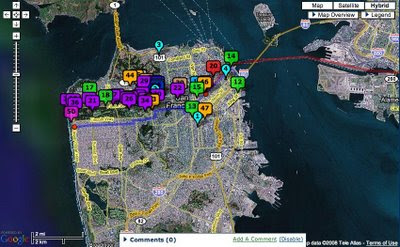

"i've got one last thing to show you all," i said as a way to signal my lecture's conclusion, "and it's a map of krakow!"

i raced to my laptop and brought up the annotated map of beautiful krakow that 15 papal university journalism students, professor krzysztof gurba, iwona sadecka from the US consulate in krakow, and i collectively created a few nights earlier. it was exciting to use the work of polish college students to teach other polish college students - students teaching students! returning to a point i made in the beginning of the lecture, i congratulated the students on our work and reminded them, and the rest of the students in the classroom, that we did not need a television station nor a printing press nor a radio station to make and share and distribute our stories about krakow. nor, i said, did we need lots of money. plus, i said, to the students in the room but really to all the polish students i met during my week-long trip, nobody tried to censor us.


polish students are less likely than US students to speak up in class and polish classrooms are less participatory than US classrooms, so i was excited that 5-6 students asked questions after my lecture. during Q and A, we discussed president obama and new media, the future of journalism, and the delights of polish food and beer. we talked about how traditional media broadcasts information and how digital media can create communities and conversations, a point i illustrated by noting the excellent fan community site, inxs.pl, co-created by a papal university journalism student joanna szumowska. then i took photographs (which, sadly, do not include all students in the room nor do they include the wonderful iwona sadecka from the US consulate in krakow and one of the organizers of the event).


after the lecture was over, krzysztof gudowski, a student who helped make the map of krakow and who joined us for post-map making periogis, approached me and said thanks.

"professor silver, i have decided something," he said. "i will make a flickr set of how to make delicious periogis."

"you know how to make delicious periogis?" i asked.

"yes. very delicious periogis," krzysztof answered. "i will make delicious periogis. i will document the process. then i will share it. therefore, you - in the future - will learn how to make delicious periogis."

"brilliant idea!" i said, and shook his hand. "and krzysztof," i said, addressing him but also hoping that my words would somehow reach all the college students in krakow and in poland, "thank you."

Thursday, March 26, 2009

there's something about krakow

maybe it's the architecture. maybe it's the weather, which can go from rain to wind to snow to sun, all within 5-10 minutes. maybe it's the food, the delicious and filling food. maybe it's all the cobblestones which a student said contained "the spirits of our ancestors." maybe it's all the people who have lived here and all the people who have fought here and all the people who have died here. maybe it's all the young people - one-fourth of all krakow residents are college students. it is an old city filled with young people.


this morning, susan parker-burns, public affairs officer at the US consulate in krakow, and i went to RMF FM for a radio interview with grzegorz jasiƄski and bogdan zalewski. we talked about president obama and his use of new media and new ideas. we discussed digital democracy, grassroots new media activism, and about everyone making our own media. bogdan is extremely smart and creative - both as a radio journalist and a big-time blogger - and connects literature to culture to politics to technology. after the interview, grzegorz gave us an excellent tour of the huge facility and shared with us some of the innovative ways the station combines traditional and digital media.


later that afternoon, iwona sadecka, public affairs advisor at the US consulate in krakow, and i headed out of the city center to the new jagiellonian university campus, where i gave a guest lecture on digital storytelling to professor maria magoska's journalism class. similar my earlier lectures, i encouraged the studenets to make media, share media, and collaborate with others to make even better media.


near the end of the lecture, i gave the students homework. i explained to the students that their professors are very smart and that they, the students, can learn so much from them. but when it comes to tomorrow's media, we professors are waiting for you students to invent it. so, your homework, i said, due in 2 or 5 or 10 years, is to invent the future and share it with the rest of us.

Saturday, October 25, 2008

doctor gendelman

i met irina gendelman at the university of washington in 2001. we were both studying communication - she as a grad student, me as a new assistant professor. within a year, she was assigned to be my research assistant and our collaborations began.


over the years, we taught each other and taught together. i taught irina a thing or two about teaching when she was one of my teaching assistants for intro to communication. irina taught me a thing or two about community collaboration with the september project mural and about student-created digital content with urban archives. and we taught - and teach - each other during our marathon walkabouts, our aimless and mindful walks around seattle and san francisco looking for nothing and everything.


yesterday morning, i flew to seattle for one last task at the university of washington - irina's dissertation defense. and by the end of the day, irina gendelman - with help from committee chair crispin thurlow, from committee members, and from honorary committee member deb kaplan - became doctor gendelman.


congratulations irina. you done make us proud.

Thursday, June 05, 2008

blogging 101 workshop

today, with help from two recently graduated seniors, i conducted a blogging 101 workshop for USF staff, librarians, and faculty. the workshop took place at the center for instruction and technology and was part of CIT's june tech-intensive workshop series.

we began at 10 am and i immediately made three promises:

1. you will walk out of here with a blog.

2. you will have a better understanding of how to use a blog and how to sustain a blog.

3. you will have lunch.

we then followed, sorta, this eleven step process.

1. introductions: who are we?

2. discussion: what do you want from a blog? what are your goals?

3. start a blog! (we used blogger)

a. sign up
b. name your blog
c. choose a template
d. done

4. write and publish one blog post.


5. then, lunch! offline! away from computers!

6. settings (with special attention paid to comments setting)

7. everyone comment on two or three other blogs ("blogging is 51% writing blog posts," i declared, offering zero evidence for my statistics, "and 49% commenting on other people's blog posts.")

8. tags and tagging

9. importing images to your blog

10. basic page elements (with a show-and-tell example of creating a blog roll)

11. strategies for sustainability (aeiou)

lis and sara, the two recently graduated USF seniors (and davies scholars) who helped me teach the workshop, were excellent. anytime a workshop participant had a question or showed some techno-frustration, lis or sara would be there with a tip or a suggestion. my thing is students teaching students but students teaching professors is pretty cool too.

something to remember - good learning environments require good food! having lunch was not only a delicious way to divide the three-hour workshop, it was also a welcomed opportunity to log off, walk away from our computers, and interact directly with our food and colleagues.

to keep a blog, you need to feed the blog. i hope the following get fed:

Stan Buller's The End of Government??
Ellen Kelly Daley's Expecting Seamus J
Life Transitions
Tom Lucas' A Jesuit's Garden by the Golden Gate
marcella's Global Sense: Youth Network Resource
My Dog is Better Than Your Dog!!!
Greg Pabst's fishlanguage
Renate's ResearchIdeaForum