pinochet died today.
update: david de ugarte is capturing and pointing to multiple streams of what is happening now.
 100 years later, filmmakers melinda stone and liz keim decided to recreate the historic event. on september 24, 2005, they hosted a free and public film screening in a park across from the ferry building. they screened the original 1905 film as well as new 2005 trips down market street. by all accounts, the evening was magical. fortunately, a lot of it is captured on a dvd called a trip down market street 1905/2005.
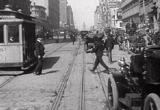
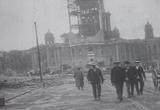
 the pathway we took with the dvd ended with "a trip down market street 2005" by melinda stone and sprague anderson, with a score by - again - beth custer and performed by the beth custer ensemble. as far as i can tell, melinda and sprague were able to convince MUNI to let them attach two cameras - a 35mm hand-crank camera and an HDV camera - to a street car and film market street 100 years after the original. just like kuttner's trip down market street, this one is full of the city, full of buildings and cars and streets and bicycles and traffic, full of people (including marina, zane, milo, and sirrus, not to mention a smiling sam green in a nice green shirt). but most of all, it's full of perspectives - perspectives of a city so many of us can't get enough of.


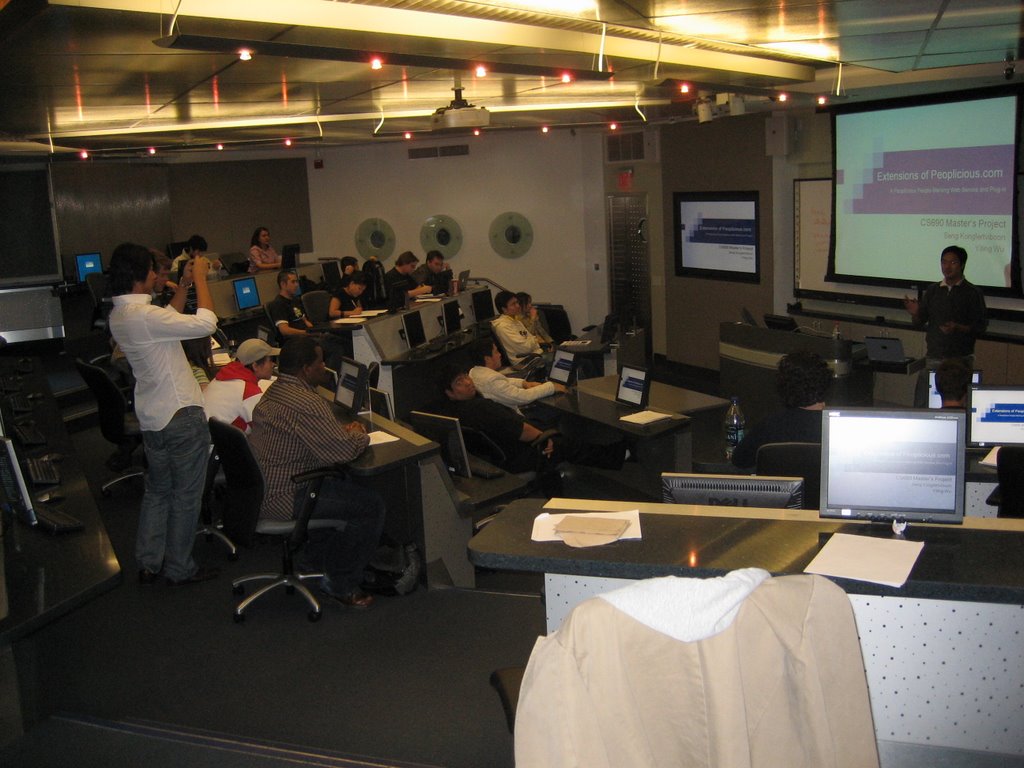
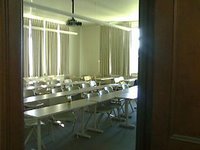
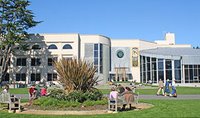
 digital democracy meets in a classroom on the third floor of lone mountain. throughout the semester, we have experimented with the best way to configure the room. i'm starting to think that this shape, a u-shape, is the best for class discussions. in this configuration, all of the students are able to see and hear the speaker and see and hear each other.


"Citizen Josh:" A Performance and Q&A Session with Josh Kornbluth
Friday, December 1st, 2006
12:00-2:00pm
The Studio Theater on Lone Mountain
Bay Area writer, director, and public television host Josh Kornbluth will perform an improvised piece focused on the central question of democratic involvement and possibilities for democracy in today's world. This performance will be a culmination of Kornbluth's week-long visit to the USF campus and various Politics department classes.
A Q&A session will follow the performance. All USF students, faculty, and staff are welcome to attend.
About the artist: Josh Kornbluth was raised in New York City and moved to San Francisco in 1987. He has been writing and performing monologues - including "Haiku Tunnel" (which was made into a feature film in 2001), "Red Diaper Baby," and "Ben Franklin: Unplugged") - throughout the Bay Area and beyond for several years. He is currently hosting an interview program on KQED-TV titled "The Josh Kornbluth Show." More information can be found at his website (also: check out his blog).
"Citizen Josh" is being co-sponsored by the USF Politics, History, and Philosophy Departments, as well as the Honors Program in the Humanities.

1. Answer a question with support from outside readings2. Read/Write the Web
- Formulate an interesting question you have regarding new media.
- In no more than 4 double-spaced pages, answer your question.
- Your answer must include at least one use of Dan Gillmor's We the Media. If you do not know how to integrate readings into your writing, see me immediately.
- Your answer must integrate ideas and/or evidence from at least 3 outside readings beyond Gillmor. Any reading in any medium is acceptable as long as it is credible.
- Zero typos. Zero grammatical mistakes.
- Include a bibliography. Alphabetize your bibliography. If you don't know how to make a bibliography, ask a librarian in Gleeson Library.
- Blog at least 3 times about your project and its development.
- Hint 1: Before turning in your paper, consider swapping drafts with another student or students in class. Give and receive edits, suggestions, and questions with that student or students.
- Hint 2: Select a question that makes you genuinely curious.
Your papers are due in class on Tuesday, December 12. No late papers accepted. Be ready to informally introduce your findings during our last class. Pizza will be served.
- From the reading and class discussion, we've discussed 12 read/write technologies: mailing lists and forums; blogs; wikis; sms; mobile-connected cameras; internet broadcast; peer-to-peer; RSS; online photo-sharing; online video-sharing; social bookmarking; and social networking sites. Select one of these that you wish to learn more about.
- Spend time with the software and the community around it. Explore. Experiment.
- Be sure to read and write – to download and upload – and pay attention to what happens.
- Blog at least 3 times about your project and its development.
- In no more than 3 double-spaced pages write about your experiences.
- Write about both what you download (learned) and uploaded (contributed), but mostly write about what you uploaded.
- Zero typos. Zero grammatical mistakes.
- Hint 1: Consider selecting an application you have zero familiarity with.
- Hint 2: If you are not having fun with your read/write technology, you probably have not selected the correct one.
technorati tag: teaching-carnival


Digital Media, Learning, and Libraries: Web 2.0, Learning 2.0, and Libraries 2.0there's over 250 panels to attend, a conference wiki to collectively build, and the very, very cool cyber zed shed. plus, one of the keynote speakers is baltimore's very own john waters!
Let's be clear about it: The term Web 2.0 is, first and foremost, a marketing gimmick. Its purpose is to create a sense of new, foster a buzz about new media, and generate new investment. So far, it's working.
At the same time, for those of us with access to recent developments on the web, it is difficult to deny that something new is indeed afloat. New social software coupled with new social interactions seem to be generating new forms of collective intelligence. Although these forms manifest in different ways, they most often share an important similarity: They encourage users to contribute - to add and annotate, as well as to read and reflect - to the collective intelligence.
With help from sites like theworldisnotflat.com, dosomethingamazing.com, intellipedia, and librarything, this talk seeks to open discussions around the intersections among social software, student learning, and academic libraries.
David Silver
Department of Media Studies
University of San Francisco


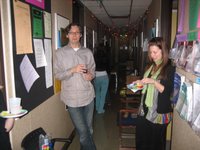
 here, chris witteman (standing on the right) provides some context of bay area media policy history. and, if you look closely, you will see shinjoung yeo and james jacobs (of, among other things, free government information).
 later in the afternoon, i was part of a panel titled "video/audio blogging, social networks and labor." the panel was comprised of jay dedman (an educator of web blogging and broadcasting and the person responsible for the excellent site freevlog), john parulis (media democracy activist and labortech program committee member), colette washington (web site coordinator of the california nurses association and genius behind About Time for 89, arguably the first rap music video to be written about a proposition), and myself.

 in general, i highlighted strategies that involved collective blogging and already existing information for time-strapped labor organizations. my brief notes focused on five tips:
 do you have your MLS? do you enjoy working with digital collections? wanna work and live in san francisco?
 deb kaplan, assistant professor of communication, former community journalist, and all around lovable human being, died the night before last in her sleep. i met deb about three years ago when she became a professor at university of washington in the department of communication. she was engaged: engaged about teaching, engaged with the world, engaged about suffering. she was also a bundle of fun to be around.
In the months leading up to the U.S. invasion of Iraq, I watched as the protests grew from thousands of people to millions of people across the United States and around the world. This grassroots movement against the Iraq war grew at a larger and faster rate than the Vietnam anti-war movement of the 1960s. And yet, it received very little coverage in the mainstream media. As an independent documentary filmmaker, I felt compelled to make a film about this important grassroots movement that would show in a very personal way some of the people who are protesting this war.today on campus there will be a free screening of this film. the event is sponsored by the USF Politics Society, Leo T. McCarthy Center for Public Service & the Common Good, Peace and Justice Studies Program, Politics Department, and Media Studies Department.


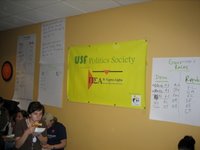 to introduce these two concepts, i began by describing election night at USF. i told a brief story (better heard than read) that recounted how many of the students in attendance were in middle school in 2001 and how i tried to imagine what they thought when president bush followed september 11 by encouraging us to go shopping. next, i discussed how students used multiple media - laptops, cell phones, television - to follow the election, how they talked and debated about their findings, and how they created media (in the form of posters on walls) to update and share their findings. i think i may have mentioned that in a society which too often educates youth to be consumers, it sure feels inspiring to watch them become citizens.


 pizza, popcorn, cookies, laptops, tv, and lots of excitement. the election results are just now streaming in but here's what the scene looks like in crossroads cafe.
 professors stephen zunes (standing, left) and corey cook (standing, right) use a commercial break as an opportunity to explain some of the numbers.
 news seems to travel faster through the web than through tv. it's great when a student with a laptop can call a race faster than the suits on CNN.
 the moment new data gets posted to the web it gets posted to the posters. the left side of the poster, the democratic side, is filling fast.
 corey cook (a USF professor of politics), students enrolled in his Legislative Process class, USF's department of politics, the leo t. mccarthy center for public service and the common good, and USF's politics society have organized an excellent event for tomorrow night. it takes place between 6 - 9 pm in crossroads cafe.
Students, faculty, and staff from the University of San Francisco are invited to an election night party at the Crossroads Café. We will be watching the local and national coverage on large screen televisions and have laptop computers set up to get immediate election returns from around the country ... In addition, faculty experts will be available to speak about the most competitive U.S. Senate races in the country including those in Connecticut, Maryland, Minnesota, Missouri, Montana, New Jersey, Ohio, Pennsylvania, Rhode Island, and Tennessee, statewide and state legislative races, local races for county supervisor in San Francisco, and state and local ballot propositions.kudos, thanks, and much respect to corey and the politics society for giving us something to do collectively on such an important and exciting evening. and i'll look forward to seeing my friend and colleague dave wolber and his excellent project who's funding whom? i hope to see you there.
Sponsors:
University of San Francisco Department of Politics
Leo T. McCarthy Center for Public Service and the Common Good
University of San Francisco Politics Society
Faculty:
Corey Cook, Politics
David Silver, Media Studies
David Wolber, Computer Science