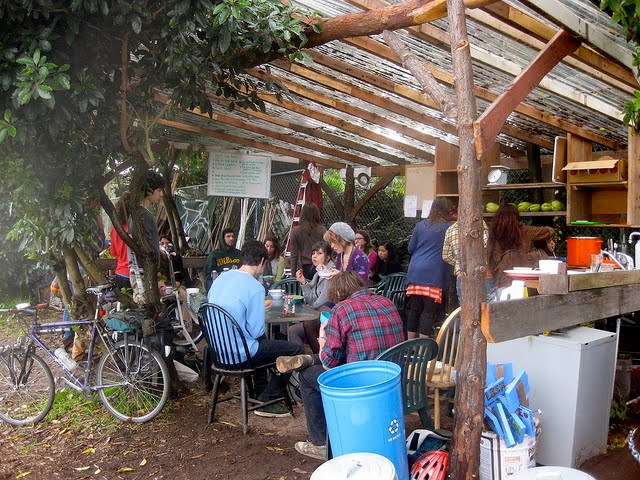
Showing posts with label community garden outreach. Show all posts

Wednesday, January 25, 2017

community garden outreach syllabus (spring 2017)

Community Garden Outreach
Thursdays, 11:45 am – 3:25 pm & 5-9 pm on 1st Thursdays
Class location: USF Garden, Gleeson Plaza, & St. Cyprian’s Church (Turk and Lyon)
Twitter: @USFgarden / Instagram: usfgardenoutreach

Professor David Silver (dmsilver [ at ] usfca [ dot ] edu)
Office / hours: Kalmanovitz 141, MW, 1-2 & by appointment
TA: Santiago Delgadillo (sdelgadillo [ at ] dons [ dot ] usfca [ dot ] edu)

Course Description: Community Garden Outreach introduces students to ideas, skills, and practices in ultra-local, urban-based food production and distribution. Through readings, reflections, and discussions, students will explore various social, cultural, and economic issues around food, food production, and food distribution. Through cooking and preserving workshops, urban farm visits, monthly campus farmstands in Gleeson Plaza, and monthly community dinners at St. Cyprian’s Church, students will engage directly with community food practices.

Learning Goals:
  1. Develop practical skills in preparing, preserving, and distributing local, seasonal food;
  2. Design, implement, and administer the campus farmstand and St. Cyprian’s community dinner;
  3. Design and implement outreach methods to publicize class events; and
  4. Demonstrate effective and creative collaboration with class members and community partners.


Grading:
50%  Participation in and contribution to 3 USF Farmstands and 3 St Cyprian’s Community Dinners
10%   Recipe Project
20%   Family Cuisine Project
10%   Homework assignments and reflections
10%   Out-of-class volunteering

Farmstands and Community Dinners: The heart of this class is the campus farmstands and community dinners. Occurring three times a semester, the campus farmstand takes place in Gleeson Plaza. Students are responsible for all aspects of the farmstand, including organizing, publicizing, harvesting, gleaning, cooking and preparing the food, setting up, serving, cleaning up, and documenting. Also occurring three times a semester, the community dinners take place at St. Cyprian's Church (at Turk and Lyon) on the first Thursday evening of each month. Again, students are responsible for all aspects of the community dinner.

Out-of-class volunteering: Each student is required to make at least three visits to an urban farm or food-related event in the city. We will talk more about this but in general students visit the urban farm during work days, work in the farm for about two hours, and write a one page reflection about your experiences. Possible urban farms include: Alemany Farm, Garden for the Environment, and Tenderloin People’s Garden. Students can also volunteer at USF’s Stress Less Day (February 28) and the Earth Day Seed Swap at San Francisco Public Library (on April 22).

Attendance Policy: Missing class, or attending class unprepared, will significantly affect your final grade. If you do miss class, contact a classmate to find out what we discussed in class and ask to borrow her or his notes. Then, do the same with a second classmate. After this, if you still have questions about missed material, visit me during office hours or email me.

Course Rules
1.    No late work accepted.
2.    No drinking out of non-reusable containers during class, during farmstands, and during community dinners.
3.    Unless extremely necessary, stay off your phones during class.


Course Calendar
Thursday, January 26: Class and individual introductions. Food icebreaker. Tour USF Garden. Make a salad. Review syllabus. Homework: Visit a Farmer’s Market, preferably the Ferry Building Farmer’s Market on Saturday, to assess what makes a successful farmer’s market. Compile your observations into a one page reflection and bring to class on February 2.

Thursday, February 2: Discussion: What makes a stall at the farmer’s market good or bad? What’s a farmstand? What kind of farmstand do we want ours to be? Tour G05. Visit USF Seed Library and meet Gleeson librarians Debbie Benrubi and Carol Spector. Harvest for evening cooking workshop. Evening (5-9 pm): Cooking workshop and group dinner at St Cyprian’s. Dinner guests: Bruno Peguese, Senior Warden of St. Cyprian's Church; and Rev. Thomas Jackson, Vicar, St. Cyprian’s Episcopal Church. Homework: farmstand preparations, harvest/cook/coordinate with your team for next week’s farmstand.

Thursday, February 9: USF Farmstand 1. Class meets at Gleeson Plaza. After farmstand, we will have a brief visit from Lauren White, a representative from the HECUA Internship Program in Tuscany (“Sustainable Agriculture, Food and Justice in Italy”). Homework: Listen to TED Radio Hour, “The Food We Eat” (52 minutes), NPR.

Thursday, February 16: Recipe workshop. Homework: Readings on seeds and seed libraries distributed in class.

Thursday, February 23: Seed packet design workshop with Maren Salomon, Debbie Benrubi, and Carol Spector. Class meets near the USF Seed Library in Gleeson Library.

Thursday, March 2: Class meets at St. Cyprian’s to cook and prepare community dinner. Evening (5-9 pm): Community Dinner 1. Homework: farmstand preparations, harvest/cook/coordinate with your team for next week’s farmstand.

Thursday, March 9: USF Farmstand 2. Class meets at Gleeson Plaza.

Thursday, March 16: No class: Spring Break

Thursday, March 23: Mexican food and culture workshop with Josah Perley, owner of small-scale taco business, Tacoschani. Homework: Read Melati Citrawireja, “Deepa Natarajan: Ethnobotanist and natural fabric dyer,” Berkeleyside, November 9, 2015; and selections from John Keay, The Spice Route.

Thursday, March 30: Chai and spices workshop with Deepa Natarajan.

Thursday, April 6: Class meets at St. Cyprian’s to cook and prepare community dinner. Evening (5-9 pm): Community Dinner 2. Homework: Read Sandra Cate, “‘Breaking Bread with a Spread’ in the San Francisco County Jail,” Gastronomica, Summer 2008, pp. 17-24.

Thursday, April 13: Baking workshop. Guest baker: Samantha Blackburn. Class meets at St Cyprian’s kitchen. Homework: farmstand preparations, harvest/cook/coordinate with your team for next week’s farmstand.

Thursday, April 20: USF Farmstand 3. Class meets at Gleeson Plaza. Homework: Family cuisine assignment.

(*** On Saturday, April 22, there will be an Earth Day Seed Swap at the main branch of the San Francisco Public Library. The USF Seed Library is a co-organizer of this event and all CGO students are required to attend and participate in it.)

Thursday, April 27: Family Cuisine Project due in class.

Thursday, May 4: Class meets at St. Cyprian’s to cook and prepare community dinner. Evening (5-9 pm): Community Dinner 3. Homework: final reflection assignment.

Thursday, May 11: Last-day-of-class potluck party in USF Garden.

This class has no final.

Saturday, March 31, 2012

last week's farmstand + gleeson library

a few weeks ago, following a very successful farmstand one, i gave the 21 students and 1 TA in community garden outreach a challenge: "at our next farmstand, when people approach your table and say, 'i would like a salad, please,' i want you to say, 'which one?' at the last farmstand we offered 1 of everything. this time, let's offer 2."

at our second farmstand (thursday, march 22) CGO students delivered. they harvested for, cooked, and served 2 salads (a mixed green with golden goddess dressing and a raw kale salad), 2 soups (a butternut squash with greens soup and spicy collard green with potato and sausage soup), 3 (3!) desserts (lavender cookies, lemon bars, and rhubarb almond bars), 3 (or 4) frittatas, and 1 huge vat of lavender lemonade -- all featuring at least 1 ingredient from the USF garden.


there's a real community forming around farmstand and it includes students, faculty, librarians, staff, administration, and jesuits. by the time we finally opened (about 12:10, i think) there was a long line of folks waiting for good food.


this farmstand included, for the first time, a food/cooking/gardening/sustainability-related book and DVD collection curated and created by gleeson library. arranged by USF librarians debbie benrubi, shawn calhoun, matt collins, and sherise kimura, the gleeson mobile library offered on-the-spot, free, relevant, and borrowable books and DVDs to the farmstand community. perfect.


Monday, January 23, 2012

community garden outreach (spring 2012)

Community Garden Outreach
Environmental Studies 145
Thursdays, 12:45 – 4:25 pm, in the USF Garden

Professor David Silver
Office: Kalmanovitz 141
Office Hours: Tues 1 – 2 pm & by appointment
Contact: dmsilver [ at ] usfca [ dot ] edu

Community Garden Outreach introduces students to ideas, skills, and practices in ultra-local, urban-based food production and distribution. Through course readings and discussions, harvesting in the USF garden, running the campus farmstand, and working on group projects, students will gain first-hand knowledge of and experience in ultra-local, urban-based food systems.


Learning Outcomes
1. Develop practical skills in harvesting, preparing, preserving, and distributing food;
2. Gain hands-on experience in designing, implementing, publicizing, and administering the campus farmstand;
3. Learn how to collaborate creatively and effectively.

Course Schedule
This course meets once-a-week for fifteen weeks. Approximately one-third of our class periods will be spent discussing assigned readings and films, sharing ideas and progress on group projects, and brainstorming our next farmstand. Another one-third of our class periods will be spent in cooking and homesteading workshops in the community kitchen at St. Cyprian's Church (2097 Turk Street). A final one-third of our class periods will be spent setting up, administering, documenting, and breaking down our campus farmstands.

Grading
33% - Quizzes, homework, in-class assignments, weekly reflections, and class participation.
33% - Participation in and contribution to campus farmstands, including designing, setting up, publicizing, preparing food, administering, documenting, and cleaning up.
33% - Individual contribution to group project. This includes: selecting a topic that sustains your attention for a semester; working with other team-members in a collective and generous manner; and devoting at least four hours a week to your project.

Attendance Policy
Missing class, or attending class unprepared, will significantly affect your final grade. If you do miss class, contact a classmate to find out what we discussed in class and ask to borrow his or her notes. Then, do the same with a second classmate. After doing this, if you have questions about missed material, visit me during office hours or send me an email.

Rules
1. No late work accepted.
2. No drinking out of non-reusable containers during class.

Wednesday, March 02, 2011

first friday farmstand

please join the garden project living learning community this friday at harney plaza for good food and fresh produce. first friday farmstand offers homemade meals made with fresh veggies, fruits, and herbs grown in our organic garden on campus. lunch will be served from 12-2 or until the food runs out. bring yer own bowl and receive a half-priced soup or salad!


menu includes: happily harvested garden greens, potato leek soup, veggie sandwiches on homemade bread, veggie quesadillas, collard dolmas, garden tea, and a to-be-determined dessert. friday's farmstand will also feature salves and tinctures made by garden project students during a homestead workshop with sarah duscoe of the wellness place.


this farmstand is in sponsorship with robin kuehn, a history major at USF and garden project student during 2009-10. this summer, robin is participating in a 4,000 mile bike & build ride across the US with stops to help work on affordable housing projects. half of friday's farmstand proceeds will go to support robin's summer quest.

Wednesday, January 26, 2011

community garden outreach (spring 2011)

Community Garden Outreach
Environmental Studies 145
Fridays 11:45 am – 3:25 pm
Hayes Healy Formal Lounge

Professor Melinda Stone
Office: Kalmanovitz 120
Office Hours: Wed 10 – 12 & by appointment
Contact: stone [ at ] usfca [ dot ] edu / 422-5755

Professor David Silver
Office: Kalmanovitz 141
Office Hours: Tues & Thurs 3 – 4 pm & by appointment
Contact: [ at ] usfca [ dot ] edu

Community Garden Outreach introduces students to environmental, cultural, social, political, and philosophical issues that circulate through and around food production, preparation, and distribution. Through readings, guests, and class discussions, students will learn about sustainable and unsustainable systems of food production. Through field trips, homestead workshops, and our on-campus farmstand, students will engage directly with various sustainable food practices. This service-learning course is offered in tandem with Justin Valone’s Urban Ag II and both are part of USF’s Garden Project living learning community.

Learning Goals:
1. To continue managing – effectively and collaboratively – the campus farmstand;
2. To develop advanced skills in preparing, preserving, and distributing food; and
3. Through field trips to San Francisco/Bay Area urban farms and gardens, to explore first-hand some of challenges and opportunities in urban agriculture.


Course Schedule:
Friday, January 28
Re-introductions

Friday, February 4
First Friday Farmstand

Friday, February 11
Field trip to Little City Gardens
Prior to field trip, read Chloe Roth, Little City Gardens makes a go of urban agriculture in San Francisco, SFGate, April 29, 2010; and Robert Selna, Urban agriculture: S.F. considers allowing sales, SFGate, December 23, 2010.

Friday, February 18
Homestead Workshop: Making Herbal salves, oils, teas and tinctures with Sarah Duscoe
Prior to homestead workshop, read: Sarah Holmes, Western Herbalism, September 11, 2000; Matthew Wood, The Three Basic Principles of Traditional Western Herbalism; and Jane E. Brody, Babies Know: A Little Dirt Is Good for You, New York Times, January 26, 2009.

Friday, February 25
Garden Guests: Daniel Tucker and Anne Hamersky
Read selected chapters from Amy Franceschini and Daniel Tucker’s Farm Together Now: A portrait of people, places and ideas for a new food movement (2010).

Friday, March 4
First Friday Farmstand

Friday, March 11
Field trip to UCSC Farm
Prior to field trip, read Patricia Allen and Martha Brown, Sustainable Agriculture at UC Santa Cruz, CASFS.

Friday, March 18
SPRING BREAK

Friday, March 25
Homestead Workshop: Foraging with Justin Valone
Readings TBD.

Friday, April 1
First Friday Farmstand

Friday, April 8
Garden Guest: Heather Hoag
Readings TBD.

Friday, April 15
Field trip to Garden for the Environment
Read: Can City Farmers Make a Living? Activist Eli Zigas on the Challenges of Urban Agriculture, Good, January 11, 2011.

Friday, April 22
Good Friday: No class.

Friday, April 29
Garden Guest: Marco Perez Navarrete, Permaculture Institute of El Salvador
Read selections from Raj Patel, Stuffed and Starved: The Hidden Battle for the World Food System (Melville House, 2008).

Friday, May 6
First Friday Farmstand

This class has no final.


Course Grading:
Weekly Reflections - 40%
Farmstand Participation - 40%
Classroom Participation - 20%

Rules:

1. No late work accepted.
2. In class, on field trips, and during farm stand, no drinking out of non-reusable containers.

Thursday, August 19, 2010

community garden outreach (fall 2010)

i'm teaching two classes this fall. one of them is community garden outreach which i'm co-teaching with melinda stone. classes begin august 25, 2010.


Community Garden Outreach
Environmental Studies 145
Wednesdays 11:45 am - 3:25 pm
Hayes Healy Formal Lounge

Professor David Silver
Office: Kalmanovitz 141
Office Hours: Mon and Wed 9 – 10 am & by appointment
Contact: dmsilver [ at ] usfca [ dot ] edu

Professor Melinda Stone
Office: Kalmanovitz 120
Office Hours: Tues 10 am – noon & by appointment
Contact: stone [ at ] usfca [ dot ] edu / 422-5755

Course Description:
Community Garden Outreach introduces students to environmental, cultural, social, political, and philosophical issues that circulate through and around food production, preparation, preservation, and distribution. Through readings, films, and class discussions, students will learn about sustainable and unsustainable systems of food production. Through field trips, homestead workshops, and an on-campus farmstand, students will engaged directly with various food production, preparation, preservation, and distribution practices. This service learning course is offered in tandem with Justin Valone’s Urban Ag I and both are part of USF’s Garden Project living learning community.

Learning Goals:
1. Discuss some of the key contemporary issues revolving around food and food production;
2. Develop practical skills in preparing, preserving, and distributing food;
3. Design, implement, and manage the campus farmstand;
4. Create and distribute farmstand recipes that engage and educate the campus community; and
5. Demonstrate effective and creative collaboration.

Book:
Michael Pollan’s Second Nature: A Gardener's Education, 1991.

Course Calendar:
August 25:
In class we will introduce ourselves, the course, and course expectations. At the end of class, we will field trip to the Upper Haight Farmers Market. Your homework, in addition to your weekly reflection, is to visit the Ferry Plaza Farmers Market on either Thursday, August 26 or Saturday, August 28.

September 1:
Discussion about farmers markets and our farmstand. Class guests will include a few past Garden Project students who will share their experiences with running farmstand. Class will also include a visit from Sarah Klein, who will help us assess our kitchen and garden. Keep in mind: On Thursday, September 2, we will have our 1st campus farmstand!

September 8:
Prior to class, read Mollie Katzen's "Useful Tools," from The New Moosewood Cookbook, pp. xvi- xvii; and Joan Dye Gussow, “Is It Worth It?” from This Organic Life: Confessions of a Suburban Homesteader, pp. 200-214. Full kitchen/cooking day with Sarah Klein. At the end of class, be ready to commit to particular tasks for this semester's farmstand.

September 15:
Prior to class, watch Food, Inc., which we will discuss in class. We will end class with a discussion and early assessment of our farmstand.

September 22:
Prior to class, read Michael Pollan’s “Introduction” & “Two Gardens,” pp. 1-34, which we will discuss in class.

September 29:
Prior to class, read Joseph Radabaugh's "A History of Solar Cooking," "Designing & Building Your Own Solar Cooker," and "Building the SunStar," from Heaven's Flame: A Guide to Solar Cookers, pp. 1-4, 71-110. Homestead workshop: Solar Ovens and Sour Dough Crackers.

October 6:
Prior to class, read Molly Katzen's “An Illustrated Guide to the Baking of Yeast Bread,” from The Enchanted Broccoli Forest, pp. 86-95; Mark Bittman's Making No-Knead Bread (Video – 4:58), New York Times, December 29, 2006; and Brother Rick Curry, S.J., “Making Bread,” from The Secrets of Jesuit Breadmaking, pp. 11-21. Homestead workshop: Baking Bread.

October 13:
We will not have our regular Wednesday class this week in preparation for our field trip to Occidental Arts and Ecology Center (OAEC), on Friday and Saturday, October 15-16.

October 20:
Prior to class, read Kim Severson's “Neighbor, Can You Spare A Plum?” New York Times, June 10, 2009; Fallen Fruit, “Take Back the Fruit: Public Space and Community Activism,” from Food, edited by John Knechtel, pp. 94-103; Roxanne Webber's 10 Ways to Barter for Food, Chow, August 6, 2009; and Pollan’s “The Harvest,” pp. 137-149. Homestead workshop: Green Media.

October 27:
Prior to class, read Pollan's “Compost and Its Moral Imperatives,” pp. 66-75. Homestead workshop: Canning.

November 3:
Prior to class, watch Chet Bentley's Elixir of Life, from How-to Homestead (2010); and David Owens, Brittany Rowles and Reece Snyder's Jerusalem Artichokes, from How-to Homestead (2009). Homestead workshop: Gleaning & Preserving.

November 10:
Prior to class, watch Ruth Stout’s Garden (23 minutes); Close to Nature Garden (24 minutes); and Garden Song (28 minutes). Be ready to discuss the three films in class.

November 17:
Prior to class, read Pollan's “Weeds Are Us,” pp. 98-116. (Important: Field trip to GFE has been postponed until spring semester) Field trip to Garden for the Environment.

November 24:
No class: Thanksgiving

December 1:
Prior to class, watch Dirt! which we will discuss in class.

December 8:
Wrap up first semester and prepare for Vision Day, Thursday, December 9.

Grading:

o Weekly 1-page reflection papers - 25%
o Classroom, field trip, and workshop participation - 25%
o Farmstand participation - 25%
o Creating and distributing farmstand recipes (Students enrolled in 2 units will be required to create – either individually or collectively – 2 farmstand recipes; students enrolled in 4 units will be required to create 4.) - 25%

Please note: Students enrolled in 2 units will be expected to work at least 2 hours a week towards our campus farmstand; students enrolled in 4 units will be expected to work at least 4 hours a week towards our campus farmstand.

Course Rules:
1. Starting September 1, no drinking out of non-reusable containers in class and during farmstand. Be creative with your thirst-quenching solutions.
2. In class, on field trips, and during farmstand, try your best to listen to and learn from everyone.
3. No late work accepted.

Wednesday, April 07, 2010

stir it up - a talk @ sfpl

later this evening, melinda stone and i will be giving a presentation at the main branch of san francisco public library. our talk is called stir it up - in the pot and on the web: making media about making food. it's free and open to the public and yer invited!

with luck, i hope to share ideas via a single flickr set:


if time permits, i also hope to share:

Daniele Dominguez's Vegan Lemon Scones with Lemon Glaze
Kate Greenspan & Sophia Lorenzi's Soph's Loaf of Chocolate Banana Bread
Christina Hammill's No-Knead Bread
Samuel Hernandez & Peter Thoene's rosemary rock salt focaccia
Joel Weston's Blueberry-Lime Poundcake

hope to see you at the library!

Tuesday, February 16, 2010

friday's foraging fieldtrip

garden project and green media students - this friday we'll be field-tripping to the inner sunset to forage for wild greens. we'll meet at the garden for the environment at 10:30 am sharp. don't be late. here are walking/biking directions and muni bus directions from USF to the GFE.

justin valone, of USF's garden project, will lead and teach us about foraging.


what should you bring?

1. comfortable shoes;

2. a bowl and fork for salad;

3. some kind of salad amendments - nuts, seeds, homemade dressing;

4. your thoughts and ideas about chapter one of novella carpenter's farm city; and

5. if it's raining, bring rain gear.

Thursday, January 28, 2010

twitter assignment

twitter assignment for digital media production, green media, and community garden outreach

1. if you have not yet joined twitter, join twitter.

2. create a profile. in either your user name or bio (or both), use your real name.

3. make your profile public. if you already have a twitter account that is private and wish to keep it that way, create a new account for this class.

4. find and follow all members (students and professor) of our class.

5. search for and follow all people whose work (writings, video, web) is assigned each week. if after a week you find their tweets less than amusing, by all means unfollow them.

6. please get into the habit of checking twitter at least once a day.

Tuesday, January 12, 2010

community garden outreach (spring 10)

i'm teaching three classes in spring - two of them new. one of the new ones is community garden outreach. classes begin friday, january 29th.


Community Garden Outreach
Fridays 1:30-5 pm
Hayes Healy Formal Lounge and in the Garden

Professor: David Silver
Office: Kalmanovitz 141
Office Hours: Tues & Thurs 10:30-11:30 am & by appointment

Community Garden Outreach is a 2-unit hands-on and seminar class held in conjunction with Justin Valone’s Urban Ag class. Through gardening, harvesting, foraging, cooking, eating, reading, reflecting, and discussing, we will explore social, cultural, political, economic, and environmental issues around food, food production, and food distribution. In addition to continuing our educations as gardeners, we will work online with social media to document our garden activities and offline in groups to organize and implement various food distribution projects. Further, through life competency sessions led by Golden Venters, students will reflect upon and discuss their processes of intentional change, contemplation of self, and inter- and intrapersonal abilities. Community Garden Outreach is part of the Garden Project Living Learning Community.

Learning Goals:
o To learn more about organic gardening, urban agriculture, and community food production;
o To learn how to use different kinds social media to document the planting, preparing, and sharing of food;
o To learn how to work collaboratively to design and organize community food distribution projects; and
o To learn how to bake bread.


Books:
o Novella Carpenter, Farm City: The Education of an Urban Farmer, 2009.
o Michael Pollan’s Second Nature: A Gardener's Education, 1992.

Calendar:
Friday, January 29
Last semester, through your work in Melinda Stone and Justin Valone’s fall 2009 courses, you’ve learned a lot about gardening, urban agriculture, and food production. The majority of today’s class will be spent bringing the professor up to speed with your individual and group projects and progress. We will also discuss the syllabus, course expectations, and your spring internships.

Friday, February 5
Read Barbara Kingsolver, “Called Home,” Animal, Vegetable, Miracle, pp. 1-22. Begin using twitter. Life Competency Session with Golden Venters from 3-5 pm.

Friday, February 12
Read Michael Pollan, “Made Wild by Pompous Catalogs,” Second Nature: A Gardener's Education, pp. 205-228, and Maggie Gosselin, Sarah Klein, and Jessica Prentice’s “San Francisco Bay Area Local Foods Wheel.” Brainstorm & discuss our three food distribution projects: Campus Farmstand, Food Not Bombs, and Dean’s Dinners. Begin using flickr.

Friday, February 19
Field trip with Justin Valone to forage for wild greens and stinging nettles.

Friday, February 26
Read Novella Carpenter, “Turkey,” Farm City: The Education of an Urban Farmer, pp. 1-98. Begin blogging. Life Competency Session with Golden Venters from 3-5 pm.

Friday, March 5
Read Novella Carpenter, “Rabbit,” Farm City, pp. 99-184. Prepare garden tour and meal for class guest Novella Carpenter, author (Farm City) and urban homesteader (Ghost Town Farm).

Friday, March 12
Read “The Story of Food Not Bombs (Parts 1-4).” Watch “Food for Bombs – Nigeria." Prepare garden tour and meal for class guest Keith McHenry, co-founder of Food Not Bombs.

Friday, March 19:
SPRING BREAK

Friday, March 26
Read Novella Carpenter, “Pig,” Farm City, pp. 185-269. Discuss internship progress. Life Competency Session with Golden Venters from 3-5 pm.

Friday, April 2:
GOOD FRIDAY

Friday, April 9
Read Michael Pollan, “Planting a Tree,” Second Nature, pp. 150-175. Brainstorm and discuss documenting the building of the garden kitchen.

Friday, April 16
Read Michael Pollan, “Green Thumb,” Second Nature, pp. 117-134. Cook with Chef Jean-Marc Fullsack to prepare Food Not Bombs meal.

Friday, April 23
Read Elizabeth Kolbert, “Green Like Me: Living without a fridge, and other experiments in environmentalism,” The New Yorker, August 31, 2009. Life Competency Session with Golden Venters from 3-5 pm.

Friday, April 30
Read Michael Pollan, “The Garden Tour,” Second Nature, pp. 229-258, and Matt Hickman, “40 farmers under 40: Readers’ choice,” Mother Nature Network blog, September 24, 2009. Discuss semester’s successes and shortcomings. Brainstorm final party.

Friday, May 7
Prepare a delicious garden meal for the final party. Life Competency Session with Golden Venters from 3-5 pm.

This class has no final exam.


Grading:
o Class participation - 25%
o Social media participation - 25%
o Food distribution group projects - 25%
o Student Internships - 25%

If you are curious or concerned about your grade, you can request a meeting with me anytime during the semester.

Rulez:
1. Read all assigned readings prior to class.
2. In class and in the garden, listen to and learn from everyone.
3. No late work accepted.
4. No drinking out of non-reusable containers in class.