last weekend i was in cambridge, massachusetts for the
media in transition 5 conference. the conference spanned two and a half days, included something like 250 presentations, and was distributed across various buildings on the MIT campus. the conference was organized by MIT's
comparative media studies program with support from the
center for social media and the
macarthur foundation.
the conference began with a talk by
henry jenkins. discussing much of the ground he covered at the
beyond broadcast conference, jenkins shared his ideas on participatory culture, remixing, and sampling and played humorous clips of stephen colbert. he argued that what feels new today has historical roots and should be approached as "a new layer on top of a larger cultural logic."
this larger cultural topic was explored in depth in the first plenary,
folk cultures and digital cultures (
mp3), which included
lewis hyde,
thomas pettitt, and
craig watkins. watkins was especially excellent and used the technologies of hip hop (sampling, remixing, appropriation) and black oral and cultural traditions to suggest that participatory culture did not begin with the internet. it was really smart, i think, to begin the conference with a plenary on history.
the highlight of the first day was a talk and video by sandra indian, principal of mikinaak school (onigaming first nations, nestor falls, ontario). this was part of a panel called "productive and playful pedagogies: new media and education," and followed an excellent paper by
suzanne de castell and
jennifer jenson. sandra's video captured a young woman's experiences - her relationships to her surroundings, to her family, to her history - in her community and then at a white college ("the people here are always talking. they say very little"). the video was beautiful. for a rare moment, conference attendees stopped reading their email from their laptops, stopped text messaging through their cell phones and blackberries, and stopped twittering. they listened and received.
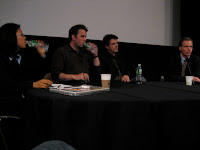
the first day ended with the second plenary,
collaboration and collective intelligence (
mp3), featuring
mimi ito,
cory ondrejka, and
trebor scholz. all three speakers were excellent. trebor's talk offered a very articulate and very necessary critical edge, raising issues like - gasp! - labor and capital and consumerism and corporations. trebor stopped short of critiquing consumer capitalism, which seemed odd, but it was nice to get concepts of commodification on the table. great plenary.
the next day, saturday, featured the best panel of the conference. titled "technological translations and digital dilemmas," the panel featured
kimberly christen,
kate hennessy,
nariyo kono,
patrick moore, and
katerina martina teaiwa. katerina offered the conference's most interesting example of appropriation: the twenty million tons of phosphate mined from the two and a half square mile island of banaba/ocean island in kiribati to fertilize all of australia and new zealand. the island is now a shell, a skeleton. katerina connected appropriation to empire, to colonialization, to global economies, to race, to land, to oppression, to dance - a powerful presentation. katerina described her work as "an ethnography of the land." kim christen's talk totally rocked. she introduced the
warumungu community digital archive project, a collaboration with warumungu community members and the
nyinkka nyunyu art and culture centre in tennant creek, australia. kim described the project as a sort of virtual repatriation - curating an online archive of digital representations of original artifacts. the interesting part is that many of these objects - drums, maps, images, songs - can only be seen by certain people. permissions to observe are based on various factors including affiliation, age, gender, dreamings, and ritual status. in other words, instead of building an open access archive, they need to build a multi-tiered access archive. they need to design and build a
mukurta - "a safe keeping place" - a place that abides by the complex permissions system of the warumungu people. suddenly,
open access = good no longer looks so universal, eh? the only problem with this panel was that it wasn't long enough. plus, it should have been a plenary rather than one of many concurrent panels so that all conference attendees could have been part of it.
bright and early sunday morning was our panel, culture 2.0, featuring
mary madden,
chuck tyron,
trav scott, and myself. (axel bruns, who i finally met face to face, provides
an excellent summary of what was covered.) it was nice to see a full room:


the last plenary,
summary perspectives (
mp3), featured
suzanne de castell,
fred turner,
siva vaidhyanathan, and
josé van dijck. the plenary was designed to assess the conference and to begin thinking about future directions. suzanne highlighted kimberly christen and katerina martina teaiwa's presentations and noted - so elegantly, so generously - that "If we don't want a literal and superficial and enduringly oppressive epistemology of remix and remediation, we need to go to the borders, limits, and edges to ideas whose deep roots challenge us to hold firm to our contexts and communities. We need these challenges from the borders and margins so an agenda of radical inclusion is in my view the most generative agenda for the future" (transcribed by
kim). josé riffed off the term generation c (creativity, collectivity, collaboration) and suggested we add a few more c's like capitalism, commodification, consumerism, and control. yes! josé's brief comments were stellar. fred turner highlighted three conference trajectories - collective authorship, struggles over copyright, and educational change - and suggested we spend more time on four other trajectories: corporate-consumer transformations, militarization, an increased complexity of political life, and race. siva added five things he said we - as a conference, as an intellectual community - are finally learning to do well: asking questions about how culture is regulated, asking deep historical questions, on the verge of asking important questions about political economy, formulating new models for searching and indexing information, and expressing deep concerns about norms and ethics. all four speakers were absolutely excellent.

the floor was then opened and audience members were encouraged to share our thoughts on the conference. i gathered my courage and stepped to the mic. i thanked the panelists for an excellent plenary and made three suggestions: 1) the media we study is coversational yet our conferences are anything but. we need to rethink the old ways academic conferences are designed: less lectures, more conversation; 2)
more librarians (me: "academics hoard knowledge; librarians share knowledge"); and 3) we are spending too much time online. we need to learn to log off. (jean burgess nicely covered and fairly critiqued my suggestions, especially regarding twitter, on
her own blog.) we need to develop non neo-luddite critiques of new media.
what a privilege it is to travel across the country to be a part of a conference like this. what fun it is to see old friends and meet new ones. and what a delight it is to catch up with people who used to be my students and now are my friends and colleagues.
but each night, as i walked along the charles river from campus to my hotel, some of the fun and delight wore off. while the worlds in our (privileged) screens may be alive with possibility, the world we walk upon continues to crumble. at times, at MiT5, it was as if there were no wars, no maniacal administrations running/ruining the world, no poverty, no global warming. at times, at MiT5, it was if there was no world - real or imagined - outside of capitalism, no visions outside of consumption. at times, at MiT5, monumentally important issues like race, gender, and class were almost entirely left off the table. at times, for me, this conference felt too damn giddy.
to paraphrase siva who in turn was paraphrasing
danah boyd, we need to wisen up and realize it is less about technology and more about what people do collectively with the technology. let's hope that when we reach that point we'll be smart enough to do things collectively that have nothing to do with war and shopping.