Sunday, February 25, 2007

arthur magazine folds

arthur, america's best and boldest magazine, folded on friday.

arthur launched in 2002 under the fearless leadership of jay babcock (one of my best friends from college). the concept was - and is - novel: long feature articles about art, culture, and politics written by some of today's best writers. oh, and the magazine was free.

back in 2003, as america crept towards war and americans kept silent, arthur published "arthur against empire," a loud and bombastic and fearless fuck you to the forces of war. as americans tuned out, arthur turned on, featuring articles about smoking pot, about shamanism, about transcendence. as americans spent more and more of their time logged on, arthur suggested logging off, and featured some of doug rushkoff's best work about technology and stepping away from it.

arthur told us about devendra banhart years ago, when most of us were like, "devandra what?" arthur put brightblack morning light on the cover followed by joanna newsom. arthur featured a 12,000 word essay (12,000!) by alan moore (v for vendetta, the watchmen) on 25,000 years of pornography. arthur featured articles about how to ciphon gas from SUVs, about the powers of almonds and sprigs of mint, and about how a significant portion of NBA players play stoned. arthur featured a hilarious and horrifying interview between jay and the lead singer of godsmack about the band's music being used for army recruitment.


arthur challenged almost everything horrific about our times - the war, the war machine, a violent everyday culture, capitalism run amok, the corporatization of everything, mass produced culture and mass produced imaginations, and the utter lack of curiosity that plagues our country. when faced with the horror of our times, arthur was something you could actually believe in. and did i mention it was free?

if you're in LA, consider attending arthur's wake. free giveaways and readings by molly frances, oliver hall, and peter relic. the wake goes down thursday, march 1, at 7:30, and takes place at the family bookstore at 436 n. fairfax ave (across the street from canter's deli).

in my world, the word visionary is used too often. these days, any kid running a dot.com that sells out to google for a bazillion dollars is called a visionary. but visionaries, true visionaries, have something to give, something that is deep and wonderful and scary and enlightening. true visionaries give us something that make us better people - a rare and special something that makes us more sensitive, wise, curious, and engaged. jay's a visionary and i'll be eager to see what kinds of visions he works on next. but in the meantime, it sure is sad to see this one fold.

update: for a taste of the inside scoop, check out the village voice's coverage.

Wednesday, February 21, 2007

the heart of campus is its library

digital journalism continues to grow and the students continue to impress me. things feel significantly ramped up - we have a group blog, students are blogging independently, and students (and others!) are leaving interesting comments here and there. and today one student, eva, asked if she and others can blog about stuff i didn't assign. my answer, in two simple words, was: hell yes!

our domain is USF campus. so ... imagine a google map of a college campus spread over a few blocks in the middle of san francisco. now imagine pins stuck on various campus buildings, green areas, residence halls, recreational facilities, and spaces for reflection. finally, imagine each of these pins being clickable so that users are hyperlinked to student designed and written blog posts, flickr sets, and video about particular portions of campus.

can't imagine it? well, i can. but, much more importantly - i think my students can imagine it. for the most part, i am impressed with my students' ability to keep up with weekly readings, lesson plans, and new media tasks while simultaneously being able to think about the bigger picture, the bigger vision, of the course. i suspect that my students understand that once we learn some basic tools we can create cool stuff. now if only they would stop arriving late to class ...

we began with the heart of campus - gleeson library. fortunately for us, gleeson library currently features an outstanding exhibit on graphic novels curated by USF librarians kathy woo and debbie benrubi. as a class, we visited the library, took pictures with our digital cameras and cellphones, and interviewed librarians involved in the exhibit. (students enrolled in digital journalism have already taken journalism 1, either with teresa moore or michael robertson, so they already have basic reporting, interviewing, and writing skills.) finally, before leaving they were required to select at least one graphic novel and check it out from the library.

the assignment that followed was simple: blog about the exhibit in gleeson library. i asked my students to cover a particular angle of the exhibit, to make their blog posts fascinating, and to include at least one image, one hyperlink, and a bunch of tags. finally, i asked them to integrate - somehow, someway - their graphic novel into their blog posts.

true journalists, my students posted their blog entries minutes before deadline. we spent today talking about and critiquing each others' blog posts. my students are nice and polite and directed most of their time towards what they liked, not disliked, about their fellow students' blog posts. but when critiques did arise students were really receptive and took them in.

the semester is still young but so far i remain impressed.

Tuesday, February 20, 2007

usf event: wise fool community arts showcase and discussion

members of wise fool community arts create and use giant, beautiful puppets for community celebrations and protests. there's nothing quite like being part of a march or demonstration and finding yourself next to people and puppets like this:


next week, members of wise fools community arts, based in berkeley, will be on campus discussing and sharing how they use art and theater as vehicles for community building, self-determination, and social and political change. the event is the first of three in the "'we must be the change': a performance and social justice speaker series," organized by eve shapiro, that brings local political art and performance groups to the USF campus during spring 2007.

just the facts:

date: monday, february 26, 12:15-2:15pm
location: mclaren 252
cost: free of charge and open to all!

"we must be the change" is co-sponsored by the davies forum, gender and sexuality studies, latin american studies, the mccarthy center, media studies, performance and social justice, politics, sociology, and visual arts.

Sunday, February 18, 2007

what is feevy?

i've been thinking and playing with feevy for the last few days and am trying to answer what should be an easy question: what is feevy?

1. blogroll: at the most simple level, feevy replaces the blogroll. feevy is a list, a public list, of some of the blogs i read.

2. RSS reader: feevy serves as a RSS reader. (what's RSS? read lee lefever's "RSS in plain english.") since i've had feevy, i have stopped using bloglines.

3. visiting voices: so much of blogging is narcissistic - here are my daily observations! here, via flickr, are my daily photos! here, via last.fm, are my favorite songs! here, via library thing, are the books i read! through feevy, other bloggers, their words, and their pictures become part of my blog. to a certain extent, the me! me! evolves, a little, to me! me! we! we! we! and that's cool. i really like how, with feevy's help, a significant portion of the words on this page are written by people who are not me.

4. blog portal: feevy is not exactly a blog portal but it makes creating blog portals very, very easy. david has been pointing many bloggers to one example - parlamentarios.info - a portal of spanish representatives who have blogs. excellent! someone interested in the US 08 presidential race should create some similar blog roll with democratic candidates on the left and republican candidates on the right - and with easy scalability to allow for alternatives to the two party machine. with about an hour of work, you would have an easy way to track blog posts from 2008 US prez blogs.

there's more. there's much more deeper considerations like the way feevy changes blog reading. it's one thing to read blogs from bookmarks, it's another thing to read blogs via RSS. well, it's yet another thing to read blogs via feevy. there's deeper considerations like the way feevy changes our tracking of blog visitors. anyone who has used feevy plus some kind of tracker like statcounter knows exactly what i am talking about. and then there's deeper cultural considerations like the fact that feevy was developed not in silicon valley but in spain and that its original base community is spanish speaking.

but it's a long weekend and i'm in santa cruz so family and fun calls.

Thursday, February 15, 2007

usfblogtastic

usfblogtastic, our blog for digital journalism, is up and running. this semester, i learned from barbara ganley and delayed the launch of the course blog so we could spend the first few weeks getting to know one another. now, as week four comes to an end, my students are uploading, blogging, tagging, and commenting. i expect great things to come from this.

usf event: media studies colloquium featuring andrew goodwin

dissertation fellow john kim continues to organize our excellent media studies colloquium and the spring line-up looks awesome.

andrew goodwin, professor of media studies and author of dancing in the distraction factory, is up first and will be reading passages from his recent novel. (curious? check out his recent short story, "the afternoon of the living dead.") here's the facts:

who? Andrew Goodwin, Department of Media Studies

what? "Let Me Take You On A Trip: On Trying To Write Fiction (Whilst Not Jumping The Shark) In The Era Of Postmodern Media

say what? A reading of passages from Andrew's recent novel and a
Q&A with the author

where and when? February 21, 2007, 4:30 - 6:00 pm, UC 419

the media studies colloquium runs through spring and also includes the following talks and screenings:

March 6, 2007, 4:15 - 5:45 pm, UC 419
Bill Brown, Filmmaker and USF Department of Media Studies
"The Next Best Place: Road Movies with Bill Brown"

March 21, 2007, 4 - 6 pm, Maraschi Room, Fromm Hall
Eric Byler, Director of Charlotte Sometimes and Americanese
"Asian Pacific Americans in 2006-2008: Art, Media Representation, and Social Responsibility"
(Co-sponsored by Asian American Studies and the San Francisco International Asian American Film Festival 2007)

stay tuned here.

Wednesday, February 14, 2007

congratulations kelly quinn

this fall, kelly quinn becomes assistant professor of american studies at miami university. of all the professors i know, and i know a lot, kelly quinn's the best. congratulations miami university. congratulations q dawg.

Tuesday, February 13, 2007

gone

feevy - a free blogging tool from spain

feevy is a new and free blog tool developed by david de ugarte and the sociedad de las indias electrónicas. feevy replaces boring, static blogrolls with more personalized, dynamic blog bits. by incorporating RSS, feevy feeds the right column of my blog with fresh content from bloggers i read. plus, it's extremely easy to use. sweet.

i imagine feevy can be used quite easily to set up some kind of blog portal. for example, with a relatively small university like USF (around 8,000 students), it would be interesting to try to aggregate all USF student, faculty, and staff bloggers and, using feevy, make a one-stop page for quick and easy USF blog reading.

one night in 2003, in prague, david shared with me his many, many theories, experiments, and actions in contemporary activism and cyberactivism. the metaphor he returned to over and over again was ivy. ivy, david said, has shallow but distributed roots, stays close to the ground, and grows quickly and collectively. plus, he said, it's really difficult to get rid of. feevy, i believe, stands for feed the ivy. nice.

Thursday, February 08, 2007

usf journalism blog

way back in august, 2005, my media studies colleague and fellow blogger, michael robertson, launched the USF journalism blog where, according to the blog, “USF faculty, students and graduates are invited to talk about journalism and its problems and opportunities.” more than two years later, the blog is thriving and growing in interesting directions.

what is it?

first and foremost, the blog serves as a virtual space where any USF student, past student, or faculty member can post ideas, essays, and images about journalism. second, the blog collects and aggregates various journalism and new media course offerings from the department of media studies. third, the blog keeps track of USF media studies graduates - the left column of the blog includes nearly three dozen students and links to where they are currently working. fourth, michael encourages USF graduates to post any advice they have for current students and any jobs their company may have available. in this way, the blog serves as a job/internship board for and by USF journalism students.

in other words, what michael has done with the USF journalism blog is to encourage students and faculty to discuss the future of journalism and to be a part of that future. what i really like about the blog, though, is this: michael has created an online community that includes both current and past USF students. in essence, the blog is an online learning community with students teaching students - not to mention students teaching their professors, too.

too often, college students graduate and leave - physically and intellectually - their campus. the USF journalism blog is an effective vehicle that allows past students to converge with current students. the former students become teachers and mentor all of us about what today and tomorrow's journalism looks like, about what kinds of skills are required, and about what kinds of tools and skills students should learn today to be an effective journalist tomorrow.

through interactions on the blog our current students have tapped our past students in order to land jobs and internships. more importantly, though, the blog has helped foster a learning community, one that gets smarter and more interesting the larger it gets.

Tuesday, February 06, 2007

davies forum: gender, sexuality and media: representations and realities

the davies forum is a unique opportunity for USF students and faculty. the davies forum consists of an undergraduate class that focuses on values in public life taught by the davies professor and filled with USF students chosen as davies scholars. the forum also includes guest lectures by leaders in a particular field; the guest lectures are open, i believe, to the whole USF community.

the davies forum for spring 2007 is titled "gender, sexuality and media: representations and realities." it is taught by bernadette barker-plummer, a professor in media studies and the director of the gender and sexualities studies minor.

the lineup is impressive and the diversity of the topic is evident in the long list of co-sponsoring departments and units, including gender and sexualities studies, global women's rights forum, latin american studies, mccarthy center, media studies, performance and social justice, politics, psychology, sociology, and visual arts. bernadette is also collaborating with eve shapiro, in sociology, and eve's terrific series titled "we must be the change: a performance and social justice speaker series." i'm especially intrigued by the combination of academics, artists, and activists as forum speakers.

here's the plan:
    Tuesday, February 27, 1:30-3:30 pm, LM 365
    Straight Eye for the Queer Guy: Reality Television, Shopping, and the New Gay Visibility.
    Josh Gamson - Sociology, University of San Francisco

    Tuesday, March 6, 1:30-4:15 pm, LM 365
    New Gay Visibility on Television: Business or Politics?
    Katherine Sender - Annenberg School for Communication, University of Pennsylvania

    Monday, March 19, 6:30-9:00 pm, HRN 232
    Performing Gender
    Sean Dorsey and Shawna Virago, Fresh Meat Productions

    Monday, April 2, 6:30-8:30 pm, Maraschi Room, Fromm Hall
    Animating Revolt/Revolting Animation: Penguin Love, Doll Sex and the Spectacle of the Queer Non-Human
    Judith Halberstam – English, University of Southern California

    Tuesday, April 10, 1:30-4:15 pm, LM 365
    Bitch Magazine: Feminist Response to Pop Culture
    Andi Zeisler (Founder) and Rachel Fudge (Editor) of Bitch Magazine

    Monday, April 16, 6:30-9:00 pm, HRN 232
    (H)Errata, Woman, Art and Revolution
    Lynn Hershman - Feminist film maker/new media artist

    Monday April 23, 6:30-9:00 pm, HRN 232
    SheWrite: A Documentary Screening and Discussion with the Directors
    Anjali Monteiro and K.P. Jayasankar - Center for Media and Cultural Studies, Tata Institute of Social Sciences, Mumbai, India

    Tuesday April 24, 2:00-4:00 p.m., LM 365
    Arts and Activism
    Valentin Aguirre – San Francisco LGBT activist and video maker
very cool. more info at http://artsci.usfca.edu/daviesforum

Monday, February 05, 2007

digital journalism - flickr project

after handing out project one today, i told my students that if they follow the directions it will be the easiest 10% of a course grade they've ever earned. then i reminded them that the main learning goal with this project is to learn how to learn new tools quickly. so far, the students have been pretty fearless - online and especially offline - so i'm eager to see what they create. i am also curious to see if they understand tagging and the potential of tagging. here's project one:

flickr project: Telling Stories through Images

For this project, you will be using flickr to design and share a story related to the physical campus of USF. Using a combination of pictures and words, tell a story about our campus. When reflecting upon a topic, take your time and choose one that is interesting. At the same time, keep in mind this project is due in two days.

Requirements:
o Read Lee Rainie’s “28% of Online Americans Have Used the Internet to Tag Content.”
o Take smart pictures. Take a lot of pictures so you have a large set from which to select your favorites. Select between 5-10 digital photographs of some aspect or aspects of USF campus and upload them to your flickr account.
o Make a flickr set. Be sure to title your set.
o Include a title, a description, and at least one tag on each of your images for this project. Keep in mind the article about tagging; select smart tags.

Goals:
o To learn some early basics of flickr and visual storytelling.
o To learn about tagging in general and tagging images in particular.
o To learn how to learn new tools quickly and independently.

Due:
Your flickr set is due by the time class beings on Wednesday, February 7. No late work accepted. This assignment is worth 10% of your grade.

Thursday, February 01, 2007

new reviews in cyberculture studies (february 2007)

[via RCCS] a new set of book reviews for february 2007:

Information Politics on the Web

Author: Richard Rogers
MIT Press, 2004
Review 1: Adrienne Massanari

Play Between Worlds: Exploring Online Game Culture
Author: T. L. Taylor
MIT Press, 2006
Review 1: Mark Chen
Author response: T.L. Taylor

Soft Cinema: Navigating the Database
Authors: Lev Manovich & Andreas Kratky
MIT Press, 2005
Review 1: Tico Romao
Author response: Lev Manovich

The Cinema Effect
Author: Sean Cubitt
MIT Press, 2005
Review 1: Anxo Cereijo Roibas
Author response: Sean Cubitt

there's lots more where that came from. enjoy.

Wednesday, January 31, 2007

occupying campus to encourage students to become soldiers

today, USF's ROTC was in full-force on campus. their presence included a climbing mountain, a tricked out hummer, and a table of free stuff like ROTC water bottles, pens, and pins. the theme of the campus spectacle was ... fun!

strapping on a harness and climbing up simulated mountains? fun!


spray-painted hummers (which we began to see in black neighborhoods in 2003)? fun!


a hummer with a booming bass and filled with sports video games? fun!

Sunday, January 28, 2007

harvard comes to san francisco

yesterday, harvard came to san francisco in the form of a mobile identity workshop - an unconference organized by the berkman center and held at CNet headquarters. the workshop's host was doc searls. i attended the morning sessions and the evening reception.

the topic of the workshop was user-centric identity within mobile spaces. in a nutshell, as digitial environments become more common in our everyday lives, we create more and more digital identities - our credit identities, our consumer identities, our civic identities, our alternative identities - to help us navigate through such environments. workshop questions included is it possible to have a single digital identity to save time? is it advantageous? who creates those identities? who manages them and who mines them? who controls the identities? and who controls access to those identities' information trails?

the unique mode of the unconference - or open space technology - allows participants to actually meet other participants. i met stacy bond, of audioluxe, who is also teaching audio production (including podcasting) this semester for media studies. i met leslie rule, of KQED's digital storytelling initiative, who also is involved in a cool sounding digital storytelling undergraduate class at sf state. i remet brad fitzpatrick, creator of livejournal, who also took an independent study with me years ago when he was an undergraduate studying computer science at UW. and best of all i saw beth kolko - professor, colleague, and one of my favorite humans i know - who told me about the mobile indentity workshop in the first place.

the workshop was far from perfect. for me, too often participants referred to users as consumers rather than citizens. was this a business workshop or an activist workshop? the makeup of the participants, like so many other technology-related events i've attended, was embarassingly male and embarassingly white. i can't imagine how it must have felt to be a female in an 80-90% male-filled room - when will this nonsense stop? and, at times, there seemed to be too much talking and not enough listening.

that said, i thoroughly enjoyed the event. doc kepts us on pace, folks shared ideas with respect and curiosity, and there was no shortage of smart minds in the room. i am a convert of the unconference format and believe academic conferences should implement similar modes of interaction immediately. and i think it was smart of the berkman center to take their show on the road and come to the bay area where mobile identities and other forms of digital culture seem to be invented and reinvented on a monthly basis.

i had plans that afternoon so i was unable to attend the later sessions but i gladly returned downtown for the evening reception. free drinks! smart people! free food! more free drinks! ordinarily, these kinds of schmooze and booze things aren't my thing; i usually take my partying elsewhere, away from fancy hotels that serve rich people. but this was different. the berkman center has brought together some really smart people, both as staff and fellows, smart people who also build remarkable things like creative commons, global voices, and the center for citizen media. plus, during the reception i got to meet the insanely smart seth young.

at some point during the unconference, beth introduced me to colin maclay, managing director of the berkman center, who told me about beyond broadcast: from participatory culture to participatory democracy. this. looks. wicked. cool. a collaboration between academic units from MIT, harvard, and yale, the conference will feature a keynote from henry jenkins and panel discussions from media makers and policy commentators. the second half, it appears, follows a more unconference mode and will include working groups that attendees will help organize. beyond broadcast takes place at MIT on feb 24. it costs fifty bucks to register, but that includes lunch and an evening reception. with a little luck i'll be there.

Thursday, January 25, 2007

dot.mil

from brock read at the wired campus, i learned that the cia now has a facebook group (registration required).

here's what it looks like today:


it currently has 2,949 facebook members. it has sponsored ads on the right that hyperlink facebookers directly to the cia's careers page. and it has a share button which allows users to post the group on their profiles or send it to their facebook friends.

the cia's facebook features this embedded youtube video (27 seconds). if you watch the whole thing, all the way to the last few frames, you'll see this woman:


who's she?

the cia needs to parse their content better.

Tuesday, January 23, 2007

Monday, January 22, 2007

USFtv

last year, a few USF students thought it would be interesting to have a campus tv station. they brainstormed a plan, brought it to melinda stone, and USFtv was born. this year, because melinda is on sabbatical, kate haug and i are USFtv's faculty co-advisors.

USFtv is a campus-wide cablecast created by and for USF students. USFtv produces around five cablecasts a semester. cablecasts are between one and two hours and include student films and videos, USF news, interviews with bay area residents, artists, musicians, and media makers, documentaries about USF social justice organizations, and other assorted media goodies. USFtv is an opportunity for USF students to work in teams to make engaged, provocative, and creative media - and distribute it across campus. working with USFtv has been one of the highlights of my first year here at USF.

working with kate is great. she's a filmmaker, a screenwriter, an author, and an academic, so she offers all kinds of perspectives to the students. plus, this year, she's the department's film studies minor coordinator which means she knows more about the filmic skills of our current students than anyone. in addition to providing advice and support, our main contribution is watching the cablecasts and offering feedback prior to their distribution. the process is time-consuming (our feedback often runs three to four single-spaced pages) but when the cablecasts improve each time we know our feedback is being heard which makes the process well worth it.

the best part is watching the students grow USFtv. they designed it all - content, format, distribution, branding, outreach, fundraising - and so far it more or less works. with each episode, USF news gets better, more diverse, and more interesting. the student films are getting edgier and finally we're starting to see some weird stuff. the production is getting slicker (USFtv has an excellent team of editors). now, at mid-year, the key is to not get lazy. spring semester is not for relaxation. it is for creation.

last thursday and friday, the core team of USFtv organized a retreat. i was there for most of friday and it was extremely productive. the students hammered out a production schedule for the entire semester, discussed their collaboration with baykids, and brainstormed identity issues. we spent a lot of time talking about the web, which was pure fun for me. we talked about blogs, we talked about flickr, we talked about youtube. jessica dragotto is taking a directed study with me in spring to launch the USFtv web site. (i'll link to that when it happens.)

judging from the retreat, the students this semester are much more organized, much more focused. they know what it takes to make one hour of good content every two to three weeks. they know how to work in teams - camera person, sound person, interviewer, editor - an invaluable skill in today's media world. and they are beginning to know that it's not about a good show or a bad show - it's about your newest show being better than your last show which was better than the one before. i'm excited for what spring will bring.

Sunday, January 21, 2007

this is so cool; this is so sad

via david weinberger, i learned about the very interesting "goodbye gutenberg" - volume 60, number 4 of nieman reports. from the introduction: "Journalism is on a fast-paced, transformative journey, its destination still unknown. That the Web and other media technologies are affecting mightily the practice of journalism is beyond dispute. Less clear is any shared vision of what the future holds. Newsrooms are being hollowed out, and editors who resist such cutbacks are losing their jobs. Digital video cameras and tape recorders replace reporters' notebooks as newspapers—and other news organizations—train staff in multimedia storytelling. In this issue, words about journalists' experiences in the digital era transport our vision forward, while our eye takes us on a visual voyage back to a time when newspapers wove communities together." all online. all for free.

"goodbye gutenberg" will be the last thing we read in digital journalism. later in the semester, after assessing the students' individual and collective interests, i'll assign various portions of the report to different students. then, in class, we'll share what we learned. while typing "goodbye gutenberg" into my word-based syllabus, i realized that this was the most up-to-date reading i've ever assigned in an undergraduate class. very cool.

via jessamyn, i learned that all fifteen branches of jackson county (oregon) library system are closing in early april. imagine that: an entire county-wide library system closing. imagine that: an entire county without a library. imagine that: jackson county citizens have to go to another county to get free and public knowledge and resources. and imagine that: a new generation of children who will not have the experience of going to a public library.

jackson county library system has set up a blog, which is so sad to read. no doubt decisions like this are complex and involve many factors including city and county politics, city and county taxes, city and county initiatives, state taxes, state funding, federal taxes, federal funding, etc etc etc. but it is hard not to view closings like this as signs of the times for a country that cuts taxes on the rich, cuts social services for the people, and increases, by billions, our continued military slaughter. unless we change fast, closed libraries - not to mention closed schools - is our future. very sad.

Friday, January 19, 2007

spring semester around the corner

spring semester begins on monday and i'll be teaching two classes: digital journalism and media internship. i hope to blog about both courses throughout spring semester. i spent a lot of winter break thinking, brainstorming, and reading books and blogs about digital journalism and the syllabus is nearly finished!

students enrolled in digital journalism can expect to learn about web-based tools for gathering and assessing news and stories (like blogs, RSS, and wikis). students can also expect to learn about web-based tools for creating and distributing news and stories (like blogs, flickr, facebook, and youtube).

we'll be reading two books (plus a packet with all kinds of goodies). the first is dan gillmor's we the media: grassroots journalism by the people, for the people (o'reilly media, 2006; but also here for free). the second is kevin howley's community media: people, places, and communication technologies (cambridge university press, 2005).

at this point, the class has seven students, the perfect number, i think, for a group blog. one of my teaching goals this semester is to learn more about how to encourage students to both blog and comment on fellow students' blogs. i know i can assign this, but i'm hoping it will happen organically instead. i want them to post because they want to, not because they have to.

students will be required to learn - in class, out of class, alone, and in groups - many web-based tools including atlas, blogs, facebook, flickr, RSS, wikipedia, and youtube. some of these tools i know well; some less so; some none. i hope it will be a real each one, teach one learning environment.

i'm excited about using atlas and spent a portion of yesterday taking pictures of campus so that i could test the new atlas feature ... multiple pin colors! in the map below, red pins represent photographs of USF buildings (and a bench); green pins signify green spaces. (please note: last night, when i put together the map, the images and hyperlinks were working; this morning, strangely, everything is broken; i'll fix later.)


one of the many things i like about working with digital maps is the ease of scaling. i like, for example, how you can mouseclick the "-" button (on the left side of the map) to get a view of USF campus, the panhandle, golden gate park, the city, the bay area, etc. i like how you can continue to click to see california, the west coast, north america, earth. the very process is, i believe, pedagogical; it teaches.

i hope other classes with other students will map other campuses. on tuesday, i drove down to palo alto to meet with my friends and stanford university librarians, shinjoung yeo and james jacobs (of, among many things, freegovinfo.info and radical reference), and howard rheingold, who, in addition to being author of this and this and this, is also teaching digital journalism this year at stanford. i hope we'll do something jointly in the near future. i think it would be great to have teams of students from all over san francisco and the bay area annotating their campuses, their neighborhoods, their city.

but first things first - i still need to finish my syllabus.

Thursday, January 18, 2007

and then there were six

late, late last night, in a hospital in new york city, my sister lisa and her husband jean had twins boys - august gordon and prosper luc.

three sisters with two boys each equals six nephews.

congratulations and mazel tov lisa and jean.

august and prosper - may this thing called life constantly amaze you.

Monday, January 15, 2007

going it alone

david horsey has it right.

the democrats should propose a reduction of 21,500 US troops in iraq. if after one month, less human beings are killed in iraq than the month before, we should reduce our troops by another 21,500 the following month, and then another 21,500 the month after that, and the one after that, until the united states military is completely out of iraq.

Saturday, January 13, 2007

panel = accepted

mary madden (pew internet & american life project), d. travers scott (communication, university of southern california), chuck tryon (film and media studies, fayetteville state university), and my panel proposal for MIT's media in transition conference got accepted.

sweet!

here's our proposal:

Digital technologies that engage media creators through social networks of distribution and collaboration suggest a state of cultural production often referred to as "2.0." The term implies improvement and progress, but also indicates a revision of the past; it simultaneously hints at a prior paradigm (1.0) and brings attention to a new one (2.0).

By examining three areas of contemporary cultural production - music 2.0, movies 2.0, and military culture 2.0 - we draw attention to the historical and technological precedents that were necessary for 2.0 applications to take hold in each of our spheres.

In music culture, patterns of socially-driven music sharing - pre-internet and post-internet - have incubated online communities of content creators and influenced a wide range of Web 2.0 activities. In movie culture, independent producers navigate new channels of distribution and promotion by adapting techniques that borrow from the DIY music community and earlier modes of cinematic production. In U.S. military culture, various agencies have begun experimenting with open access to games, video sharing, and wikis despite a legacy of strict institutional control. However, a loose network of technologists challenge the newness of the Web 2.0 phenomenon, and critique the concept as just another iteration of inflated techno-hype.


excellent news to bring an altogether excellent day to an end.


tomorrow morning, i leave washington dc and head back home. it's been a great trip but it will be nice to return. i miss sarah.

Friday, January 12, 2007

a meeting in washington dc

it's hard work keeping up with any field and it seems even harder when the field is new and emerging like the internet. and yet, somehow, the pew internet and american life project has done it - and they've been doing it now for seven years.

today i'm in washington dc - as part of an advisory board meeting for the pew internet and american life project. on a personal level, it's always fun returning to dc, the city i lived in for my last two years of grad school. on a professional level, it's a privilege to be in the same room with so many smart minds - smart minds who contributed to my decision to study digital culture in the first place and smart minds who contribute to my current understandings of what digital culture has become today.

i was excited to hear about future pew reports that examine latino/a use of the internet and the ways in which americans used the net during the 2006 election. i was excited to hear about future pew reports on information ecologies and how americans use the net to search themselves and others. and i was excited to hear that there will be additional reports regarding teens and technology.

the best part for me was when we all went around the room and shared what we thought was new, cutting edge, and important in terms of the internet and american life. being in a room with smart people talking about the future is exciting but it can also be a bit overwhelming - within an hour, we generated enough questions for a few dozen dissertations. but the best part was watching members of the project team. far from being overwhelmed, they seemed ready for more.

for years i've been excited by the work generated by the pew internet and american life project. after today, i'm excited about the work they'll generate tomorrow.

Saturday, January 06, 2007

duboce park, atlas, and digital journalism

from two great posts over at innovation in college media, i learned about atlas. created by journalists and web developers at faneuil media, atlas is a free web-based mapping tool that is incredibly easy to use. with atlas, you can create a map and annotate it with text, images, and links. similar to youtube, you can easily embed atlas maps into blog posts.

i have been playing with atlas for the last few days and am happy with how easy it is to use. this afternoon i used atlas to create this map of the nice walk i took this morning in nearby duboce park.


as i play more and more with atlas, i begin to think of all kinds of public art, public history, and public engagement applications. i think of how someone like my friend kelly quinn could and would use something like this. but for now, staying as disciplined as i can be during winter break, i'm brainstorming ways that we'll use atlas in my spring semester course - digital journalism.

Wednesday, January 03, 2007

USF president stephen privett to deliver invocation at tomorrow's swearing in of US speaker of the house nancy pelosi

i just learned that the university of san francisco's president, rev. stephen a. privett, s.j., has been invited by speaker-elect nancy pelosi to deliver an invocation prior to her being sworn in as US speaker of the house.

via the USF press release:
    Colleagues,

    USF's President, Rev. Stephen A. Privett, S.J., has been invited by Speaker-elect Nancy Pelosi to deliver an invocation just before she is sworn in as Speaker of the House. On Thursday, January 4, 2007, Father Privett will offer the opening prayer on the floor of the House in Washington D.C., at 12:00 noon Eastern time.

    In addition, Anne-Marie Devine sent me the following message this morning. Ann-Marie recently joined us as Assistant Director of Media Relations.

    Leading up to the ceremony, Fr. Privett will appear on KTVU's (Fox 2) morning news program during a five-minute live interview with Ross McGowen at 7:15am pacific time. Fr. Privett will discuss the theme of his invocation and the honor of being part of this momentous event.

    This is a great honor for our President and for the University. Upon his return, we shall encourage him to post the text of his prayer on his web-page.

    Dave Macmillan
what an honor and an opportunity.

i've seen father privett speak numerous times and each time he engages people in issues that matter. he focuses - and encourages us to focus - on social justice, human rights, and the need for dramatic change. father privett's delivering the invocation is certainly an honor for the university of san francisco. but more importantly, it gives voice, however temporary, to social justice, human rights, and dramatic change - three things desperately needed in washington, dc.

Monday, January 01, 2007

this week should get interesting

bbc news is reporting that bush will give a speech this week to announce a new strategy for his war in iraq. bush's new strategy is, by most accounts, a massive increase in US troops in iraq.

will karl rove position bush as the decider?


will rove use background graphics?


how will karl dress the president?


i hope republican senator chuck hagel's reaction to the troop increase will carry the day: "It's Alice in Wonderland. I'm absolutely opposed to sending any more troops to Iraq. It is folly."

an experiment to embed an atlas map

Sunday, December 31, 2006

new reviews in cyberculture studies (january 2007)

[via RCCS] a new set of book reviews for january 2007:
  1. From 9/11 to Terror War: The Dangers of the Bush Legacy
    Author: Douglas Kellner
    Publisher: Rowman & Littlefield Publishers, 2003
    Review 1: Robert Tynes

  2. Media Access: Social and Psychological Dimensions of New Technology Use
    Editors: Erik Bucy & John Newhagen
    Publisher: Lawrence Erlbaum Associates, 2004
    Review 1: Cheryl Brown
    Editors response: Erik Bucy & John Newhagen

  3. Media Debates: Great Issues for the Digital Age
    Editors: Everett E. Dennis & John C. Merrill
    Publisher: Thomson Wadsworth, 2006
    Review 1: Tim Dwyer

  4. No Safety in Numbers: How the Computer Quantified Everything and Made People Risk Aversive
    Author: Henry J. Perkinson
    Publisher: Hampton Press Inc, 1996
    Review 1: Robert Whitbred
coming very soon:
    Sean Cubitt, The Cinema Effect

    Christina Garsten & Helena Wulff, New Technologies at Work: People, Screens and Social Virtuality

    Andreas Kitzmann, Saved from Oblivion: Documenting the Daily from Diaries to Web Cams

    Lev Manovich & Andreas Kratky, Soft Cinema: Navigating the Database

    Bradley Quinn, Techno Fashion

    Richard Rogers, Information Politics on the Web

    T. L. Taylor, Play Between Worlds: Exploring Online Game Culture

    Joseph Turow & Andrea Kavanaugh, The Wired Homestead: A Sourcebook on the Internet and the Family
also coming very soon: a massive list of new and exciting books looking for reviewers. stay tuned.

Friday, December 29, 2006

happy birthday sarah!

looking for some bob dylan

yesterday, sarah's parents and i drove over to st. paul to see the minnesota historical society. the place was packed, with little kids all over the place. the crowds were there, we were told, to see "baseball as america," a travelling exhibition of over 500 artifacts from the baseball hall of fame cooperstown.

but i wasn't there for baseball. i was looking for some bob dylan.

dylan's from minnesota - from hibbing to be more precise. in 1960, a nineteen year old dylan left hibbing for minneapolis, where he enrolled at the university of minnesota but, um, never had much time for classes. instead, he hung out in the cafes in dinkytown, learned and played folk music, and eventually got hold of some records by woody guthrie. shortly thereafter, he set out for new york city. although dylan spent much of his career trying to escape his minnesotan roots, he seemed to return to the north country - physically and musically - over and over again.

before coming to minnesota, sarah did some online research and found me some dylan at the minnesota historical society's library. i filled out a request slip, turned it in, and five minute later found myself sitting at a desk staring at dylan's original pen-on-paper lyrics for "temporary like achilles." this is what i came to see.

the bob dylan scrapbook, 1956-1966, published in 2005, first introduced me visually to dylan's writing process. seeing some lyrics handwritten on a hotel napkin - written, rewritten; scrambled, rescrambled - intrigued me. songs seemed to stream from dylan nearly complete, but, as i learned from this book and this book, he would edit them meticulously into shape.

it was the editing process that drew me to the minnesota historical society, to the library within it, and to these two sheets of paper that contained two different drafts of what would become "temporary like achilles."

drafts.

i've been thinking a lot lately about drafts and the abhorance of drafts many of my students seem to have. too many of my students think that writing is the collection of words and sentences that first gush out of their heads. editing? what's that? second draft? why? multiple drafts? please.

a beautiful lesson plan grew and unfurled in my head and i nearly ran from my desk to the librarian to ask permission to take pictures of dylan's drafts with my digital camera.

"no."

i asked if i could, um, at least make xerox copies of dylan's drafts.

"no."

i'm sure there's some reason behind this - copyright; potential damage to primary sources - but still. it seems so boneheaded. if a library holds the original, shouldn't reproductions be encouraged, thereby increasing the value of - and, more importantly, curiosity in - the original? wouldn't a jpeg distributed via the web serve to further promote the library's holdings?

arg.

it surely wasn't the librarian's fault, so i smiled, said thanks, and left the library to meet up again with sarah's parents.

Wednesday, December 27, 2006

in which we leave the warm, heated home in search of some art and culture

today, four of us bravely crept out of the warm, heated home and went to the walker art center, the recently reopened contemporary art museum in minneapolis. the building itself, unfortunately, was quite underwhelming - too much aluminum! not enough windows! but fortunately the art and work within was quite the opposite.

there was:
  • a beautiful piece by yoko ono called a painting to hammer a nail in. the hammer was made of glass and the painting was made of a mirror, thereby making the viewer - you - part of the work. yoko ono rules, and i'll be sure to see her retrospective, grapefruit, at the berkeley art museum.
  • an inspired collection of postwar abstraction, called the shape of time. the work ranged from robert rauschenberg and jasper johns (including two works by johns from the collection of my brother-in-law, jean castelli) to pop artists like roy lichtenstein and andy warhol.
  • a massive walk-through installation by thomas hirschhorn called cavemanman. made primarily of cardboard and tape, with posters of pop and porn stars, cans of soda pop, and a library of left-leaning books on philosophy, oppression, and revolution, the piece is a series of caves, a labyrinth of tunnels, serving as a metaphor, hirschhorn tells us, for our minds - littered, distracted, and filled with garbage. curious? the village voice has more.
unfortunately, "my complement, my enemy, my oppressor, my love," the first full-scale american retrospective of the work of kara walker, wasn't yet opened and won't be until february 17. also filed under unfortunate: walker's screening of zidane: a 21st century portrait ("using 17 synchronized cameras, the film tracks the world-class athlete from the first kick until he leaves the field") takes place well after we leave minneapolis, between february 9-11.

Saturday, December 23, 2006

a day in the city with a friend from another country

from 1985-1986, veit gerlach lived in san luis obispo, california. he was a high school exchange student from stuttgart, germany. we met my senior year at san luis obispo high school.

two decades later, veit returned to california! using nothing more than our feet, we went from north beach to chinatown to downtown to lower haight to the castro to the mission. good, good times.

Wednesday, December 20, 2006

grading is over and winter break is here

today, i finished grading my fall courses and independent studies. it takes a lot to teach college students for an entire semester, so turning in grades is like crossing the finish line. i submitted my grades online and it actually worked.

that means winter break is here. on christmas day, sarah and i fly to minneapolis to join jini, don, pat, and jewlee. we'll be back in the city by the new year and classes don't start until january 22. i wanna chill. i wanna eat fresh food. i wanna explore the city. i wanna read books.

but before that, here's a few big things that i learned this semester:
  • my students' knowledge of digital media and culture varies greatly. i think the department needs a more general course, a prerequisite to classes like digital democracy, that would be something like "introduction to digital media and culture." some usf media studies students are insanely wired; some are not.

  • my students' research skills need significant improvement. they need to stop relying on google and wikipedia. they need to stop fearing books and libraries. and they need to start asking questions that take days - or maybe a week, or a few weeks, or even a year - to answer.

  • in the old days, it took multiple class sessions to teach stuff like unix, html, dreamweaver, and - ack! - ftp. today, powerful applications like blogs, flickr, and youtube are fairly easy to learn and afford us tools for massive creativity and collaboration. this semester, my students reminded me that we just might be living in interesting times.
and now ... winter break!

technorati tag:

Tuesday, December 19, 2006

Wednesday, December 13, 2006

organic information design

papers and projects are in; i'm grading.

riffing off something irina suggested when i was silver in seattle, i've been building a slideshow on flickr:


it's not as nicely designed as the white male president graphic below, but it sure is interesting to watch it grow and grow and grow.

back to grading; graduation is this friday!

Monday, December 11, 2006

good information design

good information design communicates deep and deeply-rooted problems quickly and effectively:


(from "The Pattern May Change, if ..." by adam nagourney and jeff zeleny.)

Sunday, December 10, 2006

Saturday, December 09, 2006

usf award: this is cool

the carnegie foundation for the advancement of teaching has selected 76 community engaged colleges and universities in the country and the university of san francisco is one of them.

cool.

USF's press release has a lot more information and includes a great quote from gerardo marin, associate provost of USF:
    "Our faculty are engaged with our community doing research that improves people's lives and promotes social justice. Our students are engaged in and out of the classroom finding the truth as they become change agents. This designation clearly shows that we are indeed committed to educating minds and hearts to change the world."
USF should design some kind of web site that brings together our many community engagements. that way, students, faculty, and staff would have a better idea about the projects going on and they would have a better sense of how they can participate. considering departmental internship opportunities and the university-wide service learning requirement, a site like this would be, i think, quite useful for students. the key of course is a web site that students don't just visit - they help build it, annotate it, tag it.

the carnegie recognition is the kind of award that a campus community can feel proud about. congratulations to all those - students, faculty, and staff - whose work the award recognizes.

Wednesday, December 06, 2006

holiday party on the fifth floor

the fifth floor of USF's university center building is an interesting mix of professors' and departmental offices. instead of putting professors in the same department next to each other, the offices are, more or less, on shuffle: a communication studies prof's office is next to one in media studies which is next to one in sociology which is next to one in peace and justice studies. it's awesome.

yesterday, the middle row of offices on the fifth floor had their annual holiday party. through the grace of teresa moore, i - a non-middle row office person - was invited to join the festivities. good lights, good snacks (mmm, pomegranate guacamole; mmm, homemade perogies - thanks lydia!), good drinks, and good people make for good times.


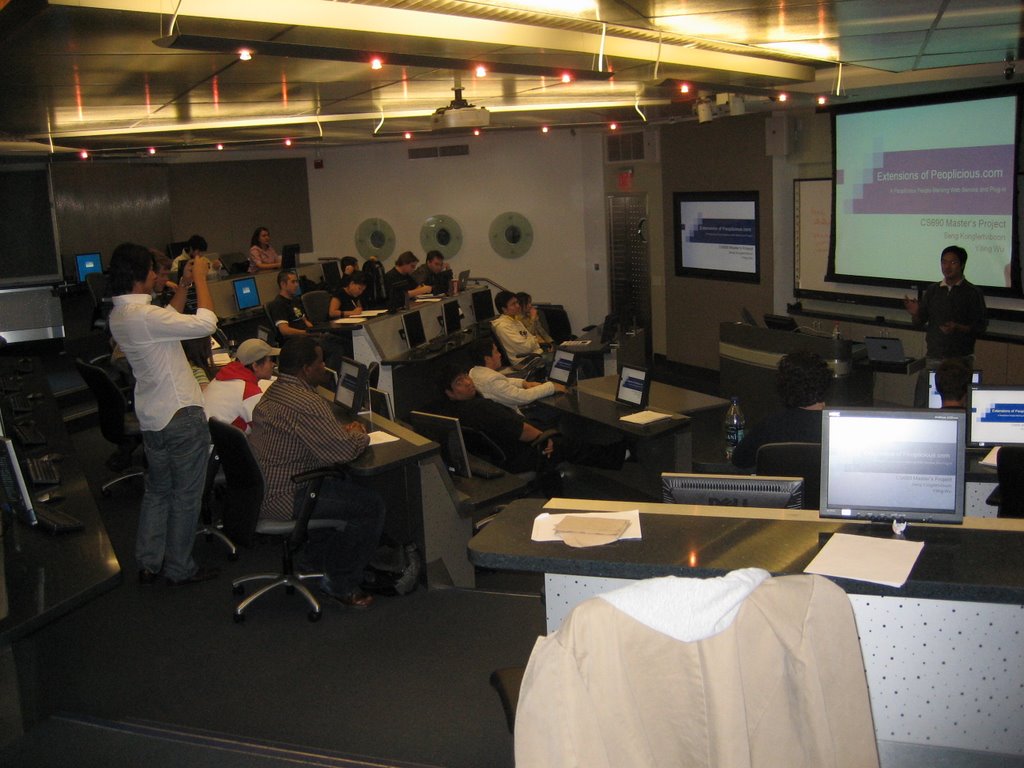
earlier that day, i attended the department of computer science's SLS/CS speaker series. the speakers were students - seng konglertviboon and yiting wu presented "extensions to peoplicious.com," a project sponsored by professor dave wolber, and tony ngo presented "rjax: a web-based gui for river," a project sponsored by professor greg benson. i believe the presentations were the culminations of large research projects and the students presented to a nearly packed lab of students and faculty. impressive.