flickr assignment for digital media production
1. by now, all of you have a flickr account. you know how to create sets and tag photos in flickr.
2. visit keri smith's everything i've consumed today. spend some time with it. consider sharing it with a friend, roommate, or classmate and having a conversation about it.
3. for one whole day (or 24 hours), photograph everything you consume. upload your photos to flickr, create a set, provocatively title the set, and strategically tag the photos. use as few or as many photos as necessary to tell a compelling and comprehensive story about your one day's worth of consumption.
4. in doing this assignment, be responsible and exercise good judgement with what you do and do not document. keep it real, but also keep it smart.
5. once your flickr set is finished, thick tweet it, making sure to include a link in your tweet to your flickr set.
6. on tuesday, october 6, demo your flickr set in class. during your demo, encourage, listen for, and receive suggestions on how to make your flickr set even better. it is your responsibility to solicit feedback. if you have no new work to demo, do not come to class.
7. in a one page, single-spaced essay turned in at the beginning of class on thursday, october 8, discuss your project, making sure to address two topics: a) what you learned about your own consumption behaviors from doing this project; and b) how you changed, altered, or otherwise improved your project as a direct result of what one or more of your classmates said during demo day. failure to alter your project and discuss this alteration in your essay will set your grade back considerably. no late work accepted.
Wednesday, September 30, 2009


Friday, September 25, 2009

Monday, September 14, 2009
twitter assignment
twitter assignment for digital media production
1. if you have not yet joined twitter, join twitter.
2. create a profile. use your real name. make your profile public.
3. find and follow all members of digital media production class.
4. search for and follow all people mentioned in all of our previous readings. this includes people who wrote the articles, people mentioned in the articles, people who made the videos, and people featured in the videos. you are free, of course, to unfollow any or all of these people, but only after first following them for a few days and reading through portions of their archive.
5. keep in mind that we will be using twitter extensively and in many different ways throughout the semester. the goal of this assignment is to get all of us up and running and connected with one another.
6. reply to at least one tweet.
7. post at least one RT.
8. post at least one #followfriday.
9. on tuesday, we will discuss in class the difference between thin and thick tweets. post at least one thick tweet. make it good.
10. in no more than a one-page single-spaced essay, discuss why you created your profile the way you did, introduce one person you follow, and explain why you find her/him interesting.
rules: a) on tuesday, september 22, be prepared to demo your work. demo whatever you wish to demo but be sure to include a discussion of your profile, one person you follow, and one thick tweet. if you have no work to demo, do not come to class; and b) your one page paper is due in class on thursday, september 24. no late work accepted.
hints: if you are an experienced twitter user, use this assignment and class to up your skills. if you have not yet used twitter, give it a chance before declaring it silly. finally, read and follow all the directions included in this assignment.
Friday, September 11, 2009

Wednesday, September 02, 2009


Monday, August 31, 2009
facebook assignment
facebook assignment for digital media production
1. design a new or redesign an already existing facebook group. you may belong to the group but the group may not be about you.
2. when designing and creating your facebook group, seek and receive feedback from other people. consider talking to people who you think would join such a group; consider talking to the skeptics. seek and speak with more than a few people but not too many. above all, listen to what they say.
3. after carefully considering your feedback and paying special attention to the elements of social network sites discussed in Social Network Sites: Definition, History, and Scholarship, create your facebook group.
4. once you have created your facebook group, design an outreach strategy that results in people (or "fans") joining your group. your goal with respect to fans may be size, niche, geographic diversity, or anything else - but you must have a goal and you must design an outreach strategy to meet that goal.
5. in no more than a one-page single-spaced essay, explain your facebook group, your goal, your outreach strategy, and the outcomes.
rules: a) on tuesday, september 8, be prepared to demo your work. if you have no work to demo, do not come to class; and b) your one page paper is due in class on thursday, september 10. no late work accepted.
hints: a) you are allowed to create a gag/joke group but i highly advise against it. instead, you should work on/with a group that actually means something to you; and b) the most important element of this project is learning to listen to other people.
new reviews in cyberculture studies (september 2009)
each month, RCCS Reviews pumps out free, full-length reviews of books about contemporary media and culture. this month, RCCS Reviews features 14 reviews of 7 books with 5 author responses!
books of the month for september 2009 are:

Digital Citizenship: The Internet, Society, and Participation
Authors: Karen Mossberger, Caroline J. Tolbert, Ramona S. McNeal
Publisher: MIT Press, 2008
Review 1: Carlos Nunes Silva
Digital Culture, Play and Identity: A World of Warcraft Reader
Editors: Hilde G Corneliussen, Jill Walker Rettberg
Publisher: MIT Press, 2008
Review 1: Shira Chess
Review 2: Jordan Patrick Lieser
Review 3: Christopher A. Paul
Author Response: Hilde G. Corneliussen and Jill Walker Rettberg
Ham Radio's Technical Culture
Author: Kristen Haring
Publisher: MIT Press, 2006
Review 1: Mark D. Johns
Review 2: Amanda R. Keeler
Author Response: Kristen Haring
iSpy: Surveillance and Power in the Interactive Era
Author: Mark Andrejevic
Publisher: University Press of Kansas, 2007
Review 1: Jacob Kramer-Duffield
Review 2: W. Benjamin Myers
Review 3: Hiesun Cecilia Suhr
Review 4: A. Freya Thimsen
Author Response: Mark Andrejevic
Online Social Support: The Interplay of Social Networks and Computer-Mediated Communication
Author: Antonina Bambina
Publisher: Cambria Press, 2007
Review 1: Willem de Koster
Review 2: Fred Stutzman
Author Response: Antonina Bambina
Surviving the New Economy
Editors: John Amman, Tris Carpenter, Gina Neff
Publisher: Paradigm Publishers, 2007
Review 1: Maria Rosales-Sequeiros
Author Response: John Amman, Tris Carpenter, and Gina Neff
Theorizing Digital Cultural Heritage: A Critical Discourse
Editors: Fiona Cameron, Sarah Kenderdine
Publisher: MIT Press, 2007
Review 1: Jennifer Way
enjoy. there's a wee bit more where that came from.
books of the month for september 2009 are:
Digital Citizenship: The Internet, Society, and Participation
Authors: Karen Mossberger, Caroline J. Tolbert, Ramona S. McNeal
Publisher: MIT Press, 2008
Review 1: Carlos Nunes Silva
Digital Culture, Play and Identity: A World of Warcraft Reader
Editors: Hilde G Corneliussen, Jill Walker Rettberg
Publisher: MIT Press, 2008
Review 1: Shira Chess
Review 2: Jordan Patrick Lieser
Review 3: Christopher A. Paul
Author Response: Hilde G. Corneliussen and Jill Walker Rettberg
Ham Radio's Technical Culture
Author: Kristen Haring
Publisher: MIT Press, 2006
Review 1: Mark D. Johns
Review 2: Amanda R. Keeler
Author Response: Kristen Haring
iSpy: Surveillance and Power in the Interactive Era
Author: Mark Andrejevic
Publisher: University Press of Kansas, 2007
Review 1: Jacob Kramer-Duffield
Review 2: W. Benjamin Myers
Review 3: Hiesun Cecilia Suhr
Review 4: A. Freya Thimsen
Author Response: Mark Andrejevic
Online Social Support: The Interplay of Social Networks and Computer-Mediated Communication
Author: Antonina Bambina
Publisher: Cambria Press, 2007
Review 1: Willem de Koster
Review 2: Fred Stutzman
Author Response: Antonina Bambina
Surviving the New Economy
Editors: John Amman, Tris Carpenter, Gina Neff
Publisher: Paradigm Publishers, 2007
Review 1: Maria Rosales-Sequeiros
Author Response: John Amman, Tris Carpenter, and Gina Neff
Theorizing Digital Cultural Heritage: A Critical Discourse
Editors: Fiona Cameron, Sarah Kenderdine
Publisher: MIT Press, 2007
Review 1: Jennifer Way
enjoy. there's a wee bit more where that came from.
Wednesday, August 26, 2009
first day of class
yesterday in digital media production, instead of printing out 13 copies of my 6-page syllabus, i copied the URL, pasted it 13 times, and printed it out on bright green paper. then i cut the piece of paper into fortune cookie-like strips and handed them out to students in class.

using colored markers and a whiteboard, my students recorded their experience (or lack thereof) with the 7 digital platforms we'll be using this semester: facebook, twitter, flickr, yelp, blogs, google maps, and kiva.

and once again i included what i'm now calling the green and golden rule (USF's school colors!) - green because it's more sustainable and golden because it saves my students and me money.

despite the room we were assigned (on a scale of 1-5 our room's technology level is, literally, 0 - and this is for a class on digital media production), i have high hopes for this class and the 13 students in it.

using colored markers and a whiteboard, my students recorded their experience (or lack thereof) with the 7 digital platforms we'll be using this semester: facebook, twitter, flickr, yelp, blogs, google maps, and kiva.

and once again i included what i'm now calling the green and golden rule (USF's school colors!) - green because it's more sustainable and golden because it saves my students and me money.
despite the room we were assigned (on a scale of 1-5 our room's technology level is, literally, 0 - and this is for a class on digital media production), i have high hopes for this class and the 13 students in it.
Monday, August 24, 2009
digital media production (fall 09)
this fall, i'm teaching a special topics course called digital media production. classes begin tuesday, august 25.

digital media production
Tues & Thurs 10:30 - 12:15
Professional Studies 227
Professor: David Silver
Office: Kalmanovitz 141
Office Hours: Tues & Thurs 9 - 10 am & by appointment
Digital Media Production is a special topics course designed around creating, sharing, and collaborating with digital media. Students will make digital media using facebook, twitter, flickr, yelp, blogs, google maps, transmedia, and kiva. Readings and discussions about digital media history and culture will accompany and inform our production and participation.
Learning Goals:
1. To learn how to use digital media creatively and effectively;
2. To learn how to use digital media collectively and collaboratively;
3. To learn how to learn new tools quickly and independently;
4. To learn about digital media history and culture; and
5. To experiment with the intersections among digital media and social justice.
Required Texts/Costs:
o Jessica Abel and Ira Glass, Radio: An Illustrated Guide (Chicago: WBEZ, 2008) - $5 (includes shipping)
o flickr pro account, $25
o One loan, via kiva.org, which will be returned in full.
Calendar:
Week 1: Introductions
Tuesday, August 25
o Introduce ourselves, distribute syllabus, and discuss course expectations.
Thursday, August 27
o Clive Thompson, Brave New World of Digital Intimacy, New York Times Magazine, September 5, 2008.
o Rachel Dry, What Would Warhol Blog? Washington Post, August 16, 2009.
o Clay Shirky, How social media can make history, Ted Talks, June 2009.
Weeks 2-3: Social Media and Facebook
Tuesday, September 1
o Lee and Sachi LeFever, Social Networking in Plain English, Common Craft, June 27, 2007.
o danah boyd and Nicole B. Ellison, Social Network Sites: Definition, History, and Scholarship, Journal of Computer-Mediated Communication, 13(1).
o Kate Miller-Heidke, Are You F*cking Kidding Me? (Facebook Song), YouTube
Thursday, September 3
o Amanda Lenhart, Adults and Social Network Websites, Pew Internet and American Life Project, January 14, 2009.
o Justin Smith, Exclusive: Discussing the Future of Facebook with CEO Mark Zuckerberg, Inside Facebook, June 3, 2009.
o Stephanie Clifford, Ads Follow Web Users, and Get More Personal, New York Times, July 30, 2009.
o Chadwick Matlin, Facebook Cornering Market on E-Friends: Fight to Own Social Media Heats Up, Washington Post, August 16, 2009.
Tuesday, September 8
o Demo Day: Facebook
Thursday, September 10
o David Gauntlett, Participation culture, creativity, and social change, YouTube, November 12, 2008.
o Due: Facebook Project
Weeks 4-5: Identity, Community, and Twitter
Tuesday, September 15
o Lee and Sachi LeFever, Twitter in Plain English, Common Craft, March 5, 2008.
o Sherry Turkle, Can You Hear Me Now? Forbes, May 5, 2007.
o Ben Parr, HOW TO: Retweet on Twitter, Mashable, April 16, 2009.
o Mashable, How #FollowFriday Works
o Virginia Heffernan, Hashing Things Out: How Hashtags are Remaking Conversations on Twitter, New York Times Magazine, August 7, 2009
Thursday, September 17
o Corey Flintoff, Gaza Conflict Plays Out Online Through Social Media, NPR.org, January 6, 2009.
o Evgeny Morozov, Think Again: Twitter, Foreign Policy, August 6, 2009.
o Steven Johnson, How Twitter Will Change the Way We Live, Time, June 5, 2009.
Tuesday, September 22
o Demo Day: Twitter
Thursday, September 24
o Tim Lemke, Athletes open up in Twitter arena, Washington Times, May 26, 2009.
o Rick Maese, With Twitter's Arrival, NFL Loses Control of Image Game, Washington Post, August 2, 2009.
o Jennifer Van Grove, Michael Vick Signs with Eagles: NFL Players Tweet Reactions, Mashable, August 13, 2009.
o Jay Fienberg, I'd really wish someone with a muted trumpet would walk by right now and play something dusky.
o Due: Twitter Project
Weeks 6-7: Images, Public/Private, and Flickr
Tuesday, September 29
o Lee and Sachi LeFever, Online Photo Sharing in Plain English, Common Craft, January 9, 2008.
o Virginia Heffernan, Sepia No More, New York Times Magazine, April 27, 2008.
o Michael Kimmelman, At Louvre, Many Stop to Snap but Few Stay to Focus, New York Times, August 2, 2009.
o Peter Menzel and Faith D'Aluisio, Hungry Planet: What the World Eats, Part II, Time Magazine.
Thursday, October 1
o Ira Glass, On good taste ... This American Life (Video: 5:20).
o Amparo Lasén and Edgar Gómez-Cruz, Digital Photography and Picture Sharing: Redefining the Public/Private Divide, Knowledge, Technology & Policy, August 2009
Tuesday, October 6
o Demo Day: Flickr
Thursday, October 8
o Noam Cohen, Historical Photos in Web Archives Gain Vivid New Lives, New York Times, January 18, 2009.
o Eugenio Tisselli, "thinkflickrthink": a case study on strategic tagging, 2009.
o Due: Flickr Project
Weeks 8-9: Free/User-Generated/Exploited Labor and Yelp
Tuesday, October 13:
o No Class (Fall Break)
Thursday, October 15
o Stacy Schiff, Know it All: Can Wikipedia conquer expertise? The New Yorker, July 31, 2006.
o Stephen Baker, Will Work for Praise: The Web's Free-Labor Economy, Business Week, December 28, 2008.
o Eric Karjaluoto, Is Tim Ferriss acting like an asshole? ideasonideas, August 11, 2009.
Tuesday, October 20
o Demo Day: Yelp
Thursday, October 22
o Rob Walker, Handmade 2.0, New York Times Magazine, December 16, 2007.
o Kathleen Richards, Yelp and the Business of Extortion 2.0, East Bay Express, February 18, 2009.
o Deborah Gage, S.F. Yelp user faces lawsuit over review, San Francisco Chronicle, January 8, 2009.
o Due: Yelp Project
Weeks 10-11: Words, Images, Video, Sound, Links, and Blogs
Tuesday, October 27
o Tom Coates, (Weblogs and) The Mass Amateurisation of (Nearly) Everything... plasticbag.org, September 3, 2003.
o Andrew Sullivan, Why I Blog, The Atlantic, November 2008.
o Paul Boutin, Twitter, Flickr, Facebook Make Blogs Look So 2004, Wired, November 2008.
Thursday, October 29.
o Michael Wesch, An anthropological introduction to YouTube, presented at the Library of Congress, June 23, 2008 (Video: 55.33).
Tuesday, November 3
o Demo Day: Blogs
Thursday, November 5
o Scott Rosenberg, Putting Everything Out There [Justin Hall] from Say Everything.
Weeks 12-13: Place, Movement, and Google Maps
Tuesday, November 10
o Spend a significant amount of time exploring: Oakland Crimespotting, Hillary Rodham Clinton in Africa, PhillyHistory, Fallen Fruit
Thursday, November 12
o Gabriel Cohen, You Talkin’ to Me? New York's Brash, Boisterous Blogosphere, New York Times, January 9, 2009.
o Malia Wollan, The Big Draw of a GPS Run, New York Times, August 19, 2009.
o Rex Sorgatz, A Data Point on Every Block: An Interview with Adrian Holovaty, Fimoculous, February 14, 2008.
Tuesday, November 17
o Demo Day: Google Maps
Thursday, November 19
o Due: Google Maps Project
Weeks 14-15: Digital Storytelling, New Literacies, and Transmedia
Tuesday, November 24
o Jessica Abel and Ira Glass, Radio: An Illustrated Guide (Chicago: WBEZ, 2008)
o Henry Jenkins, Why Heather Can Write, Technology Review, February 6, 2004.
o The Extended Reality of Cross-Media Storytelling, Power to the Pixel, February 4, 2009.
Thursday, November 26:
o No Class (Thanksgiving)
Tuesday, December 1
o Demo Day: Transmedia
Thursday, December 3
o Demo Day: Transmedia
Week 16: Giving, Getting Back, and Kiva
Tues, December 8
o Demo Day: Kiva
This class has no final exam.
Grading:
20% - Reading quizzes and in-class assignments
20% - Class and online participation
20% - Demo Days
40% - Projects
If you are concerned about your grade, you can request a meeting with me anytime during the semester.
Rulez:
1. Read all assigned readings prior to class.
2. In class, listen to and learn from everyone.
3. No late work accepted.
4. If you have no new work on Demo Day, do not come to class.
5. Publish work under your own name.
6. Starting August 27, no drinking out of non-reusable containers in class. Be creative with your thirst-quenching solutions.
Sunday, August 23, 2009
designing a syllabus (steps 6-9) - abridged
alas, my ambitious 9-part how to design a syllabus is not going to be completed ... this semester. with luck, i'll return to it next semester. or maybe i'll do it every semester until i get it right. but, for now, with classes starting tuesday, family in town, and spending the last splinters of summer celebrating siena's six-week old milestone, it's just not gonna happen.
but for those curious, here's steps 6-9, abridged!
step 6: grades! too many students obsess over them, nearly all professors hate them, and most classes seem to need them.
step 7: rules! i've seen syllabi with pages of rules, i've seen (and designed) syllabi with a few sentences of rules. my rule of thumb on rules: class rules should be brief enough to fill a tweet. if a rule can't be explained in 140 characters or less, pare it down to make it more digestible.
step 8: course description! now that you've done it all - basic info, course calendar, learning goals, course readings, assignments, grades, and rules - you are finally in a position to actually know what your course is all about. in a concise paragraph, describe your course, paying special attention to be clear, and stick it on the top (directly after "basic info") of your syllabus. you are now nearly finished with your syllabus. congratulations!
step 9: give it away! why hoard a syllabus? why keep it on your computer desktop or walled behind blackboard? make your syllabus public and accessible for free - give it away. let other people - professors, students, graduate students - access it, use it, tweak it. if you think your syllabus is good, give it away so that other professors and teachers can make their courses that much better. if you think your syllabus isn't so good, give it away so that other professors and teachers and students can offer you feedback on it. just give it away.

with luck, one day i'll return to this exercise, maybe recruit others to help me, and try to draft an extensive 9-part series on how to design a syllabus. but for now, with summer beginning to set and with my own syllabus screaming for attention, i'll have to let it go, put it to a temporary rest, and give it away.
Wednesday, August 19, 2009
designing a syllabus (step 5 of 9) - assignments
(confession/disclaimer/warning: five and a half weeks into parenting, i am quickly becoming aware of what a beyond full-time job it is. how do people have more than one child? these days, time, which i used to hunt and gather efficiently and in abundance, is hard to come by. i mention this to say that the once-noble nine-part syllabus-building series has lately, by necessity, suffered from a lack of attention. as such, these posts in pixels hardly match my best ideas and intentions in my head.)
now that you have collected and compiled your course readings, you are ready for assignments.
in a perfect world, students (and professors) would come to class fully prepared and wildly curious, seeking knowledge not grades, fostering community not competition. and although this sometimes happens, it's all to rare. enter assignments.
assignments come in all forms and sizes. there's reading assignments to encourage students to do the readings, making subsequent class discussions more interesting and participatory. there's homework assignments that require students to take what they learn in class and apply it outside of class. there's major assignments that require students to wrestle with class themes and topics and synthesize them into the form of tests, papers, and projects. and there's extra credit assignments, little nuggets that reward (or pamper?) students for taking the course topic a few steps farther.
once you have your assignments, add them to your syllabus, save the document, shut down your computer, and celebrate your progress.
Friday, August 14, 2009

Wednesday, August 12, 2009
designing a syllabus (step 4 of 9) - readings
creating a good course reading list is the most difficult, most time-consuming, and most arduous part of designing a syllabus. it is also, i think, the most important.
good readings engage and inspire students and professors. good readings encourage students and professors to attend class and participate in class discussions. good readings make students and professors curious. good readings make students and professors want to learn more.
naturally there's not a single way to put together a set of course readings but here's a few tips that have helped me along the way.
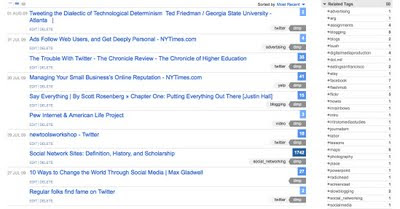
1. collect and compile potential readings all year round. face it: most syllabi are created the weekend before classes begin. instead of designing your reading list under duress, do it all year around. the next time you read something that relates to a course you teach or want to teach, place the reading in a folder devoted to your course. for online readings, consider opening a delicious account and start a tag for each class. for example, throughout the year, when i come across a relevant reading for my digital media production class, i save it to delicious and tag it "dmp." when i'm ready to put together my syllabus i have a year's worth of relevant readings to chose from.
2. use year-end evaluations to get student feedback - positive and negative - about readings. at my university, professors are allowed, if not encouraged, to add their own questions to the more standard evaluation forms. each semester, i ask my students: "which reading or readings was your favorite?" and "which reading or readings was your least favorite?" each semester, nearly without fail, one or two readings are mentioned by the majority of students as their favorites and least favorites. favorite readings are nearly always included in the next version of the class while least favorite readings are often (yet not always) ditched.
3. assign different kinds of readings. if so few of us read academic journal articles, why do we inflict them upon our students? although i do not oppose including an academic article or two in my syllabi, i'm certainly not going to overwhelm my students with articles designed for a small - and shrinking - audience. instead, my landscape for potential readings includes popular books, popular magazines, and (once) popular newspapers.
4. assign different formats of readings. i love words on printed pages but i'm aware that good readings come in many forms. in my courses, "readings" come from printed media like books, journals, magazines, and newspapers, but also come from radio, film, television, and - increasingly and especially - the internet. i routinely assign brief and not-so-brief ted talks to my students and find that they engage in the video's ideas as smartly, if not more smartly, as they would have with a print-source.
5. look for and select free readings when possible. many of us have been talking about a time when all the readings we want to assign would be online, accessible for free. for many fields, especially my own field of media studies, that time is now. last year's version of digital media production was comprised entirely of free, online readings. it worked.

6. finally, please don't assign the same readings over and over and over again. when we assign the same readings each semester, we get lazy. we get bored - and boring. when we're bored, our students are bored. and when everyone's bored, no one learns.
the best advice i received on this matter was from jeff paris, a popular professor of philosophy at USF. at a teaching workshop conducted for new faculty in 2006, jeff suggested - i'm paraphrasing - that we never teach the same class. once we feel comfortable with a class, jeff said, once we know what it's about and what to assign, kill it. ditch it. or give it away.
and begin designing a new one.
once you have your reading list, add it to your syllabus, save the document, shut down your computer, and celebrate your progress.
good readings engage and inspire students and professors. good readings encourage students and professors to attend class and participate in class discussions. good readings make students and professors curious. good readings make students and professors want to learn more.
naturally there's not a single way to put together a set of course readings but here's a few tips that have helped me along the way.
1. collect and compile potential readings all year round. face it: most syllabi are created the weekend before classes begin. instead of designing your reading list under duress, do it all year around. the next time you read something that relates to a course you teach or want to teach, place the reading in a folder devoted to your course. for online readings, consider opening a delicious account and start a tag for each class. for example, throughout the year, when i come across a relevant reading for my digital media production class, i save it to delicious and tag it "dmp." when i'm ready to put together my syllabus i have a year's worth of relevant readings to chose from.

2. use year-end evaluations to get student feedback - positive and negative - about readings. at my university, professors are allowed, if not encouraged, to add their own questions to the more standard evaluation forms. each semester, i ask my students: "which reading or readings was your favorite?" and "which reading or readings was your least favorite?" each semester, nearly without fail, one or two readings are mentioned by the majority of students as their favorites and least favorites. favorite readings are nearly always included in the next version of the class while least favorite readings are often (yet not always) ditched.
3. assign different kinds of readings. if so few of us read academic journal articles, why do we inflict them upon our students? although i do not oppose including an academic article or two in my syllabi, i'm certainly not going to overwhelm my students with articles designed for a small - and shrinking - audience. instead, my landscape for potential readings includes popular books, popular magazines, and (once) popular newspapers.
4. assign different formats of readings. i love words on printed pages but i'm aware that good readings come in many forms. in my courses, "readings" come from printed media like books, journals, magazines, and newspapers, but also come from radio, film, television, and - increasingly and especially - the internet. i routinely assign brief and not-so-brief ted talks to my students and find that they engage in the video's ideas as smartly, if not more smartly, as they would have with a print-source.
5. look for and select free readings when possible. many of us have been talking about a time when all the readings we want to assign would be online, accessible for free. for many fields, especially my own field of media studies, that time is now. last year's version of digital media production was comprised entirely of free, online readings. it worked.

6. finally, please don't assign the same readings over and over and over again. when we assign the same readings each semester, we get lazy. we get bored - and boring. when we're bored, our students are bored. and when everyone's bored, no one learns.
the best advice i received on this matter was from jeff paris, a popular professor of philosophy at USF. at a teaching workshop conducted for new faculty in 2006, jeff suggested - i'm paraphrasing - that we never teach the same class. once we feel comfortable with a class, jeff said, once we know what it's about and what to assign, kill it. ditch it. or give it away.
and begin designing a new one.
once you have your reading list, add it to your syllabus, save the document, shut down your computer, and celebrate your progress.
Wednesday, August 05, 2009
designing a course syllabus (step 3 of 9) - learning goals
if you boil down a syllabus to its most core ingredient you are left with its learning goals.
on the first day of classes, learning goals signal to students what they can and should expect to learn from your course. on the last day of classes, learning goals help students assess what they did or should have learned from your course.
although your learning goals will take up a relatively small space of real estate on your syllabus, they should take up a large chunk of your thinking. think hard about what you are trying to accomplish in your course and work even harder to articulate these goals in clear and comprehensible terms. if you have taught the course before, look back on older versions of the syllabus and assess whether or not the learning goals are still relevant. if you have not taught the course before, look at your colleagues' syllabi and think about which, if any, of the learning goals you would like to continue, replace, and extend.
try to craft learning goals that engage students who enroll in your course with significant knowledge of the topic and students who arrive with zero experience - and, perhaps, zero interest - in the topic. in general, consider including 3-5 learning goals in your syllabus.
so, for example, here are the learning goals for digital media production, a course i am teaching this fall:

once finished, add the learning goals to your syllabus, save the document, shut down your computer, and celebrate your progress.
Monday, August 03, 2009
designing a course syllabus (step 2 of 9) - course calendar
the second step of designing a course syllabus is to create the course calendar.
find and download an academic calendar for your college or university. for example, here is USF's 2008-2011 academic calendar. you can usually find your academic calendar by visiting your college/university's web page and searching for "academic calendar."
type in all days that your course meets. consult your academic calendar and note which days are vacation days - thanksgiving, spring break, etc.
at this point, your course calendar will look something like this:

once complete, stare a while at your course calendar. get a sense of its temporal nature. appreciate the months that your course occupies. become familiar with how many weeks your course lasts, locate the half-way point of the course, and dream about the final weeks of the course.
then, save your document, shut down your computer, and celebrate your progress.
designing a course syllabus (step 1 of 9) - basic info
open up a word document, text file, web page, or any other platform you plan to build your syllabus on.
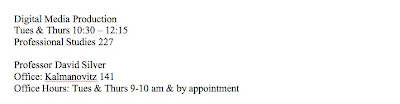
at the top of the document, type a) the title of your course; b) the days and times when it meets; and c) the building and room number where it meets.
skip a line and then type: a) your name; b) your office; and c) your office hours. if you don't have an office, list your email address, phone number, or preferred mode for students to contact you. also, because most students have busy schedules and because many of them find any excuse to avoid office hours, it's a good idea to add "and by appointment" to your regular office hours.
your now-started syllabus should look something like this:
you are now finished with step 1 of designing your course syllabus. save your document, shut down your computer, and celebrate your progress!
at the top of the document, type a) the title of your course; b) the days and times when it meets; and c) the building and room number where it meets.
skip a line and then type: a) your name; b) your office; and c) your office hours. if you don't have an office, list your email address, phone number, or preferred mode for students to contact you. also, because most students have busy schedules and because many of them find any excuse to avoid office hours, it's a good idea to add "and by appointment" to your regular office hours.
your now-started syllabus should look something like this:

you are now finished with step 1 of designing your course syllabus. save your document, shut down your computer, and celebrate your progress!
Thursday, July 30, 2009
new reviews in cyberculture studies (august 2009)
each month, RCCS Reviews pumps out free, full-length reviews of books about contemporary media and culture. this month, RCCS Reviews features 9 reviews of 4 books with 3 author responses! books of the month for august 2009 are:

Playing the Past: History and Nostalgia in Video Games
Editors: Zach Whalen, Laurie N. Taylor
Publisher: Vanderbilt University Press, 2008
Review 1: Carly A. Kocurek
Author Response: Zach Whalen
The Internet in the Arab World: Egypt and Beyond
Author: Rasha A. Abdulla
Publisher: Peter Lang, 2007
Review 1: Antonio A. Garcia
Review 2: Laurence Raw
Review 3: Natasha Ritsma
Author Response: Rasha A. Abdulla
The Pleasures of Computer Gaming: Essays on Cultural History, Theory and Aesthetics
Editors: Melanie Swalwell, Jason Wilson
Publisher: McFarland, 2008
Review 1: Dave Jones
Review 2: Alex Meredith
Author Response: Melanie Swalwell
Zero Comments: Blogging and Critical Internet Culture
Author: Geert Lovink
Publisher: Routledge, 2008
Review 1: Liz Ellcessor
Review 2: Tricia M. Farwell
Review 3: Madeline Yonker
enjoy. there's a little bit more where that came from.
Wednesday, July 22, 2009
a more green classroom
last year, in my three courses - intro to media studies, digital media production, and eating san francisco - i included the following rule:
No drinking out of non-reusable containers. Be creative with your thirst-quenching solutions.
at first, a few students grumbled and complained but within a week or so, students got the hang of it. students began bringing to class beautiful, multicolored, reusable bottles filled with homemade tea and canteens filled with coffee they brewed themselves or bought at the campus cafe. substituting glass bottles filled with delicious - and free - california tap water for plastic bottles of water and soda, we saved a ton of money over the course of the semester. but best of all, we all became a bit more mindful of our daily actions and the need for all of us, individually and collectively, to change our behaviors and change them quickly.

as i begin to think about my fall course, i'm curious to hear other strategies for a more green classroom. i'm also curious to hear from students - both those who have taken my courses and those who haven't - about what they think about such rules.
Sunday, July 19, 2009
team siena
last saturday, july 11th, our daughter siena malia was born. both the baby and the mama are healthy and beautiful.
now, so much is happening - so much to learn, so much to do, so much to take in - and all my instincts point forward. but for a moment i want to look backwards, briefly and humbly, and thank team siena, a collection of people, nearly all women, who helped us get to where we are now.
before siena's birth, sarah and i gained both knowledge and confidence by workshops sponsored by UCSF's women's health resource center and UCSF's osher center for integrative medicine. we learned a lot about labor - and life - from nancy bardacke's mindful birthing program and a lot about breastfeeding from sabrina rascon's breastfeeding workshop.
siena was born at UCSF's children hospital, where she - and we - received constant care and attention from nurses, midwives, and lactation consultants like aislinn bishop, karen "fabulous" cullen, sabrina miller, therese moran, sarah norse, dawn reidy, and melanie vose.

jini washburn, sarah's mom and my mother-in-law, was a huge part of team siena. jini was there throughout the delivery, offering encouragement, massages, support, and love. thanks jini.

kathy woo was our doula. kathy is a force of nature. at every twist and turn, kathy offered superhuman support. a week after the delivery, i'm still trying to figure out how kathy did the things she did. thank you kathy.
sharon wiener was our midwife. sharon was there during the first trimester, the second trimester, and the third trimester, and, miraculously, was at the hospital during the delivery. when sharon spoke, sarah listened. when sharon said push, sarah pushed. and when sharon said "let's have your baby," we had our baby. thank you sharon, again and again.
thank you team siena.

Sunday, June 28, 2009
new reviews in cyberculture studies (july 2009)
each month, RCCS Reviews pumps out free, full-length reviews of books about contemporary media and culture. books of the month for july 2009 are:

Cheating: Gaining Advantage in Videogames
Author: Mia Consalvo
Publisher: MIT Press, 2007
Review 1: Bryan G. Behrenshausen
Review 2: Tanner Higgin
Review 3: Ray Vichot
Author Response: Mia Consalvo
Digitizing Race: Visual Cultures of the Internet
Author: Lisa Nakamura
Publisher: University of Minnesota Press, 2007
Review 1: Yuya Kiuchi
Review 2: Nicholas Knouf
Review 3: Koen Leurs
Review 4: Andrea L. Volpe
Author Response: Lisa Nakamura
Evocative Objects: Things We Think With
Editor: Sherry Turkle
Publisher: MIT Press, 2007
Review 1: Chris Foster
Review 2: Gloria Gannaway
Review 3: Linda Levitt
Review 4: Albin Wallace
enjoy. there's a bit more where that came from.
Subscribe to:
Posts (Atom)

