twitter assignment for digital media production, green media, and community garden outreach
1. if you have not yet joined twitter, join twitter.
2. create a profile. in either your user name or bio (or both), use your real name.
3. make your profile public. if you already have a twitter account that is private and wish to keep it that way, create a new account for this class.
4. find and follow all members (students and professor) of our class.
5. search for and follow all people whose work (writings, video, web) is assigned each week. if after a week you find their tweets less than amusing, by all means unfollow them.
6. please get into the habit of checking twitter at least once a day.
Thursday, January 28, 2010


Wednesday, January 27, 2010
green media (spring 10)
in spring, i'm teaching three classes - two of them new. one of the new ones is green media. classes begin friday, january 29th.

Green Media
Fridays 9:40 am-12:25 pm (and some lunches, too)
Education 104 (and sometimes in the Garden)
Professor: David Silver
Office: Kalmanovitz 141
Office Hours: Tues & Thurs 10:30-11:30 am & by appointment
Green Media is a special topics production class devoted to making media about making food. Throughout the semester, students will plan, plant, tend, and harvest a veggie plot in USF's organic garden; research, cook, and share a selection of seasonal, regional recipes; and eat, experience, and experiment with real food. Further, using social media like twitter, flickr, facebook, blogs, and video, students will make and share media about growing, cooking, and eating food. Finally, students will work collaboratively to design and build two food-related exhibits in Gleeson Library.
Learning Goals:
o to learn how to plan and plant a garden;
o to learn how to research and cook 3-4 seasonal, regional, and delicious meals;
o to learn how to use social media to document the planting and preparing of food;
o to learn how to work collaboratively; and
o to become more aware of and in tune with seasons.
Book:
Please purchase Novella Carpenter's Farm City: The Education of an Urban Farmer (Penguin Press, 2009).
* All other course readings are either free and online, available outside my office, or available at Gleeson Library.
Calendar:
Friday, January 29
Discuss the syllabus and course expectations. Visit our garden plot. Begin using twitter.
Friday, February 5
Read Patricia Harris, David Lyon, and Sue McLaughlin, “Food & Life,” from The Meaning of Food, pp. 1-59; Michael Pollan, Out of the Kitchen, Onto the Couch, New York Times Magazine, July 29, 2009. Watch Britta Riley and Rebecca Bray, Window Farms (Video - 1:38), November 3, 2009. Library workshop with USF librarians Debbie Benrubi and Sherise Kimura.
Friday, February 12
Read Maggie Gosselin, Sarah Klein, and Jessica Prentice’s “San Francisco Bay Area Local Foods Wheel”; Localvore Network, California availability guide; selections from Pam Pierce’s Golden Gate Gardening: The Complete Guide to Year-Round Food Gardening in the San Francisco Bay Area & Coastal California; Allison Arieff, “Hive Minds: As Honeybees around the world vanish, one Bay Area biologist is enlisting an army of backyard gardeners to help figure out why,” Sunset, August 2009, pp. 54-56; and Maira Kalman, Back to the Land ... And the Pursuit of Happiness, New York Times, November 26, 2009. Plan our garden plot. Begin using flickr. Due in class: Breakfast Project.
Friday, February 19
Read Novella Carpenter, “Turkey,” from Farm City: The Education of an Urban Farmer, pp. 1-98; Field trip with Justin Valone to forage for wild greens and stinging nettles.
Friday, February 26
Read “Basic White Bread – Ten Steps to Fresh-baked Goodness,” from Sunset Cook Book of Breads, pp. 8-9; Mark Bittman, Making No-Knead Bread (Video – 4:58), New York Times, December 29, 2006; Brother Rick Curry, S.J., “Making Bread,” from The Secrets of Jesuit Breadmaking, pp. 11-21; Molly Katzen, "An Illustrated Guide to the Baking of Yeast Bread," from The Enchanted Broccoli Forest, pp. 86-95; and Lulu McCllister, How to Make a Delicious Omelet Using Wild Foods. Watch Giselle Kennedy, Brew (Video - 13:50), How-to Homestead, 2009; and Sergey Yazvinsky, One Minute Apple Pie (Video - 1:29), Serious Eats, September 10, 2009. Bake a loaf of bread. Begin blogging.
Friday, March 5
Read Novella Carpenter, “Rabbit,” from Farm City, pp. 99-184; and John Emerson, Neo Gardenism, Social Design Notes blog, June 15, 2009. Library workshop with USF librarians Debbie Benrubi and Sherise Kimura. Join garden guest Novella Carpenter, author (Farm City) and urban homesteader (Ghost Town Farm), for lunch and discussion.
Friday, March 12
Read Patricia Harris, David Lyon, and Sue McLaughlin, “Food & Culture,” from The Meaning of Food, pp. 61-105; Keith McHenry, The Story of Food Not Bombs (Parts 1-4); and Sandra Cate, "'Breaking Bread with a Spread' in the San Francisco County Jail," Gastronomica, Summer 2008, pp. 17-24. Join garden guest Keith McHenry, co-founder of Food Not Bombs, for lunch and discussion.
Friday, March 19:
SPRING BREAK (No Class)
Friday, March 26
Read Novella Carpenter, “Pig,” from Farm City, pp. 185-269; and Ian Frazier, The Cursing Mommy Cooks Italian, The New Yorker, January 11, 2010, pp. 34-35. Due in class: Media-Food Person Research Project.
Friday, April 2:
GOOD FRIDAY (No Class)
Read Tina Peterson, "Bringing Up Baby (Carrots), Gastronomica, Fall 2008, pp. 55-59. Watch Deborah Koons Garcia’s The Future of Food (Video - 1:28:51); and The Meatrix (I, II, and II 1/2).
Friday, April 9
Read Douglas Quenqua, To Harvest Squash, Click Here, New York Times, October 28, 2009. Watch expertvillage, How to Grow Squash in a Vegetable Garden (Video - 2:44), October 24, 2008; Melinda Stone, The Humanure Cycle (Video: 8:27), How-to Homestead, 2008; and a healthy dose of River Cottage. Visit, play, and be ready to discuss in class FarmVille. Due in class: Lunch Project.
Friday, April 16
Read Kim Severson, Neighbor, Can You Spare A Plum? New York Times, June 10, 2009; Emma Brown, Changing How We Live and Eat, One Fig at a Time, Common Dreams, February 2, 2009; Fallen Fruit, "Take Back the Fruit: Public Space and Community Activism," from Food, edited by John Knechtel, pp. 94-103; and Roxanne Webber, New iPhone App Finds You Free Fruit, Chow, January 12, 2010. Visit and be ready to discuss in class City Fruit Tree Mapper; Neighborhood Fruit; Fallen Fruit; and Urban Edibles.
Friday, April 23 (David out of town)
Read Elizabeth Kolbert, Green Like Me: Living without a fridge, and other experiments in environmentalism, The New Yorker, August 31, 2009, pp. 70-74; Ten websites that will help you eat with greater awareness, Culinate blog, August 10, 2009; and Megan Gordon, Eat, Read, Look: Food Websites Worth Your Time, Bay Area Bites blog, January 18, 2010.
Friday, April 30
Read Rachel Laudan, “A Plea for Culinary Modernism: Why We Should Love New, Fast, Processed Food,” Gastronomica, February 2001, pp 36-44; Caitlin Flanagan, Cultivating Failure: How school gardens are cheating our most vulnerable students, The Atlantic, January/February 2010; Angela McGregor, Cultivating Conversation: How Caitlin Flanagan has got us all thinking out loud, Cornell Garden-Based Learning blog, January 27, 2010; and at least two of the essays McGregor links to. Discuss semester’s successes and shortcomings. Brainstorm final party.
Friday, May 7
Read Mark Andrew Boyer, Is a Food Revolution Now in Season? Yes, It Is, OrganicNation.tv blog, September 4, 2009; Sarah van Gelder, 8 Ways to Join the Local Food Movement, Yes! Magazine, February 13, 2009; and Remi Bouvier, Vallicans Guerilla Gardening Skate (Video - 6:00), Eggheads blog, November 2, 2009. Due in class: Last Supper Project.
This class has no final exam.

Grading:
20% Class and Garden Participation
10% Breakfast Project
10% Lunch Project
10% Last Supper Project
20% Media-Food Person Research Project
20% Seasonal Foods Library Exhibit Group Project
20% Food & Culture Library Exhibit Group Project
* If you are curious or concerned about your grade, you can request a meeting with me anytime during the semester.
Rulez:
1. Read all assigned readings, watch all assigned videos, and visit all assigned web sites prior to class.
2. In class, in the garden, and in the kitchen, listen to and learn from everyone.
3. No late work accepted.
4. No drinking out of non-reusable containers in class.

Green Media
Fridays 9:40 am-12:25 pm (and some lunches, too)
Education 104 (and sometimes in the Garden)
Professor: David Silver
Office: Kalmanovitz 141
Office Hours: Tues & Thurs 10:30-11:30 am & by appointment
Green Media is a special topics production class devoted to making media about making food. Throughout the semester, students will plan, plant, tend, and harvest a veggie plot in USF's organic garden; research, cook, and share a selection of seasonal, regional recipes; and eat, experience, and experiment with real food. Further, using social media like twitter, flickr, facebook, blogs, and video, students will make and share media about growing, cooking, and eating food. Finally, students will work collaboratively to design and build two food-related exhibits in Gleeson Library.
Learning Goals:
o to learn how to plan and plant a garden;
o to learn how to research and cook 3-4 seasonal, regional, and delicious meals;
o to learn how to use social media to document the planting and preparing of food;
o to learn how to work collaboratively; and
o to become more aware of and in tune with seasons.
Book:
Please purchase Novella Carpenter's Farm City: The Education of an Urban Farmer (Penguin Press, 2009).
* All other course readings are either free and online, available outside my office, or available at Gleeson Library.
Calendar:
Friday, January 29
Discuss the syllabus and course expectations. Visit our garden plot. Begin using twitter.
Friday, February 5
Read Patricia Harris, David Lyon, and Sue McLaughlin, “Food & Life,” from The Meaning of Food, pp. 1-59; Michael Pollan, Out of the Kitchen, Onto the Couch, New York Times Magazine, July 29, 2009. Watch Britta Riley and Rebecca Bray, Window Farms (Video - 1:38), November 3, 2009. Library workshop with USF librarians Debbie Benrubi and Sherise Kimura.
Friday, February 12
Read Maggie Gosselin, Sarah Klein, and Jessica Prentice’s “San Francisco Bay Area Local Foods Wheel”; Localvore Network, California availability guide; selections from Pam Pierce’s Golden Gate Gardening: The Complete Guide to Year-Round Food Gardening in the San Francisco Bay Area & Coastal California; Allison Arieff, “Hive Minds: As Honeybees around the world vanish, one Bay Area biologist is enlisting an army of backyard gardeners to help figure out why,” Sunset, August 2009, pp. 54-56; and Maira Kalman, Back to the Land ... And the Pursuit of Happiness, New York Times, November 26, 2009. Plan our garden plot. Begin using flickr. Due in class: Breakfast Project.
Friday, February 19
Read Novella Carpenter, “Turkey,” from Farm City: The Education of an Urban Farmer, pp. 1-98; Field trip with Justin Valone to forage for wild greens and stinging nettles.
Friday, February 26
Read “Basic White Bread – Ten Steps to Fresh-baked Goodness,” from Sunset Cook Book of Breads, pp. 8-9; Mark Bittman, Making No-Knead Bread (Video – 4:58), New York Times, December 29, 2006; Brother Rick Curry, S.J., “Making Bread,” from The Secrets of Jesuit Breadmaking, pp. 11-21; Molly Katzen, "An Illustrated Guide to the Baking of Yeast Bread," from The Enchanted Broccoli Forest, pp. 86-95; and Lulu McCllister, How to Make a Delicious Omelet Using Wild Foods. Watch Giselle Kennedy, Brew (Video - 13:50), How-to Homestead, 2009; and Sergey Yazvinsky, One Minute Apple Pie (Video - 1:29), Serious Eats, September 10, 2009. Bake a loaf of bread. Begin blogging.
Friday, March 5
Read Novella Carpenter, “Rabbit,” from Farm City, pp. 99-184; and John Emerson, Neo Gardenism, Social Design Notes blog, June 15, 2009. Library workshop with USF librarians Debbie Benrubi and Sherise Kimura. Join garden guest Novella Carpenter, author (Farm City) and urban homesteader (Ghost Town Farm), for lunch and discussion.
Friday, March 12
Read Patricia Harris, David Lyon, and Sue McLaughlin, “Food & Culture,” from The Meaning of Food, pp. 61-105; Keith McHenry, The Story of Food Not Bombs (Parts 1-4); and Sandra Cate, "'Breaking Bread with a Spread' in the San Francisco County Jail," Gastronomica, Summer 2008, pp. 17-24. Join garden guest Keith McHenry, co-founder of Food Not Bombs, for lunch and discussion.
Friday, March 19:
SPRING BREAK (No Class)
Friday, March 26
Read Novella Carpenter, “Pig,” from Farm City, pp. 185-269; and Ian Frazier, The Cursing Mommy Cooks Italian, The New Yorker, January 11, 2010, pp. 34-35. Due in class: Media-Food Person Research Project.
Friday, April 2:
GOOD FRIDAY (No Class)
Read Tina Peterson, "Bringing Up Baby (Carrots), Gastronomica, Fall 2008, pp. 55-59. Watch Deborah Koons Garcia’s The Future of Food (Video - 1:28:51); and The Meatrix (I, II, and II 1/2).
Friday, April 9
Read Douglas Quenqua, To Harvest Squash, Click Here, New York Times, October 28, 2009. Watch expertvillage, How to Grow Squash in a Vegetable Garden (Video - 2:44), October 24, 2008; Melinda Stone, The Humanure Cycle (Video: 8:27), How-to Homestead, 2008; and a healthy dose of River Cottage. Visit, play, and be ready to discuss in class FarmVille. Due in class: Lunch Project.
Friday, April 16
Read Kim Severson, Neighbor, Can You Spare A Plum? New York Times, June 10, 2009; Emma Brown, Changing How We Live and Eat, One Fig at a Time, Common Dreams, February 2, 2009; Fallen Fruit, "Take Back the Fruit: Public Space and Community Activism," from Food, edited by John Knechtel, pp. 94-103; and Roxanne Webber, New iPhone App Finds You Free Fruit, Chow, January 12, 2010. Visit and be ready to discuss in class City Fruit Tree Mapper; Neighborhood Fruit; Fallen Fruit; and Urban Edibles.
Friday, April 23 (David out of town)
Read Elizabeth Kolbert, Green Like Me: Living without a fridge, and other experiments in environmentalism, The New Yorker, August 31, 2009, pp. 70-74; Ten websites that will help you eat with greater awareness, Culinate blog, August 10, 2009; and Megan Gordon, Eat, Read, Look: Food Websites Worth Your Time, Bay Area Bites blog, January 18, 2010.
Friday, April 30
Read Rachel Laudan, “A Plea for Culinary Modernism: Why We Should Love New, Fast, Processed Food,” Gastronomica, February 2001, pp 36-44; Caitlin Flanagan, Cultivating Failure: How school gardens are cheating our most vulnerable students, The Atlantic, January/February 2010; Angela McGregor, Cultivating Conversation: How Caitlin Flanagan has got us all thinking out loud, Cornell Garden-Based Learning blog, January 27, 2010; and at least two of the essays McGregor links to. Discuss semester’s successes and shortcomings. Brainstorm final party.
Friday, May 7
Read Mark Andrew Boyer, Is a Food Revolution Now in Season? Yes, It Is, OrganicNation.tv blog, September 4, 2009; Sarah van Gelder, 8 Ways to Join the Local Food Movement, Yes! Magazine, February 13, 2009; and Remi Bouvier, Vallicans Guerilla Gardening Skate (Video - 6:00), Eggheads blog, November 2, 2009. Due in class: Last Supper Project.
This class has no final exam.

Grading:
20% Class and Garden Participation
10% Breakfast Project
10% Lunch Project
10% Last Supper Project
20% Media-Food Person Research Project
20% Seasonal Foods Library Exhibit Group Project
20% Food & Culture Library Exhibit Group Project
* If you are curious or concerned about your grade, you can request a meeting with me anytime during the semester.
Rulez:
1. Read all assigned readings, watch all assigned videos, and visit all assigned web sites prior to class.
2. In class, in the garden, and in the kitchen, listen to and learn from everyone.
3. No late work accepted.
4. No drinking out of non-reusable containers in class.
Tuesday, January 12, 2010
community garden outreach (spring 10)
i'm teaching three classes in spring - two of them new. one of the new ones is community garden outreach. classes begin friday, january 29th.

Community Garden Outreach
Fridays 1:30-5 pm
Hayes Healy Formal Lounge and in the Garden
Professor: David Silver
Office: Kalmanovitz 141
Office Hours: Tues & Thurs 10:30-11:30 am & by appointment
Community Garden Outreach is a 2-unit hands-on and seminar class held in conjunction with Justin Valone’s Urban Ag class. Through gardening, harvesting, foraging, cooking, eating, reading, reflecting, and discussing, we will explore social, cultural, political, economic, and environmental issues around food, food production, and food distribution. In addition to continuing our educations as gardeners, we will work online with social media to document our garden activities and offline in groups to organize and implement various food distribution projects. Further, through life competency sessions led by Golden Venters, students will reflect upon and discuss their processes of intentional change, contemplation of self, and inter- and intrapersonal abilities. Community Garden Outreach is part of the Garden Project Living Learning Community.
Learning Goals:
o To learn more about organic gardening, urban agriculture, and community food production;
o To learn how to use different kinds social media to document the planting, preparing, and sharing of food;
o To learn how to work collaboratively to design and organize community food distribution projects; and
o To learn how to bake bread.

Books:
o Novella Carpenter, Farm City: The Education of an Urban Farmer, 2009.
o Michael Pollan’s Second Nature: A Gardener's Education, 1992.
Calendar:
Friday, January 29
Last semester, through your work in Melinda Stone and Justin Valone’s fall 2009 courses, you’ve learned a lot about gardening, urban agriculture, and food production. The majority of today’s class will be spent bringing the professor up to speed with your individual and group projects and progress. We will also discuss the syllabus, course expectations, and your spring internships.
Friday, February 5
Read Barbara Kingsolver, “Called Home,” Animal, Vegetable, Miracle, pp. 1-22. Begin using twitter. Life Competency Session with Golden Venters from 3-5 pm.
Friday, February 12
Read Michael Pollan, “Made Wild by Pompous Catalogs,” Second Nature: A Gardener's Education, pp. 205-228, and Maggie Gosselin, Sarah Klein, and Jessica Prentice’s “San Francisco Bay Area Local Foods Wheel.” Brainstorm & discuss our three food distribution projects: Campus Farmstand, Food Not Bombs, and Dean’s Dinners. Begin using flickr.
Friday, February 19
Field trip with Justin Valone to forage for wild greens and stinging nettles.
Friday, February 26
Read Novella Carpenter, “Turkey,” Farm City: The Education of an Urban Farmer, pp. 1-98. Begin blogging. Life Competency Session with Golden Venters from 3-5 pm.
Friday, March 5
Read Novella Carpenter, “Rabbit,” Farm City, pp. 99-184. Prepare garden tour and meal for class guest Novella Carpenter, author (Farm City) and urban homesteader (Ghost Town Farm).
Friday, March 12
Read “The Story of Food Not Bombs (Parts 1-4).” Watch “Food for Bombs – Nigeria." Prepare garden tour and meal for class guest Keith McHenry, co-founder of Food Not Bombs.
Friday, March 19:
SPRING BREAK
Friday, March 26
Read Novella Carpenter, “Pig,” Farm City, pp. 185-269. Discuss internship progress. Life Competency Session with Golden Venters from 3-5 pm.
Friday, April 2:
GOOD FRIDAY
Friday, April 9
Read Michael Pollan, “Planting a Tree,” Second Nature, pp. 150-175. Brainstorm and discuss documenting the building of the garden kitchen.
Friday, April 16
Read Michael Pollan, “Green Thumb,” Second Nature, pp. 117-134. Cook with Chef Jean-Marc Fullsack to prepare Food Not Bombs meal.
Friday, April 23
Read Elizabeth Kolbert, “Green Like Me: Living without a fridge, and other experiments in environmentalism,” The New Yorker, August 31, 2009. Life Competency Session with Golden Venters from 3-5 pm.
Friday, April 30
Read Michael Pollan, “The Garden Tour,” Second Nature, pp. 229-258, and Matt Hickman, “40 farmers under 40: Readers’ choice,” Mother Nature Network blog, September 24, 2009. Discuss semester’s successes and shortcomings. Brainstorm final party.
Friday, May 7
Prepare a delicious garden meal for the final party. Life Competency Session with Golden Venters from 3-5 pm.
This class has no final exam.

Grading:
o Class participation - 25%
o Social media participation - 25%
o Food distribution group projects - 25%
o Student Internships - 25%
If you are curious or concerned about your grade, you can request a meeting with me anytime during the semester.
Rulez:
1. Read all assigned readings prior to class.
2. In class and in the garden, listen to and learn from everyone.
3. No late work accepted.
4. No drinking out of non-reusable containers in class.

Community Garden Outreach
Fridays 1:30-5 pm
Hayes Healy Formal Lounge and in the Garden
Professor: David Silver
Office: Kalmanovitz 141
Office Hours: Tues & Thurs 10:30-11:30 am & by appointment
Community Garden Outreach is a 2-unit hands-on and seminar class held in conjunction with Justin Valone’s Urban Ag class. Through gardening, harvesting, foraging, cooking, eating, reading, reflecting, and discussing, we will explore social, cultural, political, economic, and environmental issues around food, food production, and food distribution. In addition to continuing our educations as gardeners, we will work online with social media to document our garden activities and offline in groups to organize and implement various food distribution projects. Further, through life competency sessions led by Golden Venters, students will reflect upon and discuss their processes of intentional change, contemplation of self, and inter- and intrapersonal abilities. Community Garden Outreach is part of the Garden Project Living Learning Community.
Learning Goals:
o To learn more about organic gardening, urban agriculture, and community food production;
o To learn how to use different kinds social media to document the planting, preparing, and sharing of food;
o To learn how to work collaboratively to design and organize community food distribution projects; and
o To learn how to bake bread.

Books:
o Novella Carpenter, Farm City: The Education of an Urban Farmer, 2009.
o Michael Pollan’s Second Nature: A Gardener's Education, 1992.
Calendar:
Friday, January 29
Last semester, through your work in Melinda Stone and Justin Valone’s fall 2009 courses, you’ve learned a lot about gardening, urban agriculture, and food production. The majority of today’s class will be spent bringing the professor up to speed with your individual and group projects and progress. We will also discuss the syllabus, course expectations, and your spring internships.
Friday, February 5
Read Barbara Kingsolver, “Called Home,” Animal, Vegetable, Miracle, pp. 1-22. Begin using twitter. Life Competency Session with Golden Venters from 3-5 pm.
Friday, February 12
Read Michael Pollan, “Made Wild by Pompous Catalogs,” Second Nature: A Gardener's Education, pp. 205-228, and Maggie Gosselin, Sarah Klein, and Jessica Prentice’s “San Francisco Bay Area Local Foods Wheel.” Brainstorm & discuss our three food distribution projects: Campus Farmstand, Food Not Bombs, and Dean’s Dinners. Begin using flickr.
Friday, February 19
Field trip with Justin Valone to forage for wild greens and stinging nettles.
Friday, February 26
Read Novella Carpenter, “Turkey,” Farm City: The Education of an Urban Farmer, pp. 1-98. Begin blogging. Life Competency Session with Golden Venters from 3-5 pm.
Friday, March 5
Read Novella Carpenter, “Rabbit,” Farm City, pp. 99-184. Prepare garden tour and meal for class guest Novella Carpenter, author (Farm City) and urban homesteader (Ghost Town Farm).
Friday, March 12
Read “The Story of Food Not Bombs (Parts 1-4).” Watch “Food for Bombs – Nigeria." Prepare garden tour and meal for class guest Keith McHenry, co-founder of Food Not Bombs.
Friday, March 19:
SPRING BREAK
Friday, March 26
Read Novella Carpenter, “Pig,” Farm City, pp. 185-269. Discuss internship progress. Life Competency Session with Golden Venters from 3-5 pm.
Friday, April 2:
GOOD FRIDAY
Friday, April 9
Read Michael Pollan, “Planting a Tree,” Second Nature, pp. 150-175. Brainstorm and discuss documenting the building of the garden kitchen.
Friday, April 16
Read Michael Pollan, “Green Thumb,” Second Nature, pp. 117-134. Cook with Chef Jean-Marc Fullsack to prepare Food Not Bombs meal.
Friday, April 23
Read Elizabeth Kolbert, “Green Like Me: Living without a fridge, and other experiments in environmentalism,” The New Yorker, August 31, 2009. Life Competency Session with Golden Venters from 3-5 pm.
Friday, April 30
Read Michael Pollan, “The Garden Tour,” Second Nature, pp. 229-258, and Matt Hickman, “40 farmers under 40: Readers’ choice,” Mother Nature Network blog, September 24, 2009. Discuss semester’s successes and shortcomings. Brainstorm final party.
Friday, May 7
Prepare a delicious garden meal for the final party. Life Competency Session with Golden Venters from 3-5 pm.
This class has no final exam.

Grading:
o Class participation - 25%
o Social media participation - 25%
o Food distribution group projects - 25%
o Student Internships - 25%
If you are curious or concerned about your grade, you can request a meeting with me anytime during the semester.
Rulez:
1. Read all assigned readings prior to class.
2. In class and in the garden, listen to and learn from everyone.
3. No late work accepted.
4. No drinking out of non-reusable containers in class.
Monday, January 11, 2010
happy birthday siena, you're a half year young!
happy birthday siena, you're a half year young!
i remember six months ago, about an hour before you arrived, the midwife looked out the hospital window and exclaimed out loud, "look! a rainbow!" i peered out the window and saw a curving column of colors stretching from one side of san francisco to another. all of us, even your mommy, stopped our labors for a moment to see the rainbow. and then the midwife exclaimed again, "now let's have this baby!"

do you remember, siena, your first three months? do you remember all the sights and sounds of your new home? do you remember your colic? your inconsolable crying? your all-night bouts of fussiness? we do. what bravery you showed those first few months.

did you know, siena, that you weren't the only brave one? do you remember that while you were bravely fighting colic, your mommy was bravely fighting postpartum depression? we do. and do you remember, siena, how family and friends rallied around us like a village? we do.

do you remember, siena, about two months ago when auntie jewlee, mommy's sister, moved from colorado to california to be your nanny? we do.

do you know, siena, how often your mommy and daddy talked about you before you even arrived? do you know how much we talk about your future? but most of all, do you know, siena, how happy and proud we are of you in the present, this day and all days? we do.

happy birthday siena, you're a half year young!
i remember six months ago, about an hour before you arrived, the midwife looked out the hospital window and exclaimed out loud, "look! a rainbow!" i peered out the window and saw a curving column of colors stretching from one side of san francisco to another. all of us, even your mommy, stopped our labors for a moment to see the rainbow. and then the midwife exclaimed again, "now let's have this baby!"

do you remember, siena, your first three months? do you remember all the sights and sounds of your new home? do you remember your colic? your inconsolable crying? your all-night bouts of fussiness? we do. what bravery you showed those first few months.

did you know, siena, that you weren't the only brave one? do you remember that while you were bravely fighting colic, your mommy was bravely fighting postpartum depression? we do. and do you remember, siena, how family and friends rallied around us like a village? we do.

do you remember, siena, about two months ago when auntie jewlee, mommy's sister, moved from colorado to california to be your nanny? we do.

do you know, siena, how often your mommy and daddy talked about you before you even arrived? do you know how much we talk about your future? but most of all, do you know, siena, how happy and proud we are of you in the present, this day and all days? we do.

happy birthday siena, you're a half year young!
Sunday, December 27, 2009
digital media production (spring 10)
in spring, i'm teaching three classes. one of them is digital media production. classes begin january 26, 2010.

digital media production
Tues & Thurs 8:30 - 10:15 am
Education 304
Professor: David Silver
Office: Kalmanovitz 141
Office Hours: Tues & Thurs 10:30 - 11:30 am & by appointment
Digital Media Production is a production course designed around creating, sharing, and collaborating with digital media. Using tools and platforms like facebook, twitter, flickr, yelp, blogs, google maps, and kiva, students will explore ideas of digital storytelling, transmedia, co-authorship, and large-scale collaboration. Readings and discussions about digital media history and culture will accompany and inform our production and participation.
Learning Goals:
1. To learn how to use digital media creatively and effectively;
2. To learn how to use digital media collectively and collaboratively;
3. To learn how to learn new tools quickly and independently; and
4. To learn about and participate within the intersections among digital media and social justice.
Required Texts/Costs:
o All readings are either a) free and online or b) will be made available for free in the library and outside my office.
o Although students will be able to complete their assignments with a free flickr account, you are encouraged, especially if interested in photography, to purchase a flickr pro account for $25.
o All students are required to make one $25 micro-loan, via kiva.org, which will be returned in full.
Calendar:
Tuesday, January 26
o Introduce ourselves, distribute syllabus, and discuss course expectations.
Thursday, January 28
o Clive Thompson, Brave New World of Digital Intimacy, New York Times Magazine, September 5, 2008.
o Rachel Dry, What Would Warhol Blog? Washington Post, August 16, 2009.
o Clay Shirky, How social media can make history, Ted Talks, June 2009.
Tuesday, February 2
o Lee and Sachi LeFever, Social Networking in Plain English, Common Craft, June 27, 2007.
o danah boyd and Nicole B. Ellison, Social Network Sites: Definition, History, and Scholarship, Journal of Computer-Mediated Communication, 13(1).
o Kate Miller-Heidke, Are You F*cking Kidding Me? (Facebook Song), YouTube
Thursday, February 4
o Justin Smith, Exclusive: Discussing the Future of Facebook with CEO Mark Zuckerberg, Inside Facebook, June 3, 2009.
o Stephanie Clifford, Ads Follow Web Users, and Get More Personal, New York Times, July 30, 2009.
o Lori Aratani, When Mom or Dad Asks To Be a Facebook "Friend," Washington Post, March 9, 2008.
o Kevin Bankston, Facebook's New Privacy Changes: The Good, The Bad, and The Ugly, Electronic Frontier Foundation, December 9, 2009.
Tuesday, February 9
o Demo Day: Facebook
Thursday, February 11
o Henry Jenkins, Why Heather Can Write, Technology Review, February 6, 2004.
o Samantha M. Shapiro, Revolution, Facebook-Style: Can social networking turn disaffected young Egyptians into a force for democratic change? New York Times Magazine, January 22, 2009.
o Ira Glass, On good taste ... This American Life (Video: 5:20).
Tuesday, February 16
o Lee and Sachi LeFever, Twitter in Plain English, Common Craft, March 5, 2008.
o Ben Parr, HOW TO: Retweet on Twitter, Mashable, April 16, 2009.
o Mashable, How #FollowFriday Works
o Marko, Twitter Etiquette: 7 Common Sense Rules for Twitter, Twitter Tips blog, December 20, 2009.
o Virginia Heffernan, Hashing Things Out: How Hashtags are Remaking Conversations on Twitter, New York Times Magazine, August 7, 2009
Thursday, February 18
o Steven Johnson, How Twitter Will Change the Way We Live, Time, June 5, 2009.
o Michael Wesch, An anthropological introduction to YouTube, presented at the Library of Congress, June 23, 2008 (Video: 55.33).
Tuesday, February 23
o Demo Day: Twitter
Thursday, February 25
o Noam Cohen, Refining the Twitter Explosion, New York Times, November 8, 2009.
o Stan Schroeder, How Twitter Conquered the World in 2009, Mashable, December 25, 2009.
o Adrian Higgins, We can't see the forest for the T-Mobiles, Washington Post, December 15, 2009.
Tuesday, March 2
o Lee and Sachi LeFever, Online Photo Sharing in Plain English, Common Craft, January 9, 2008.
o Virginia Heffernan, Sepia No More, New York Times Magazine, April 27, 2008.
o Michael Kimmelman, At Louvre, Many Stop to Snap but Few Stay to Focus, New York Times, August 2, 2009.
o Peter Menzel and Faith D'Aluisio, Hungry Planet: What the World Eats, Part II, Time Magazine.
Thursday, March 4
o Noam Cohen, Use My Photo? Not Without Permission, New York Times, October 1, 2007.
o Noam Cohen, Historical Photos in Web Archives Gain Vivid New Lives, New York Times, January 18, 2009.
o Jennifer Woodard Maderazo, Flickr Changes Lives, Launches Photog Careers, MediaShift blog, August 2, 2007.
o Chris Colin, Nasty as they wanna be? Policing Flickr.com, SF Gate, September 29, 2008.
Tuesday, March 9
o Demo Day: Flickr
Thursday, March 11
o Gina Trapani, Geek to Live: Flickr Advanced User Guide, Lifehacker blog, February 15, 2006.
o Adam Ostrow, Flickr2Twitter: Flickr Enters the Twitter Stream, Mashable blog, June 30, 2009.
o Ben Parr, 5 Impressive Mashups of Twitter and Flickr, May 11, 2009.
o Try out iMapFlickr.
Tuesday, March 16: SPRING BREAK!
Thursday, March 18: SPRING BREAK!
Tuesday, March 23
o Kathleen Richards, Yelp and the Business of Extortion 2.0, East Bay Express, February 18, 2009.
o Deborah Gage, S.F. Yelp user faces lawsuit over review, San Francisco Chronicle, January 8, 2009.
Thursday, March 25
o Stephen Baker, Will Work for Praise: The Web's Free-Labor Economy, Business Week, December 28, 2008.
o Eric Karjaluoto, Is Tim Ferriss acting like an asshole? ideasonideas, August 11, 2009.
Tuesday, March 30
o Demo Day: Yelp
Thursday, April 1
o Stacy Schiff, Know it All: Can Wikipedia conquer expertise? The New Yorker, July 31, 2006.
o Rob Walker, Handmade 2.0, New York Times Magazine, December 16, 2007.
Tuesday, April 6
o Scott Rosenberg, Putting Everything Out There [Justin Hall] from Say Everything.
Thursday, April 8
o Tom Coates, (Weblogs and) The Mass Amateurisation of (Nearly) Everything... plasticbag.org, September 3, 2003.
o Doree Shafrir, Would You Take a Tumblr With This Man? New York Observer, January 15, 2008.
Tuesday, April 13
o Christian Kreutz, Maptivism: Maps for activism, transparency and engagement, Crisscrossed blog, September 14, 2009.
o Christian Kreutz, 6 innovative grassroot mashups for transparency, Crisscrossed blog, May 5, 2008.
Thursday, April 15
o Mark S. Luckie, 7 Unique and innovative maps, 10,000 Words blog, October 21, 2009.
o David Sasaki, Maps for Social Change and Community Involvement, Idea Lab blog, April 24, 2009.
o Rex Sorgatz, A Data Point on Every Block: An Interview with Adrian Holovaty, Fimoculous, February 14, 2008.
o Try out Green Maps.
Tuesday, April 20
o Demo Day: Google Maps
Thursday, April 22:
o Collaboration Workshop
Tuesday, April 27
o Henry Jenkins, "Searching for the Oragami Unicorn: The Matrix and Transmedia Storytelling," in Convergence Culture, pp. 95-134.
Thursday, April 29
o The Extended Reality of Cross-Media Storytelling, Power to the Pixel, February 4, 2009.
o Why So Serious? Marketing Overview
o Welcome to a World Without Oil
o Stefanie Olsen, Provocative politics in virtual games, CNET News, March 28, 2007.
Tuesday, May 4
o Alice Rawsthorn, Winning Ways of Making a Better World, New York Times, August 30, 2009.
o Frontline/World, Uganda - A Little Goes a Long Way, PBS, October 31, 2006.
o Martin Plaut, Internet loans swing towards US, BBC News, June 10, 2009.
o Erick Schonfeld, Four Years After Founding, Kiva Hits $100 Million In Microloans, TechCrunch, November 1, 2009.
Thursday, May 6
o Demo Day: kiva
Tuesday, May 11
o Nicholas Carr, “Is Google Making Us Stupid?” The Atlantic, July/August 2008.
o David Carr, The Fall and Rise of Media, New York Times, November 29, 2009.
Thursday, May 13
o To be determined.
This class has no final exam.
Grading:
20% - Reading quizzes and in-class assignments
20% - Class and online participation
20% - Demo Days
20% - Projects
20% - Final Project
If you are concerned about your grade, you can request a meeting with me anytime during the semester.
Rulez:
1. Read all assigned readings and view all assigned videos prior to class.
2. In class, listen to and learn from everyone.
3. No late work accepted.
4. If you have no new work on Demo Day, do not come to class.
5. Publish work under your own name.
6. Starting January 28, no drinking out of non-reusable containers in class. Be creative with your thirst-quenching solutions.

digital media production
Tues & Thurs 8:30 - 10:15 am
Education 304
Professor: David Silver
Office: Kalmanovitz 141
Office Hours: Tues & Thurs 10:30 - 11:30 am & by appointment
Digital Media Production is a production course designed around creating, sharing, and collaborating with digital media. Using tools and platforms like facebook, twitter, flickr, yelp, blogs, google maps, and kiva, students will explore ideas of digital storytelling, transmedia, co-authorship, and large-scale collaboration. Readings and discussions about digital media history and culture will accompany and inform our production and participation.
Learning Goals:
1. To learn how to use digital media creatively and effectively;
2. To learn how to use digital media collectively and collaboratively;
3. To learn how to learn new tools quickly and independently; and
4. To learn about and participate within the intersections among digital media and social justice.
Required Texts/Costs:
o All readings are either a) free and online or b) will be made available for free in the library and outside my office.
o Although students will be able to complete their assignments with a free flickr account, you are encouraged, especially if interested in photography, to purchase a flickr pro account for $25.
o All students are required to make one $25 micro-loan, via kiva.org, which will be returned in full.
Calendar:
Tuesday, January 26
o Introduce ourselves, distribute syllabus, and discuss course expectations.
Thursday, January 28
o Clive Thompson, Brave New World of Digital Intimacy, New York Times Magazine, September 5, 2008.
o Rachel Dry, What Would Warhol Blog? Washington Post, August 16, 2009.
o Clay Shirky, How social media can make history, Ted Talks, June 2009.
Tuesday, February 2
o Lee and Sachi LeFever, Social Networking in Plain English, Common Craft, June 27, 2007.
o danah boyd and Nicole B. Ellison, Social Network Sites: Definition, History, and Scholarship, Journal of Computer-Mediated Communication, 13(1).
o Kate Miller-Heidke, Are You F*cking Kidding Me? (Facebook Song), YouTube
Thursday, February 4
o Justin Smith, Exclusive: Discussing the Future of Facebook with CEO Mark Zuckerberg, Inside Facebook, June 3, 2009.
o Stephanie Clifford, Ads Follow Web Users, and Get More Personal, New York Times, July 30, 2009.
o Lori Aratani, When Mom or Dad Asks To Be a Facebook "Friend," Washington Post, March 9, 2008.
o Kevin Bankston, Facebook's New Privacy Changes: The Good, The Bad, and The Ugly, Electronic Frontier Foundation, December 9, 2009.
Tuesday, February 9
o Demo Day: Facebook
Thursday, February 11
o Henry Jenkins, Why Heather Can Write, Technology Review, February 6, 2004.
o Samantha M. Shapiro, Revolution, Facebook-Style: Can social networking turn disaffected young Egyptians into a force for democratic change? New York Times Magazine, January 22, 2009.
o Ira Glass, On good taste ... This American Life (Video: 5:20).
Tuesday, February 16
o Lee and Sachi LeFever, Twitter in Plain English, Common Craft, March 5, 2008.
o Ben Parr, HOW TO: Retweet on Twitter, Mashable, April 16, 2009.
o Mashable, How #FollowFriday Works
o Marko, Twitter Etiquette: 7 Common Sense Rules for Twitter, Twitter Tips blog, December 20, 2009.
o Virginia Heffernan, Hashing Things Out: How Hashtags are Remaking Conversations on Twitter, New York Times Magazine, August 7, 2009
Thursday, February 18
o Steven Johnson, How Twitter Will Change the Way We Live, Time, June 5, 2009.
o Michael Wesch, An anthropological introduction to YouTube, presented at the Library of Congress, June 23, 2008 (Video: 55.33).
Tuesday, February 23
o Demo Day: Twitter
Thursday, February 25
o Noam Cohen, Refining the Twitter Explosion, New York Times, November 8, 2009.
o Stan Schroeder, How Twitter Conquered the World in 2009, Mashable, December 25, 2009.
o Adrian Higgins, We can't see the forest for the T-Mobiles, Washington Post, December 15, 2009.
Tuesday, March 2
o Lee and Sachi LeFever, Online Photo Sharing in Plain English, Common Craft, January 9, 2008.
o Virginia Heffernan, Sepia No More, New York Times Magazine, April 27, 2008.
o Michael Kimmelman, At Louvre, Many Stop to Snap but Few Stay to Focus, New York Times, August 2, 2009.
o Peter Menzel and Faith D'Aluisio, Hungry Planet: What the World Eats, Part II, Time Magazine.
Thursday, March 4
o Noam Cohen, Use My Photo? Not Without Permission, New York Times, October 1, 2007.
o Noam Cohen, Historical Photos in Web Archives Gain Vivid New Lives, New York Times, January 18, 2009.
o Jennifer Woodard Maderazo, Flickr Changes Lives, Launches Photog Careers, MediaShift blog, August 2, 2007.
o Chris Colin, Nasty as they wanna be? Policing Flickr.com, SF Gate, September 29, 2008.
Tuesday, March 9
o Demo Day: Flickr
Thursday, March 11
o Gina Trapani, Geek to Live: Flickr Advanced User Guide, Lifehacker blog, February 15, 2006.
o Adam Ostrow, Flickr2Twitter: Flickr Enters the Twitter Stream, Mashable blog, June 30, 2009.
o Ben Parr, 5 Impressive Mashups of Twitter and Flickr, May 11, 2009.
o Try out iMapFlickr.
Tuesday, March 16: SPRING BREAK!
Thursday, March 18: SPRING BREAK!
Tuesday, March 23
o Kathleen Richards, Yelp and the Business of Extortion 2.0, East Bay Express, February 18, 2009.
o Deborah Gage, S.F. Yelp user faces lawsuit over review, San Francisco Chronicle, January 8, 2009.
Thursday, March 25
o Stephen Baker, Will Work for Praise: The Web's Free-Labor Economy, Business Week, December 28, 2008.
o Eric Karjaluoto, Is Tim Ferriss acting like an asshole? ideasonideas, August 11, 2009.
Tuesday, March 30
o Demo Day: Yelp
Thursday, April 1
o Stacy Schiff, Know it All: Can Wikipedia conquer expertise? The New Yorker, July 31, 2006.
o Rob Walker, Handmade 2.0, New York Times Magazine, December 16, 2007.
Tuesday, April 6
o Scott Rosenberg, Putting Everything Out There [Justin Hall] from Say Everything.
Thursday, April 8
o Tom Coates, (Weblogs and) The Mass Amateurisation of (Nearly) Everything... plasticbag.org, September 3, 2003.
o Doree Shafrir, Would You Take a Tumblr With This Man? New York Observer, January 15, 2008.
Tuesday, April 13
o Christian Kreutz, Maptivism: Maps for activism, transparency and engagement, Crisscrossed blog, September 14, 2009.
o Christian Kreutz, 6 innovative grassroot mashups for transparency, Crisscrossed blog, May 5, 2008.
Thursday, April 15
o Mark S. Luckie, 7 Unique and innovative maps, 10,000 Words blog, October 21, 2009.
o David Sasaki, Maps for Social Change and Community Involvement, Idea Lab blog, April 24, 2009.
o Rex Sorgatz, A Data Point on Every Block: An Interview with Adrian Holovaty, Fimoculous, February 14, 2008.
o Try out Green Maps.
Tuesday, April 20
o Demo Day: Google Maps
Thursday, April 22:
o Collaboration Workshop
Tuesday, April 27
o Henry Jenkins, "Searching for the Oragami Unicorn: The Matrix and Transmedia Storytelling," in Convergence Culture, pp. 95-134.
Thursday, April 29
o The Extended Reality of Cross-Media Storytelling, Power to the Pixel, February 4, 2009.
o Why So Serious? Marketing Overview
o Welcome to a World Without Oil
o Stefanie Olsen, Provocative politics in virtual games, CNET News, March 28, 2007.
Tuesday, May 4
o Alice Rawsthorn, Winning Ways of Making a Better World, New York Times, August 30, 2009.
o Frontline/World, Uganda - A Little Goes a Long Way, PBS, October 31, 2006.
o Martin Plaut, Internet loans swing towards US, BBC News, June 10, 2009.
o Erick Schonfeld, Four Years After Founding, Kiva Hits $100 Million In Microloans, TechCrunch, November 1, 2009.
Thursday, May 6
o Demo Day: kiva
Tuesday, May 11
o Nicholas Carr, “Is Google Making Us Stupid?” The Atlantic, July/August 2008.
o David Carr, The Fall and Rise of Media, New York Times, November 29, 2009.
Thursday, May 13
o To be determined.
This class has no final exam.
Grading:
20% - Reading quizzes and in-class assignments
20% - Class and online participation
20% - Demo Days
20% - Projects
20% - Final Project
If you are concerned about your grade, you can request a meeting with me anytime during the semester.
Rulez:
1. Read all assigned readings and view all assigned videos prior to class.
2. In class, listen to and learn from everyone.
3. No late work accepted.
4. If you have no new work on Demo Day, do not come to class.
5. Publish work under your own name.
6. Starting January 28, no drinking out of non-reusable containers in class. Be creative with your thirst-quenching solutions.
Friday, December 18, 2009
graduation day
at this year's graduation ceremony, USF's school of business and professional studies gave craig newmark, founder of craigslist, an honorary degree. i had the pleasure of introducing him.

my remarks looked something like this:
Back in 2007, there was a guy named Sean who owned a home in San Francisco. A nice home, near Chinatown, with one problem: the attic. The attic was full of rats. Based on a tip he received from a hardware store, Sean filled the attic with peanut butter-flavored cubes of poison. The idea was that the rats would eat the cubes, become extremely thirsty, and scuttle out of the house. The rats did indeed eat the cubes, but instead of getting thirsty and leaving for a drink, they died. Now Sean’s attic was full of dead, stinky rats. So Sean did what millions of other people do - he posted to Craigslist. In exchange for ridding his attic of dead rats, he offered 5000 CDs from his personal music collection.
I find this story fascinating for three reasons. First, it is amazing that a significant transaction - dead rats for 5000 CDs - can take place without a single dollar bill exchanged. No cash register was needed. No paypal. No shopping mall.
Second, this simple exchange requires a complex trust between two people. It requires civility. It requires human beings treating human beings like human beings.
The third reason I love this story has nothing to do with Sean, or the rats, or the 5000 CDs. It’s about what happens when many, many people use Craigslist. Craigslist was started as a hobby by Craig Newmark in early 1995. Today, more than 35 million viewers in 55 countries use Craigslist. Now, when people use Craigslist, they seldom pay for classified ads, and when people don’t pay for classified ads, it is difficult for newspapers, at least in the United States, to exist. In this way, and in many other ways, Craigslist is what we in media studies call a disruptive technology. Craigslist is a game changer. It disrupts the existing order.
In this way, Craig Newmark and Craigslist are quite similar to USF. After all, the motto of USF is not "Educating minds and hearts to make a lot of money." Nor is the motto of USF "Educating minds and hearts to maintain the status quo." The motto of USF is "Educating minds and hearts to change the world." Change the world. Be disruptive.
Today, we honor Craig Newmark, the entrepreneur who founded Craigslist. The University of San Francisco is proud to honor Craig for his success at directing technology to promote "a common good that transcends the interests of particular individuals or groups." The University does, therefore, confer upon Craig Newmark the degree of Doctor of Humane letters, honoris causa, with all the rights and privileges pertaining thereunto. Given this eighteenth day of December, in the year of our Lord two thousand and nine, and of the University, the hundredth and fifty-fourth, in San Francisco, California.

to the graduating class of 2009 - congratulations and may you be disruptive.

my remarks looked something like this:
Back in 2007, there was a guy named Sean who owned a home in San Francisco. A nice home, near Chinatown, with one problem: the attic. The attic was full of rats. Based on a tip he received from a hardware store, Sean filled the attic with peanut butter-flavored cubes of poison. The idea was that the rats would eat the cubes, become extremely thirsty, and scuttle out of the house. The rats did indeed eat the cubes, but instead of getting thirsty and leaving for a drink, they died. Now Sean’s attic was full of dead, stinky rats. So Sean did what millions of other people do - he posted to Craigslist. In exchange for ridding his attic of dead rats, he offered 5000 CDs from his personal music collection.
I find this story fascinating for three reasons. First, it is amazing that a significant transaction - dead rats for 5000 CDs - can take place without a single dollar bill exchanged. No cash register was needed. No paypal. No shopping mall.
Second, this simple exchange requires a complex trust between two people. It requires civility. It requires human beings treating human beings like human beings.
The third reason I love this story has nothing to do with Sean, or the rats, or the 5000 CDs. It’s about what happens when many, many people use Craigslist. Craigslist was started as a hobby by Craig Newmark in early 1995. Today, more than 35 million viewers in 55 countries use Craigslist. Now, when people use Craigslist, they seldom pay for classified ads, and when people don’t pay for classified ads, it is difficult for newspapers, at least in the United States, to exist. In this way, and in many other ways, Craigslist is what we in media studies call a disruptive technology. Craigslist is a game changer. It disrupts the existing order.
In this way, Craig Newmark and Craigslist are quite similar to USF. After all, the motto of USF is not "Educating minds and hearts to make a lot of money." Nor is the motto of USF "Educating minds and hearts to maintain the status quo." The motto of USF is "Educating minds and hearts to change the world." Change the world. Be disruptive.
Today, we honor Craig Newmark, the entrepreneur who founded Craigslist. The University of San Francisco is proud to honor Craig for his success at directing technology to promote "a common good that transcends the interests of particular individuals or groups." The University does, therefore, confer upon Craig Newmark the degree of Doctor of Humane letters, honoris causa, with all the rights and privileges pertaining thereunto. Given this eighteenth day of December, in the year of our Lord two thousand and nine, and of the University, the hundredth and fifty-fourth, in San Francisco, California.

to the graduating class of 2009 - congratulations and may you be disruptive.
Friday, December 11, 2009
the herb garden
the herb garden in the front yard is beginning to take shape.


(click on the image for a larger view)
Tuesday, December 01, 2009
retiring RCCS
in fall 1994, i began grad school in american studies at the university of maryland, researching and teaching about a new and obscure technology called the internet.
it was a perfect time and place to study new media. at maryland, i was able to work with and learn from john caughey, debra deruyver, katie king, bob kolker, myron lounsbury, ed martini, jo paoletti, kelly quinn, jason rhody, ben shneiderman, mary corbin sies, martha nell smith, donald snyder, and ellen yu borkowski. it was awesome.
what wasn't awesome was the larger academic community, or lack thereof. in those days, one would be lucky to find a single panel on "cyberspace" or the "world wide web" at an academic conference or to find a single article in an academic journal. these were the old days - before conferences like digital arts and culture (or DAC, first held in 1998) or the association of internet researchers (or AoIR, first held in 2000), before internet clusters like the berkman center for internet and society (established in 1998) or the oxford internet institute (established in 2001). back then, academic interest in the internet was building, but an academic community was hard to find.
in fall 1996, i enrolled in an independent study with myron lounsbury. the goal of the independent study was to build a web site which in turn would help foster a community, an online community, that would connect scholars and students interested in studying the internet. i began by collecting relevant course syllabi and conference calls - the two key ingredients for any emerging field of study - and posted them on the web site. i called the site the resource center for cyberculture studies, or RCCS, and launched it on december 8, 1996.
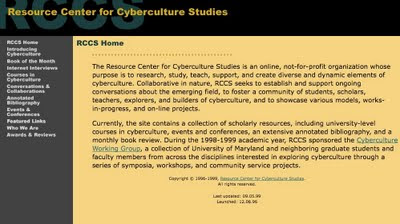
a few months later, i received a review copy of wayne rash, jr.'s politics on the nets: wiring the political process. i found the book interesting, wrote a review of it, and in july 1997 published the review on RCCS. the idea behind RCCS reviews was simple: review books about contemporary media and culture from any and all disciplinary persuasions. i decided RCCS would review books because, first, books often contain interesting, well-developed ideas and arguments, something a new field of study needs and thrives on, and, second, books, unlike web sites which began to multiple and remix at an alarming rate by 1997, are finite in number. the book reviews quickly became the heart of RCCS.
a month later, fellow maryland grad student will winton's review of gary g. gach's writers.net: every writer's essential guide to online resources and opportunities generated a new feature: the author response. shortly after publishing winton's review, i received an email from gach who was excited to see his book reviewed but eager to explain his side of the story. i invited the author to write a response, he did, and the author response was born. when it worked well, the book review + author response fostered a rich and ripe dialogue - a conversation between reviewer and reviewed.

in 1998, a new feature appeared: multiple reviews of a single book. having received a new batch of books in need of reviewers, i distributed a call for reviewers to various lists. when multiple scholars asked to review richard lanham's the electronic word: democracy, technology and the arts, i asked the publisher for an extra review copy. they said yes, i assigned the book to two reviewers, and the multiple reviews feature was born. later, RCCS would routinely feature two, three, four, and even five reviews of a single book. coupled with an author response, these multiple reviews offer multiple perspectives into a complex topic.

from the start, the book reviews and author responses were free and publicly accessible. they were also written by a range of scholars - from graduate students in their first years to full professors in their last years - representing all kinds of fields and disciplines within the arts, humanities, social sciences, and science and technology. refusing a single disciplinary orientation, RCCS included them all.
on december 1, 2009, i published the last (and excellent!) set of RCCS book reviews and author responses. although there will be no more new reviews and responses, the existing ones will remain online as a free and publicly accessible archive.
it's been a nice run. for help along the way: a big and long-lasting thanks to my maryland peeps who helped launch RCCS; a big, big thanks to john klockner and alex fedosov who helped host and configure RCCS; and a massive thanks to nectarine group who helped redesign RCCS.
but most of all, thanks to the hundreds of reviewers who contributed their time, labor, and good ideas to RCCS and to the readers who took the time to read a review or two.
it was a perfect time and place to study new media. at maryland, i was able to work with and learn from john caughey, debra deruyver, katie king, bob kolker, myron lounsbury, ed martini, jo paoletti, kelly quinn, jason rhody, ben shneiderman, mary corbin sies, martha nell smith, donald snyder, and ellen yu borkowski. it was awesome.
what wasn't awesome was the larger academic community, or lack thereof. in those days, one would be lucky to find a single panel on "cyberspace" or the "world wide web" at an academic conference or to find a single article in an academic journal. these were the old days - before conferences like digital arts and culture (or DAC, first held in 1998) or the association of internet researchers (or AoIR, first held in 2000), before internet clusters like the berkman center for internet and society (established in 1998) or the oxford internet institute (established in 2001). back then, academic interest in the internet was building, but an academic community was hard to find.
in fall 1996, i enrolled in an independent study with myron lounsbury. the goal of the independent study was to build a web site which in turn would help foster a community, an online community, that would connect scholars and students interested in studying the internet. i began by collecting relevant course syllabi and conference calls - the two key ingredients for any emerging field of study - and posted them on the web site. i called the site the resource center for cyberculture studies, or RCCS, and launched it on december 8, 1996.

a few months later, i received a review copy of wayne rash, jr.'s politics on the nets: wiring the political process. i found the book interesting, wrote a review of it, and in july 1997 published the review on RCCS. the idea behind RCCS reviews was simple: review books about contemporary media and culture from any and all disciplinary persuasions. i decided RCCS would review books because, first, books often contain interesting, well-developed ideas and arguments, something a new field of study needs and thrives on, and, second, books, unlike web sites which began to multiple and remix at an alarming rate by 1997, are finite in number. the book reviews quickly became the heart of RCCS.
a month later, fellow maryland grad student will winton's review of gary g. gach's writers.net: every writer's essential guide to online resources and opportunities generated a new feature: the author response. shortly after publishing winton's review, i received an email from gach who was excited to see his book reviewed but eager to explain his side of the story. i invited the author to write a response, he did, and the author response was born. when it worked well, the book review + author response fostered a rich and ripe dialogue - a conversation between reviewer and reviewed.

in 1998, a new feature appeared: multiple reviews of a single book. having received a new batch of books in need of reviewers, i distributed a call for reviewers to various lists. when multiple scholars asked to review richard lanham's the electronic word: democracy, technology and the arts, i asked the publisher for an extra review copy. they said yes, i assigned the book to two reviewers, and the multiple reviews feature was born. later, RCCS would routinely feature two, three, four, and even five reviews of a single book. coupled with an author response, these multiple reviews offer multiple perspectives into a complex topic.
from the start, the book reviews and author responses were free and publicly accessible. they were also written by a range of scholars - from graduate students in their first years to full professors in their last years - representing all kinds of fields and disciplines within the arts, humanities, social sciences, and science and technology. refusing a single disciplinary orientation, RCCS included them all.
on december 1, 2009, i published the last (and excellent!) set of RCCS book reviews and author responses. although there will be no more new reviews and responses, the existing ones will remain online as a free and publicly accessible archive.
it's been a nice run. for help along the way: a big and long-lasting thanks to my maryland peeps who helped launch RCCS; a big, big thanks to john klockner and alex fedosov who helped host and configure RCCS; and a massive thanks to nectarine group who helped redesign RCCS.
but most of all, thanks to the hundreds of reviewers who contributed their time, labor, and good ideas to RCCS and to the readers who took the time to read a review or two.
new (and last) set of reviews in cyberculture studies (december 09)
each month, RCCS Reviews pumps out free, full-length reviews of books about contemporary media and culture. this month, RCCS Reviews features 10 reviews of 8 books with 4 author responses. books of the month for december 2009 are:

Electronic Literature: New Horizons for the Literary
Author: N. Katherine Hayles
Publisher: University of Notre Dame Press, 2008
Review 1: Pramod K. Nayar
Review 2: Luis Amate Perez
Author Response: N. Katherine Hayles
Global Capital, Local Culture: Transnational Media Corporations in China
Author: Anthony Y.H. Fung
Publisher: Peter Lang, 2008
Review 1: Hanna Cho
Author Response: Anthony Y.H. Fung
Mechanisms: New Media and the Forensic Imagination
Author: Matthew G. Kirschenbaum
Publisher: MIT Press, 2008
Review 1: Viola Lasmana
Review 2: Jentery Sayers
Author Response: Matthew Kirschenbaum
Scholarship in the Digital Age: Information, Infrastructure, and the Internet
Author: Christine L. Borgman
Publisher: MIT Press, 2007
Review 1: Denise N. Rall
Signs of Life: Bio Art and Beyond
Editor: Eduardo Kac
Publisher: MIT Press, 2006
Review 1: Yazan Haddad
Small Tech: The Culture of Digital Tools
Editor: Byron Hawek, David M. Rieder, Ollie Oviedo
Publisher: University of Minnesota Press, 2008
Review 1: Brenda Berkelaar
Technology in a Multicultural and Global Society
Editor: May Thorseth, Charles Ess
Publisher: Norwegian University of Science and Technology, 2005
Review 1: Delia D. Dumitrica
Author Response: Charles Ess and May Thorseth
Two Bits: The Cultural Significance of Free Software
Author: Christopher M. Kelty
Publisher: Duke University Press, 2008
Review 1: Tim Jordan
enjoy.
Electronic Literature: New Horizons for the Literary
Author: N. Katherine Hayles
Publisher: University of Notre Dame Press, 2008
Review 1: Pramod K. Nayar
Review 2: Luis Amate Perez
Author Response: N. Katherine Hayles
Global Capital, Local Culture: Transnational Media Corporations in China
Author: Anthony Y.H. Fung
Publisher: Peter Lang, 2008
Review 1: Hanna Cho
Author Response: Anthony Y.H. Fung
Mechanisms: New Media and the Forensic Imagination
Author: Matthew G. Kirschenbaum
Publisher: MIT Press, 2008
Review 1: Viola Lasmana
Review 2: Jentery Sayers
Author Response: Matthew Kirschenbaum
Scholarship in the Digital Age: Information, Infrastructure, and the Internet
Author: Christine L. Borgman
Publisher: MIT Press, 2007
Review 1: Denise N. Rall
Signs of Life: Bio Art and Beyond
Editor: Eduardo Kac
Publisher: MIT Press, 2006
Review 1: Yazan Haddad
Small Tech: The Culture of Digital Tools
Editor: Byron Hawek, David M. Rieder, Ollie Oviedo
Publisher: University of Minnesota Press, 2008
Review 1: Brenda Berkelaar
Technology in a Multicultural and Global Society
Editor: May Thorseth, Charles Ess
Publisher: Norwegian University of Science and Technology, 2005
Review 1: Delia D. Dumitrica
Author Response: Charles Ess and May Thorseth
Two Bits: The Cultural Significance of Free Software
Author: Christopher M. Kelty
Publisher: Duke University Press, 2008
Review 1: Tim Jordan
enjoy.
Wednesday, November 25, 2009
learning to look and listen
this semester's digital media production class, or #DMP09, has been among the most creative and collaborative i've ever taught. the combination of easy-to-use social media like twitter, flickr, and facebook with the creativity and curiosity of the students has made for a prolific semester. but between my making media mantra - "create, collaborate, share!" i bark to my students, "now do it again! and again! and again!" - i took extra steps this semester to encourage them to simply look and listen.
over the course of the semester, we've taken campus field trips to spots with spectacular views. first, with help from twitter, we met in kalmanavitz 499, overlooking main campus, where many of us began looking at our campus for the first time.


later in the semester, we hiked up lone mountain and met in the president's conference room, a room with a gorgeous view of the city and the bay.


and yesterday we climbed the steps of st. ignatius church, all the way to the bell tower, to get new perspectives of the campus and city we call home.


i'm immensely proud of DMP09 students' abilities to create, collaborate, and share. i'm equally proud of their growing abilities to look and listen.
over the course of the semester, we've taken campus field trips to spots with spectacular views. first, with help from twitter, we met in kalmanavitz 499, overlooking main campus, where many of us began looking at our campus for the first time.


later in the semester, we hiked up lone mountain and met in the president's conference room, a room with a gorgeous view of the city and the bay.


and yesterday we climbed the steps of st. ignatius church, all the way to the bell tower, to get new perspectives of the campus and city we call home.


i'm immensely proud of DMP09 students' abilities to create, collaborate, and share. i'm equally proud of their growing abilities to look and listen.
Tuesday, November 17, 2009


Friday, October 30, 2009
new reviews in cyberculture studies (november 2009)
each month, RCCS Reviews pumps out free, full-length reviews of books about contemporary media and culture. this month, RCCS Reviews features 13 reviews of 9 books with 5 author responses! books of the month for november 2009 are:

Ambivalence Towards Convergence: Digitalisation and Media Change
Editors: Tanja Storsul, Dagny Stuedahl
Publisher: Nordicom, 2007
Review 1: Fiona Martin
Blogs, Wikipedia, Second Life, and Beyond: From Production to Produsage
Author: Axel Bruns
Publisher: Peter Lang, 2008
Review 1: Verena Laschinger
Review 2: Alan Razee
Review 3: Erin Stark
Author Response: Axel Bruns
Digital Media and Democracy: Tactics in Hard Times
Editor: Megan Boler
Publisher: MIT Press, 2008
Review 1: J. Patrick Biddix
Review 2: Mary K. Bryson
Author Response: Megan Boler
Displacing Place: Mobile Communication in the Twenty-First Century
Editor: Sharon Kleinman
Publisher: Peter Lang, 2007
Review 1: Kevin Douglas Kuswa
Review 2: Katheryn Wright
Author Response: Sharon Kleinman
Literatures in the Digital Era: Theory and Praxis
Editors: Amelia Sanz, Dolores Romero
Publisher: Cambridge Scholars Publishing, 2007
Review 1: Sara Humphreys
Making Digital Cultures: Access, Interactivity and Authenticity
Author: Martin Hand
Publisher: Ashgate, 2008
Review 1: Jen Ross
Author Response: Martin Hand
Making Silicon Valley: Innovation and the Growth of High Tech, 1930-1970
Author: Christophe Lécuyer
Publisher: MIT Press, 2005
Review 1: Judith Otto
Moving Cultures: Mobile Communications in Everyday Life
Authors: André H. Caron, Letizia Caronia
Publisher: McGill-Queen's University Press, 2007
Review 1: Erin Jonasson
Author Response: Letizia Caronia and André H. Caron
New Tech, New Ties: How Mobile Communication Is Reshaping Social Cohesion
Author: Rich Ling
Publisher: MIT Press, 2008
Review 1: Kathrin Kissau
enjoy. there's one more month's worth where that came from.
Ambivalence Towards Convergence: Digitalisation and Media Change
Editors: Tanja Storsul, Dagny Stuedahl
Publisher: Nordicom, 2007
Review 1: Fiona Martin
Blogs, Wikipedia, Second Life, and Beyond: From Production to Produsage
Author: Axel Bruns
Publisher: Peter Lang, 2008
Review 1: Verena Laschinger
Review 2: Alan Razee
Review 3: Erin Stark
Author Response: Axel Bruns
Digital Media and Democracy: Tactics in Hard Times
Editor: Megan Boler
Publisher: MIT Press, 2008
Review 1: J. Patrick Biddix
Review 2: Mary K. Bryson
Author Response: Megan Boler
Displacing Place: Mobile Communication in the Twenty-First Century
Editor: Sharon Kleinman
Publisher: Peter Lang, 2007
Review 1: Kevin Douglas Kuswa
Review 2: Katheryn Wright
Author Response: Sharon Kleinman
Literatures in the Digital Era: Theory and Praxis
Editors: Amelia Sanz, Dolores Romero
Publisher: Cambridge Scholars Publishing, 2007
Review 1: Sara Humphreys
Making Digital Cultures: Access, Interactivity and Authenticity
Author: Martin Hand
Publisher: Ashgate, 2008
Review 1: Jen Ross
Author Response: Martin Hand
Making Silicon Valley: Innovation and the Growth of High Tech, 1930-1970
Author: Christophe Lécuyer
Publisher: MIT Press, 2005
Review 1: Judith Otto
Moving Cultures: Mobile Communications in Everyday Life
Authors: André H. Caron, Letizia Caronia
Publisher: McGill-Queen's University Press, 2007
Review 1: Erin Jonasson
Author Response: Letizia Caronia and André H. Caron
New Tech, New Ties: How Mobile Communication Is Reshaping Social Cohesion
Author: Rich Ling
Publisher: MIT Press, 2008
Review 1: Kathrin Kissau
enjoy. there's one more month's worth where that came from.
Friday, October 23, 2009
tuesday's homework
as discussed in class yesterday, tuesday's homework for digital media production is as follows:
READ: Gabriel Cohen's You Talkin’ to Me? New York's Brash, Boisterous Blogosphere; Malia Wollan, The Big Draw of a GPS Run; and Rex Sorgatz's A Data Point on Every Block: An Interview with Adrian Holovaty.
LEARN: google maps. this part of the assignment is optional: you have the option to learn google maps now or later.
LOG OFF: a) visit one place, restaurant, park, bar, store, water fountain, lake, cafe, bookstore, bus line, church, alley, or any other thing or place in the city of san francisco; b) soak it in; and c) collect, compile, and create a flickr set that includes the following information:

(be sure to tag your photos dmp09mapproject)
have a nice weekend.
READ: Gabriel Cohen's You Talkin’ to Me? New York's Brash, Boisterous Blogosphere; Malia Wollan, The Big Draw of a GPS Run; and Rex Sorgatz's A Data Point on Every Block: An Interview with Adrian Holovaty.
LEARN: google maps. this part of the assignment is optional: you have the option to learn google maps now or later.
LOG OFF: a) visit one place, restaurant, park, bar, store, water fountain, lake, cafe, bookstore, bus line, church, alley, or any other thing or place in the city of san francisco; b) soak it in; and c) collect, compile, and create a flickr set that includes the following information:

(be sure to tag your photos dmp09mapproject)
have a nice weekend.
Friday, October 16, 2009
yelp homework assignment
yelp homework for digital media production
1. create a profile on yelp. using your full, real name is optional.
2. write a yelp review about something or someone in san francisco.
3. when thinking about what makes a good review, consider reading some yelp reviews to get a sense of the style, tone, and flavor.
4. once you have posted your yelp review, tweet it. be sure to include a link from your tweet to your review. your tweet is due no later than monday night.
5. this assignment is not very demanding. therefore, do it really well.
1. create a profile on yelp. using your full, real name is optional.
2. write a yelp review about something or someone in san francisco.
3. when thinking about what makes a good review, consider reading some yelp reviews to get a sense of the style, tone, and flavor.
4. once you have posted your yelp review, tweet it. be sure to include a link from your tweet to your review. your tweet is due no later than monday night.
5. this assignment is not very demanding. therefore, do it really well.
Thursday, October 01, 2009
new reviews in cyberculture studies (october 2009)
each month, RCCS Reviews pumps out free, full-length reviews of books about contemporary media and culture. this month, RCCS Reviews features 8 reviews of 5 books with 3 author responses!
books of the month for october 2009 are:

20 Questions About Youth & the Media
Editor: Sharon R. Mazzarella
Publisher: Peter Lang, 2007
Review 1: Molly Swiger
Cyborgs and Barbie Dolls: Feminism, Popular Culture and the Posthuman Body
Author: Kim Toffoletti
Publisher: I.B. Tauris, 2007
Review 1: M. Beatrice Bittarello
Review 2: Birgit Pretzsch
Review 3: Nicholas Yanes
Author Response: Kim Toffoletti
Instant Identity: Adolescent Girls and the World of Instant Messaging
Author: Shayla Thiel Stern
Publisher: Peter Lang, 2007
Review 1: Andrea J. Baker
Author Response: Shayla Thiel Stern
Knowledge as a Commons: From Theory to Practice
Editor: Charlotte Hess, Elinor Ostrom
Publisher: MIT Press, 2007
Review 1: Colette Wanless-Sobel
Author Response: Elinor Ostrom and Charlotte Hess
Queer Girls and Popular Culture: Reading, Resisting, and Creating Media
Author: Susan Driver
Publisher: Peter Lang, 2007
Review 1: Lisa Justine Hernández
Review 2: Alison Miller-Slade
enjoy. there's a wee bit more where that came from.
books of the month for october 2009 are:
20 Questions About Youth & the Media
Editor: Sharon R. Mazzarella
Publisher: Peter Lang, 2007
Review 1: Molly Swiger
Cyborgs and Barbie Dolls: Feminism, Popular Culture and the Posthuman Body
Author: Kim Toffoletti
Publisher: I.B. Tauris, 2007
Review 1: M. Beatrice Bittarello
Review 2: Birgit Pretzsch
Review 3: Nicholas Yanes
Author Response: Kim Toffoletti
Instant Identity: Adolescent Girls and the World of Instant Messaging
Author: Shayla Thiel Stern
Publisher: Peter Lang, 2007
Review 1: Andrea J. Baker
Author Response: Shayla Thiel Stern
Knowledge as a Commons: From Theory to Practice
Editor: Charlotte Hess, Elinor Ostrom
Publisher: MIT Press, 2007
Review 1: Colette Wanless-Sobel
Author Response: Elinor Ostrom and Charlotte Hess
Queer Girls and Popular Culture: Reading, Resisting, and Creating Media
Author: Susan Driver
Publisher: Peter Lang, 2007
Review 1: Lisa Justine Hernández
Review 2: Alison Miller-Slade
enjoy. there's a wee bit more where that came from.
Wednesday, September 30, 2009
flickr assignment
flickr assignment for digital media production
1. by now, all of you have a flickr account. you know how to create sets and tag photos in flickr.
2. visit keri smith's everything i've consumed today. spend some time with it. consider sharing it with a friend, roommate, or classmate and having a conversation about it.
3. for one whole day (or 24 hours), photograph everything you consume. upload your photos to flickr, create a set, provocatively title the set, and strategically tag the photos. use as few or as many photos as necessary to tell a compelling and comprehensive story about your one day's worth of consumption.
4. in doing this assignment, be responsible and exercise good judgement with what you do and do not document. keep it real, but also keep it smart.
5. once your flickr set is finished, thick tweet it, making sure to include a link in your tweet to your flickr set.
6. on tuesday, october 6, demo your flickr set in class. during your demo, encourage, listen for, and receive suggestions on how to make your flickr set even better. it is your responsibility to solicit feedback. if you have no new work to demo, do not come to class.
7. in a one page, single-spaced essay turned in at the beginning of class on thursday, october 8, discuss your project, making sure to address two topics: a) what you learned about your own consumption behaviors from doing this project; and b) how you changed, altered, or otherwise improved your project as a direct result of what one or more of your classmates said during demo day. failure to alter your project and discuss this alteration in your essay will set your grade back considerably. no late work accepted.
1. by now, all of you have a flickr account. you know how to create sets and tag photos in flickr.
2. visit keri smith's everything i've consumed today. spend some time with it. consider sharing it with a friend, roommate, or classmate and having a conversation about it.
3. for one whole day (or 24 hours), photograph everything you consume. upload your photos to flickr, create a set, provocatively title the set, and strategically tag the photos. use as few or as many photos as necessary to tell a compelling and comprehensive story about your one day's worth of consumption.
4. in doing this assignment, be responsible and exercise good judgement with what you do and do not document. keep it real, but also keep it smart.
5. once your flickr set is finished, thick tweet it, making sure to include a link in your tweet to your flickr set.
6. on tuesday, october 6, demo your flickr set in class. during your demo, encourage, listen for, and receive suggestions on how to make your flickr set even better. it is your responsibility to solicit feedback. if you have no new work to demo, do not come to class.
7. in a one page, single-spaced essay turned in at the beginning of class on thursday, october 8, discuss your project, making sure to address two topics: a) what you learned about your own consumption behaviors from doing this project; and b) how you changed, altered, or otherwise improved your project as a direct result of what one or more of your classmates said during demo day. failure to alter your project and discuss this alteration in your essay will set your grade back considerably. no late work accepted.
Friday, September 25, 2009

Monday, September 14, 2009
twitter assignment
twitter assignment for digital media production
1. if you have not yet joined twitter, join twitter.
2. create a profile. use your real name. make your profile public.
3. find and follow all members of digital media production class.
4. search for and follow all people mentioned in all of our previous readings. this includes people who wrote the articles, people mentioned in the articles, people who made the videos, and people featured in the videos. you are free, of course, to unfollow any or all of these people, but only after first following them for a few days and reading through portions of their archive.
5. keep in mind that we will be using twitter extensively and in many different ways throughout the semester. the goal of this assignment is to get all of us up and running and connected with one another.
6. reply to at least one tweet.
7. post at least one RT.
8. post at least one #followfriday.
9. on tuesday, we will discuss in class the difference between thin and thick tweets. post at least one thick tweet. make it good.
10. in no more than a one-page single-spaced essay, discuss why you created your profile the way you did, introduce one person you follow, and explain why you find her/him interesting.
rules: a) on tuesday, september 22, be prepared to demo your work. demo whatever you wish to demo but be sure to include a discussion of your profile, one person you follow, and one thick tweet. if you have no work to demo, do not come to class; and b) your one page paper is due in class on thursday, september 24. no late work accepted.
hints: if you are an experienced twitter user, use this assignment and class to up your skills. if you have not yet used twitter, give it a chance before declaring it silly. finally, read and follow all the directions included in this assignment.
1. if you have not yet joined twitter, join twitter.
2. create a profile. use your real name. make your profile public.
3. find and follow all members of digital media production class.
4. search for and follow all people mentioned in all of our previous readings. this includes people who wrote the articles, people mentioned in the articles, people who made the videos, and people featured in the videos. you are free, of course, to unfollow any or all of these people, but only after first following them for a few days and reading through portions of their archive.
5. keep in mind that we will be using twitter extensively and in many different ways throughout the semester. the goal of this assignment is to get all of us up and running and connected with one another.
6. reply to at least one tweet.
7. post at least one RT.
8. post at least one #followfriday.
9. on tuesday, we will discuss in class the difference between thin and thick tweets. post at least one thick tweet. make it good.
10. in no more than a one-page single-spaced essay, discuss why you created your profile the way you did, introduce one person you follow, and explain why you find her/him interesting.
rules: a) on tuesday, september 22, be prepared to demo your work. demo whatever you wish to demo but be sure to include a discussion of your profile, one person you follow, and one thick tweet. if you have no work to demo, do not come to class; and b) your one page paper is due in class on thursday, september 24. no late work accepted.
hints: if you are an experienced twitter user, use this assignment and class to up your skills. if you have not yet used twitter, give it a chance before declaring it silly. finally, read and follow all the directions included in this assignment.
Friday, September 11, 2009

Wednesday, September 02, 2009


Subscribe to:
Posts (Atom)

